

01 Overview of assembled steel structure nodes
For the development of assembled buildings promoted by China over the years, the assembled nodes of square steel columns and beams have gradually become a research hotspot due to their high efficiency and environmental protection advantages. There is a clear difference between the assembled steel structure and the traditional building structure, it is prefabricated in the factory, which reduces the time and uncertainty of on-site construction, and also enhances the green attributes of the building. Steel buildings are favoured by the engineering community because of their high strength and good seismic performance. In assembled steel structures, there are various types of connection nodes for square steel columns and beams, such as sleeve connections, modular column-beam connections, beam-column end-plate connections, column-column cantilevered beam connections, and beam-through connections, which have been the subject of extensive research.
[Background and development]
In 2016, China has issued a number of guiding opinions on the implementation of the development of the construction industry, which clearly stipulates the target direction of promoting the development of assembly building. Traditional steel structure beams and columns nodes are mostly welded, but on-site welding is not only inefficient, but also affected by the environment and operating conditions, making it difficult to ensure the quality of welds. In contrast, assembly steel nodes are prefabricated in factories without on-site welding, which not only improves construction efficiency and quality, but also reduces energy consumption, non-renewable resource consumption and carbon emissions due to environmentally friendly construction, which is in line with the concept of green building.
[Connection node type]
In assembled steel structures, there are many types of connection nodes for square steel columns and beams, such as sleeve and modular, which are combined with different material properties, installation requirements and load-bearing functions. These nodes, with their different construction and connection methods, often provide excellent seismic performance and energy consumption, giving key support to the development of assembled buildings.
02 Sleeve type connection node
In assembled steel structures, the sleeve connection node is an important connection method, which has attracted much attention in terms of design and performance.
[Sleeve node construction and performance]
Jacketed nodes are designed to be weldless using fully bolted connections and can be prefabricated in the factory, thus demonstrating excellent seismic and energy-consuming performance. Li Liming and others proposed a fully bolted jacketed cylindrical - H-beam beam-column connection node, and after an in-depth study of the seismic performance of the node, it was found that the node not only had excellent seismic performance, but also had outstanding energy consumption, and that by increasing the thickness of the outer sleeve appropriately, the seismic performance and stiffness of the node could be further improved. However, the installation of this node is complicated, and the main challenge is that the installation process has to be carried out within the constraints of the closed-end cross-section characteristics of square steel columns, which makes the assembly process relatively troublesome.
![图片[1]-装配式钢结构节点的核心技术探索与挑战-大连富泓机械有限公司](/wp-content/uploads/2026/01/1768271688337_0.webp)
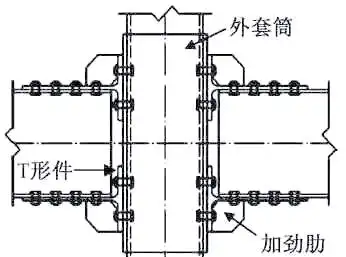
Wang Yan et al. further explored the application of tensile bolts in beam-column connection nodes of assembled steel structures, especially for the two types of nodes: inner sleeve and outer sleeve. In that paper, an innovative inner sleeve-T-piece beam-column node was introduced, which combined square steel columns, inner sleeves, T-pieces, and H-beams, and was securely connected with the help of high-strength bolts and tensile bolts.
![图片[2]-装配式钢结构节点的核心技术探索与挑战-大连富泓机械有限公司](/wp-content/uploads/2026/01/1768271688337_1.webp)
[Sleeve node installation and design challenges]
The investigation shows that the gap between the inner sleeve thickness and the column wall has a significant effect on the performance of the node and must be strictly controlled. When the sleeve thickness exceeds the column wall thickness to a certain value, the node hysteresis performance shows the best state. However, the design of the inner sleeve node also faces difficulties, the use of tensile bolts leads to symmetric concave flexure phenomenon, which to a certain extent affects the node's energy consumption capacity.
03 Modular connection nodes
Modular nodes, known for their prefabrication and rapid installation, are an important area of research in assembled steel structures.
[Modular node design and performance studies]
Modular nodes, which combine square steel columns and beams with fully bolted connections, show good ductility as well as energy-consuming capacity. Xuechun Liu and other researchers conducted in-depth finite element modelling and analysis of welded, bolted and hybrid bolted-welded nodes, in which the fully bolted nodes showed good load carrying capacity and ductility.
![图片[3]-装配式钢结构节点的核心技术探索与挑战-大连富泓机械有限公司](/wp-content/uploads/2026/01/1768271688337_4.webp)
In the work of Liu Xuechun et al, they carried out in-depth investigation on the modular node of fully bolted connection between square steel column and H-beam, by changing the thickness of the flange plate, changing the thickness of bolts and adjusting the number of bolts on the cover plate, so as to analyse the performance of the node in all aspects, and it was found that once the number of bolts was increased, the node's energy consumption capacity could be effectively It was found that once the number of bolts increased, the energy consumption capacity of the node could be effectively improved.
![图片[4]-装配式钢结构节点的核心技术探索与挑战-大连富泓机械有限公司](/wp-content/uploads/2026/01/1768271688337_5.webp)
Seismic study of modular nodes
Reducing the axial compression ratio of columns and adding stiffening ribs in modular node design can effectively improve performance, and a study has shown that in practice, such design initiatives can increase the ultimate load carrying capacity and stability of the nodes, however, the design gaps in the nodes connecting the modular building to the foundation limit its further expansion and potential for high-rise building applications.
![图片[5]-装配式钢结构节点的核心技术探索与挑战-大连富泓机械有限公司](/wp-content/uploads/2026/01/1768271688337_6.webp)
04 Node of cantilevered short beam and end plate connection
The connection between the square steel column and the short cantilever beam can be flexibly arranged to meet diversified design requirements.
![图片[6]-装配式钢结构节点的核心技术探索与挑战-大连富泓机械有限公司](/wp-content/uploads/2026/01/1768271688337_7.png)
Diversified design of short cantilevered beam nodes
The combination of square steel columns and cantilever beams is designed to improve the stress condition of the upper flange of the node by testing the I-beam and double-channel steel nodes. Some scholars, such as Guo Zhipeng, have carried out in-depth seismic performance studies on the connection nodes of square steel columns with Z-shaped cantilevered beams and weakened beams, and the I-beam nodes show stable energy dissipation, while the double-plied channel beam nodes are unstable in the weakened region.
![图片[7]-装配式钢结构节点的核心技术探索与挑战-大连富泓机械有限公司](/wp-content/uploads/2026/01/1768271688337_8.webp)
[Durability and improvement of end plate connections]
End plate connection nodes, which are limited by bolt mounting space, thus posing a challenge to human-machine interaction. The unidirectional bolt technology gives an improved idea for the end plate node. Its load-bearing capacity as well as rotation capacity needs further theoretical support. Li Guoqiang and other scholars have innovatively introduced the one-way bolt technology to the end plate node, providing a solution that does not require on-site welding.
![图片[8]-装配式钢结构节点的核心技术探索与挑战-大连富泓机械有限公司](/wp-content/uploads/2026/01/1768271688337_9.webp)
05 Beam Through Node
Beam-through nodes have a place in assembled steel structures because of their simplicity of design.
[Application and challenges of beam penetration nodes]
The type of nodes that place beams through the nodes is smart and convenient to use in low-rise buildings, but once they reach the upper floors, they may encounter difficulties regarding the capacity of the support. Liu Haojin and some other experts carried out a thorough investigation and found that the ratio of columns due to axial pressure has a significant effect on the performance of the node. If the ratio of columns due to axial pressure is too large, then the node may appear the kind of column cross-section is easy to crack the damage condition, so it is proposed to control the ratio of columns due to axial pressure is not more than 0.3.
![图片[9]-装配式钢结构节点的核心技术探索与挑战-大连富泓机械有限公司](/wp-content/uploads/2026/01/1768271688337_10.webp)
The development of assembled steel structures has not only improved construction efficiency, but has also become a key direction for future building development due to its environmental friendliness and excellent building performance. Even so, the different types of nodes still face a variety of technical challenges that need to be further researched and explored in order to promote the wide application of assembled steel structures in the construction field.
![图片[10]-装配式钢结构节点的核心技术探索与挑战-大连富泓机械有限公司](/wp-content/uploads/2026/01/1768271688337_11.webp)




 Chinese
  Japanese
  English
  German
  Finnish
No comments