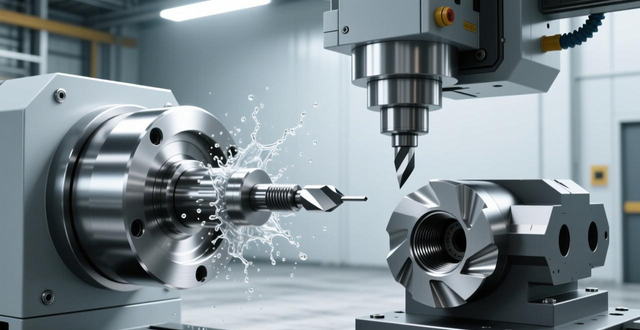


In today's modern manufacturing industry, the Turn-Mill Centre, also known as the Turn-Mill, as a highly integrated machining equipment, is slowly becoming a core production tool in many industries. By combining turning and milling functions on the same platform, this equipment greatly improves machining efficiency and workpiece accuracy, giving strong support to the manufacture of complex parts. This article will explore the working principle of the mill-turn centre, as well as the advantages of the application, as well as the technical characteristics, and explain its future development trend.
There is such a machining equipment, it is called turning and milling centre, is the turning and milling functions to the integration of the core idea, is the traditional lathe and milling machine functions into one, can let in a clamping position there to complete a lot of different machining operations, turning and milling centre is generally equipped with rotary tools, moving table, andhighly accurateAs for the milling function, it is to process the complex surface of the workpiece with the help of the cutting tool in the non-phase direction. Such an integrated processing method not only reduces the transfer time of the workpieces between different equipments, but also reduces the accuracy problem caused by the clamping error.
![图片[1]-车铣复合中心的技术演进与应用前景-大连富泓机械有限公司](/wp-content/uploads/2026/01/1768817890536_0.png)
The main advantages of mill-turn centres are their high degree of flexibility and efficiency. Firstly, given that turning and milling operations are carried out on a single machine, the combined turning and milling centre significantly reduces cycle times, as well as the time required to transfer and reposition workpieces. Secondly, it has the ability to machine complex geometries such as internal and external threads, bevelled surfaces and slots, offering greater design freedom than a single machine. Turning and milling centres also have a high degree of machining accuracy to meet demanding engineering standards. In addition, the reduction in the number of times the workpiece has to be clamped in multiple stages of machining inevitably reduces the risk of human error and further improves the overall quality of the process.
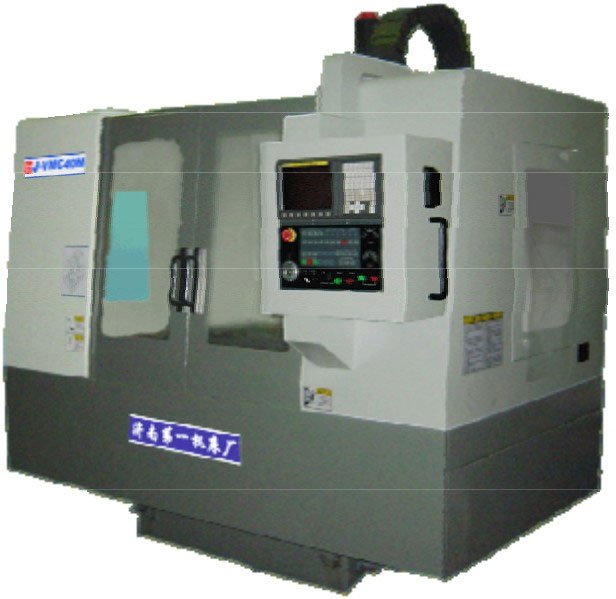
The features of mill-turn centres include multi-axis control, as well as flexible tooling systems and efficient cooling systems. Modern mill-turn centres are often equipped with up to five or more axes, which allows them to work in multiple directions simultaneously to achieve complex machining tasks. The flexibility of the tooling system allows the user to change the type of tooling as required to cope with a wide range of machining needs. A highly efficient cooling system helps to maintain optimum tool and workpiece temperatures, preventing material deformation and tool wear due to overheating. In addition, the sophisticated CNC system gives the mill-turn centre the ability to be accurately automated for an efficient and stable production process.
![图片[2]-车铣复合中心的技术演进与应用前景-大连富泓机械有限公司](/wp-content/uploads/2026/01/1768817890536_1.png)
Turn-mill composite centres are widely used in many industries. In the aerospace industry, they are used to process complex parts, such as turbine blades and fuselage structural components, which often require high precision and complex geometries; in the automotive industry, turn-mill composite centres are used to produce engine components, transmission housings, etc., which are generally of stringent dimensions and shapes; and in the medical device industry, turn-mill composite centres are used to process precision surgical instruments and implants. The medical device industry also uses turning and milling composite centres to process precision surgical instruments and implants. Along with technological advances and changes in manufacturing needs, the application areas of turning and milling composite centres will be further expanded.
The future development trend of turning and milling composite centre is mainly focused on the direction of intelligence, automation and high precision. When intelligent technology is introduced, it allows the turning and milling composite centre to achieve self-diagnosis and automatic adjustment, which in turn improves the production efficiency and machining quality, and the use of automation systems, such as automatic tool changer system and intelligent material management system, reduces the manual intervention to enhance the automation degree of the production line. In addition, the development of high-precision machining technology will further improve the machining accuracy of milling-turning composite centres to meet the increasingly stringent industrial standards.




 Chinese
  Japanese
  English
  German
  Finnish
No comments