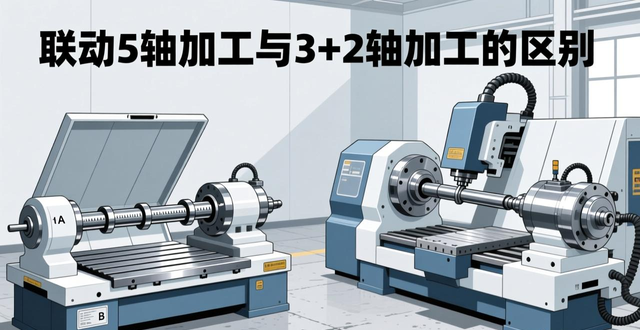


What is 3+2 AxisCNC machining?
Vertical milling machines, which are capable of three machining axes as standard, and horizontal milling machines, which are likewise capable of three machining axes as standard. However, a rotary table has been fitted and tilting swivel trunnions have been fitted with the aim of providing rotary movement along the other two axes. Basically, it's a 3+2 axis machining process, yes.
One type of machining is defined in terms of 5-axis machining, due to the fact that the fourth and fifth axes are used to stabilise the component in the appropriate position throughout the operation. This is followed by standard 3-axis machining operations, which are available as an option for the continuous movement required in this process. Furthermore, the tools used in 3+2 axis machining centres are more robust and shorter in length. Therefore, better dimensional stability can be assured.
The 3+2 machining arrangement reinforces the benefits of a standard 3-axis machining centre, with the ability to machine 360 degrees around the workpiece being a major advantage, so less preparation is required throughout the production process, which cuts down on manufacturing time and costs.
How does 3+2 axis CNC machining work?
In fact, the basic principle behind the 3 plus 2 method of positioning CNC machining as if the goal were to achieve 3-axis machining at a given angle is that the CNC machine will continue to operate in the same way as a standard 3-axis machine, even when rotated to a specific angle.
What is linked 5-axis CNC machining?
The cutting tool is able to move in all directions at the same time when synchronising the 5-axis machining process, and the required components are manufactured with three linear axes and two rotary axes at the same time.
Axis movement range
X-axis
left-to-right
Y-axis
from front to back
Z-axis
up and down
axis A
Rotate 180° around the X-axis
B-axis
Rotate 180° around the Y-axis
C-axis
Rotate 180° around the Z-axis
Synchronised 5-axis CNC machining
![图片[1]-联动5轴加工与3+2轴加工的区别-大连富泓机械有限公司](/wp-content/uploads/2026/02/1770892226227_1.png)
There are two what are called auxiliary axes, one is the tilting table axis (A) and the other is the rotary table axis (B). The axes appear to be in motion, which means that an additional tilting operation of the tool spindle or table is performed during 5-axis machining. Thus, more movement as well as rotation takes place, which in turn leads to an increase in the performance of standard CNC machining programmes.
The ability to take a machinist and create as many as five different surfaces at once with the assistance of the fourth as well as fifth axes. So the process is both accurate and productive. Additionally, it speeds up the process of creating intricate details and frames. Given the reduced setup, this method is cost-effective and can be used for a wide range of experiments.
Learn more about our 5-axis CNC machining services.
3+2 and 5-axis CNC machining
The setup is where you'll see the biggest difference between 3+2 and 5-axis CNC machining, where a 5-axis machining centre has the ability to move the tool in five different directions from each other, except that 3+2-axis machining combines the functionality of 3-axis CNC machine tools with tilt-and-turn trunnions and rotary tables.
The companies that are best suited to 3+2 and 5+ axis machining are different, depending on the type of product; 3+2 machining is effective for flat surfaces, while 5-axis CNC machining is ideal for machining complex shaped surfaces. However, not all parts require full 5-axis, and sometimes 3+2 CNC machining seems to be more efficient. One of the significant advantages of 5-axis machining is the ability to perform CNC machining on a wide range of parts and geometries, making it suitable for use in more demanding industries such as aerospace and military.
You will have to be aware of the advantages and disadvantages associated with each of them, depending on the situation, as to which one is appropriate to pick.
Advantages of 3+2 processing
The main advantages of 3+2 axis machining are:
Generate more complex features
This technology allows the use of shorter, harder cutting tools to create steep walls, undercut cavities and create many other complex features. In addition, it is also possible to form specific angles with the cutting surface.
Less programming code
Compared to simultaneous 5-axis machining, 3+2 CNC machining involves smaller spatial trajectories, and the shorter the distance travelled by the tool, the smaller its rotational motion, which allows for free-form surfaces to be processed in more accessible programming.
Lower costs and shorter cycle times
Three-plus-two CNC machining, capable of machining five or more dissimilar surfaces at the same time, may be a great challenge for traditional three-axis machining centres.
Disadvantages of 3+2 processing
Machining by adding 3 and 2 is generally regarded as setting a constant angle to the spindle. Components with complex geometries are likely to require numerous views with captions to cover the entire surface, however, this can result in overlapping toolpaths and increased machining time.
Advantages of 5-axis machining
Cost and time savings
5-axis machines for machining parts are capable of mass production in a single operation. This single setup contributes to time and cost savings. In addition, the use of shorter moulds extends their service life and eliminates the need for frequent maintenance and regular mould changes, further reducing production costs and cycle times.
Excellent quality and precision
The new 5-axis CNC machines on the market eliminate the need to adjust the angles of the workpiece during cutting, which greatly improves machining tolerances, suggesting that 5-axis machining involves less human intervention, which reduces the chances of error when improving part quality.
Complex geometric details
A 5-axis machining centre that allows the tool to approach the part from any direction. The workpiece can be completed on this machine alone, without having to move through multiple workstations. Not only does it allow movement in the X, Y and Z linear axes, but it also allows for rotation in the A and B axes, where additional rotation allows for more complex geometries and styles, and yes, punctuation.
Increased productivity and repeatability
In 5-axis machining, the cutting tool is generally tangential to the cutting surface, and this configuration allows additional material to be removed as the tool rotates, so overall machining costs and cycle times are reduced, and some machine setups allow for shorter cutting tools, which improves tool life and ensures repeatability.
Outstanding surface finish
The extra axes used to align the workpieces correctly bring them closer to the cutting tool, so you can use shorter axes to create the desired shape, these tools can cut at high speeds with minimal vibration, less vibration reduces “chatter” marks on the final product, and you can expect to create an excellent surface finish, while cutting the cost and time of post-processing. You can expect to create excellent surface finishes while cutting the cost and time of post-processing.
Disadvantages of 5-axis machining
Understanding the disadvantages of 5-axis CNC machining is worthwhile, although it has many benefits.
Higher demands on programming and operation
The trajectories for the remaining axes of rotation and the associated space are specific and abstract, so more programming work is required to achieve the required precision, accuracy and surface quality.
Higher initial cost
Raising the price of a 5-axis CNC machine and its necessary software to a significant level that far exceeds the requirements expected of a 3- or 4-axis machining centre, while at the same time further increasing the cost of maintaining the machine to a level that is both higher and more complex than that of a conventional machine tool, is a factor that will have a direct impact on the cost of machining 5-axis parts.
Not available for some applications
If the tool is too short or the handle is too wide, 4- and 5-axis machining technology cannot be used. Therefore, it is not possible to avoid vibration in the case of tilting angles.
Which is better, 3+2 or 5-axis milling?
You will find that 5-axis and 3+2 machining have very similar capabilities, and both can help make any factory production line work more efficiently, however, the appropriate method will depend on the specific application for which the results are intended, and in the case of flat surfaces, 3+2 machining is highly efficient, whereas 5-axis machining is better suited to complex contoured surfaces.
With 3 + 2 machining, current 3-axis machining users can quickly upgrade to a full 5-axis machining operation, giving many of the high-end features of a full 5-axis machine, but at a price that is not prohibitively expensive, and given that 5-axis machines are expensive to set up and programme, 3 + 2 machining may be a better option.
On the other hand, 5-axis machining centres enable increased productivity while producing components with complex geometries and tight tolerance standards. They often increase the efficiency and profitability of a wide range of processing tasks. As a result, less time is spent on set-up, the finished product becomes more precise and production times are reduced due to the fact that they are able to process all five sides of the component simultaneously.


 Chinese
  Japanese
  English
  German
  Finnish
No comments