

In recent years, five-axis linkagenumerical control machiningCentres are a prominent feature in the machining sector, with their high efficiency and quality qualities being favoured by many manufacturers. Five-axis machines add two rotary axes to the traditional three linear axes of X, Y, and Z, which greatly improves flexibility and precision in machining. So what is the magic behind 5-axis machining technology?mechanical constructionAnd what is the situation?
Mechanical forms of 5-axis machines
A machine tool with five axes, also known as 5 Axis, has two rotary axes added to the conventional three linear axes of movement, X, Y and Z, to greatly expand machining capabilities. These two rotary axes, generally selected from the A, B, and C axes, each have a unique motion pattern that allows them to adapt to and meet the precision machining needs of a wide variety of products.
In the scope of five-axis machining centre machine design, manufacturers continue to change and innovate, and strive to create a more diverse style of movement, so as to meet the needs of various types of complex processing, even if the market is a variety of five-axis machine tools, mechanical structure of different forms, but the main existence of the following types of forms:
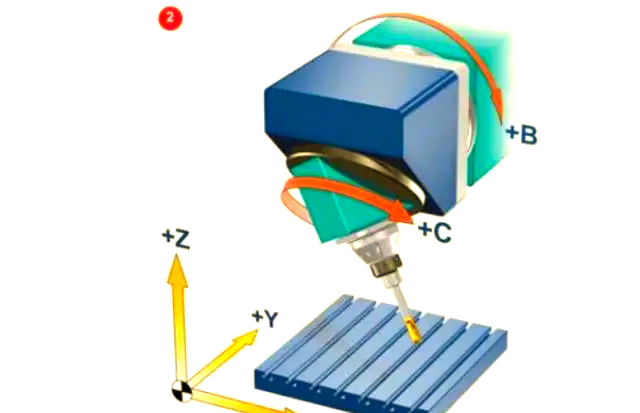
In the double pendulum form, the direction of the tool axis is directly controlled by means of two rotating co-ordinates to achieve efficient machining of complex parts.
A 5-axis machine with a double pendulum head, where two axes are at the top of the tool, is unusual in that the rotary axes are not perpendicular to the linear axes, but have a pendulum head design, which allows the machine to flexibly adjust the orientation of the tool axes during machining, resulting in efficient and high-quality machining of complex parts.
![图片[1]-五轴机床的机械结构形式-大连富泓机械有限公司](/wp-content/uploads/2026/02/1771036542196_1.png)
The two rotation coordinates directly manipulate the space rotation, presenting a double turntable layout.
Two axes are arranged on the table, however, it should be noted that these rotary axes are not perpendicular to the linear axes, but rather utilise a pendant table design.
There is a mode of operation in which there are two rotary coordinates, one for the tool and the other for the workpiece, resulting in a “one pendulum, one rotation” mode of operation.
![图片[2]-五轴机床的机械结构形式-大连富泓机械有限公司](/wp-content/uploads/2026/02/1771036542196_5.png)
Explanation of terminology: “Pitched” axes, i.e. axes where the axis of rotation is not perpendicular to the linear axis.
In the following section, we will delve deeper into the unique features of 5-axis machines in the machining process, and the advantages they offer over conventional 3-axis machines.
![图片[3]-五轴机床的机械结构形式-大连富泓机械有限公司](/wp-content/uploads/2026/02/1771036542196_6.png)
Five-axis machining, as a hot topic in the field of technology, in which comparative analysis is naturally associated with three-axis equipment. In production practice, there are vertical, horizontal and gantry types of three-axis machining equipment widely available, but the five-axis machine tool with its own higher processing flexibility and efficiency, is gradually becoming the new favourite in the manufacturing industry.
In the machining process, common methods include the use of end mills for cutting and ball end mills for profiling. The common characteristic of these methods is that the tool axis direction remains constant during machining, and the machine tool controls the precise displacement of the tool in three-dimensional space by means of the linkage of the three linear axes X, Y, and Z. However, the five-axis CNC machine takes this a step further. However, the five-axis CNC machine tool is one step further, its unique advantage is the ability to adjust the optimal cutting state of the tool in real time, and thus significantly improve the cutting conditions.
![图片[4]-五轴机床的机械结构形式-大连富泓机械有限公司](/wp-content/uploads/2026/02/1771036542196_7.png)
In the 3-axis cutting mode shown on the left, the cutting effect is reduced as the tool approaches the top or edge of the workpiece. To achieve the desired cutting conditions in these areas, the table often has to be rotated to make adjustments. However, in order to fully machine an irregular surface, it may be necessary to frequently rotate the table at different angles, which undoubtedly adds to the complexity of the operation. It is worth noting that 5-axis machines are designed to deal with this problem by ensuring that the centre point linear speed of the ball end milling cutter is always maintained, thus significantly improving the quality of the surface machining and effectively preventing tool interference.
In the aerospace industry, the machining of complex parts such as impellers, blades and complete blisks is often confronted with tool interference, which makes it difficult for three-axis machines to achieve the desired process standards. However, 5-axis machines are able to meet these challenges with ease. The use of shorter tools, increased system rigidity and a reduction in the number and type of tools allows 5-axis machines to machine these complex parts without specialised tooling, saving business owners significant tooling costs. Additionally, 5-axis machines are able to machine five surfaces in a single clamping, which reduces the number of clamping cycles and improvesprocessing efficiency.
The 5-axis machining centre significantly improves machining accuracy by streamlining the datum changeover process, making it easier to guarantee machining accuracy with a single clamping. In addition, the 5-axis machining centre not only simplifies the workflow, but also cuts down on the number of machines required, which reduces the use of fixtures and fittings, the shop floor, and the cost of maintenance, which means you can achieve more efficient and better quality machining with less fixtures, a compact plant layout, and lower maintenance costs. This means you can achieve more efficient, higher quality machining with fewer fixtures, a more compact plant layout and lower maintenance costs. At the same time, the 5-axis machine's specialised tool-side cutting capability further enhances machining efficiency.
Five-axis CNC machines feature integrated machining, which significantly shortens the overall production process and simplifies production management and scheduling. This is particularly advantageous for the manufacture of complex workpieces, where efficiency is significantly increased compared to traditional distributed multi-process production. In addition, in the aerospace, automotive and other industries, in the face of complex shapes and precision needs of the new product parts and molds, five-axis CNC machining centres rely on its excellent flexibility, precision, integration and comprehensive machining capabilities, to become an effective tool to solve the R & D process of complex parts machining accuracy and cycle time problems. It not only significantly reduces the development cycle, but also significantly improves the success rate of new product development.




 Chinese
  Japanese
  English
  German
  Finnish
No comments