

Stainless steel blackening and black plating process comparison
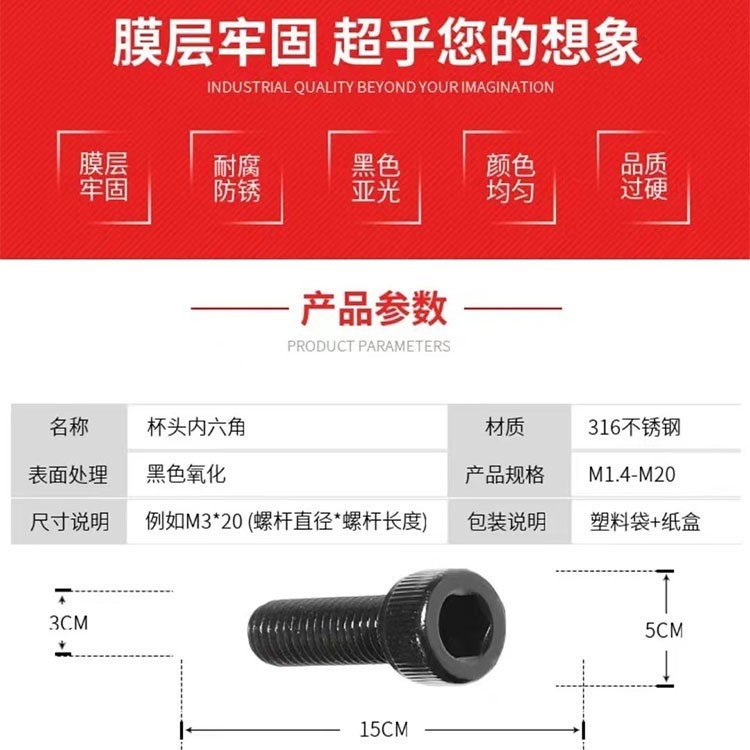
Stainless steel appears black situation, there are black plating way to achieve the black appearance, like galvanising through black nickel plating, black chromium plating, etc. can get that black look, but ah, in the process, performance and cost there are quite significant differences. First of all, the process situation, stainless steel and its blackening is achieved by oxidation reaction on the surface, and do not need to add additional plating; however, black plating, it is with the help of electrolysis, and then deposited on the surface of the kind of metal material or alloy plating that appears to be black. Then talk about the performance difference of the film layer, stainless steel formed after the blackening of the film layer, its thickness is relatively thin, probably in the range of 0.5 to 2μm, its adhesion is in the medium degree, as for the effect of corrosion resistance, must go to rely on the closure of the treatment to be able to do so; and the formation of black-plated film, its thickness compared to the blackening of the formation of a lot of thicker, probably in the range of 5 to 15μm, and it is particularly strong state of adhesion. Adhesion is particularly strong state, for corrosion resistance performance is also extremely prominent, like the case of black chrome plating, it is resistant to salt spray time can reach more than 100 hours, and its gloss is also quite high. Product appearance, black film most of the matte black or blue-black shape, its specific external performance for the colour tends to be convergent; black-plated film can reach a bright black and matte black and other different visual effects, from the overall external display appears to be more uniform and bright. From the cost point of view, the blackening process is relatively simple, so the cost is relatively low, about one to three yuan per square metre before and after; coating process is more complicated, need to complete with the help of electroplating equipment, so the cost is more expensive, about five to ten yuan per square metre. Application scenarios, blackening this process is suitable for application in ordinary mechanical parts and tools for rust treatment; black-plating process is suitable for application in automotive decorative parts and electronic shells, etc. for the appearance and corrosion resistance has higher requirements on the product.
![图片[1]-鞍形垫圈不锈钢发黑处理316螺丝黑色氧化加工防锈耐蚀-大连富泓机械有限公司](/wp-content/uploads/2026/02/1771064055349_0.jpg)
Optimisation of the temperature resistance of blackened stainless steel layers
Existing in the stainless steel on the black film layer, in the high temperature environment, easy to appear discolouration, there will be peeling phenomenon, so it is necessary to optimize the process to improve its temperature resistance. To choose the appropriate blackening process, high-temperature alkaline oxidation blackening generated by Fe₃O₄ film layer, its temperature resistance is better than the low-temperature blackening film layer, can withstand high temperatures of 200 to 300 ℃, while the low-temperature blackening film layer temperature resistance will not exceed 150 ℃, so in high-temperature working conditions, high-temperature blackening process should be used. Secondly, the optimization of the film structure: add 5 - 10g / L aluminates in the blackening solution to promote the generation of Fe ₃ O ₄ - Al ₂ O ₃ composite structure, Al ₂ O ₃ has the characteristics of the high temperature can make the film layer of the overall temperature resistance to be improved, so as to increase the upper limit of the resistance to 350 - 400 ° C. The blackened layer is better able to withstand high temperature 200 to 300 ° C, while the low-temperature blackening layer is generally not more than 150 ° C. Therefore, under high-temperature conditions should be chosen to use high-temperature blackening process. 350 - 400°C. Post-treatment strengthening steps are as follows, first blackening treatment, and then carry out high-temperature baking treatment, baking temperature is set at 250 to 300 ℃, holding time for 2 to 3 hours, through this operation, can make the crystallisation of the film layer become more complete, the structure has become more stable; if the temperature demand for more than 400 ℃, can be coated with the surface of the blackened layer of high-temperature-resistant coatings, such as organosilicon High temperature paint, coating thickness of 10 to 20μm, so as to further isolate the high temperature oxidation; In addition, to avoid contact with corrosive gases, such as hydrogen sulfide, chlorine, etc., in order to prevent the film layer from corrosion damage.
![图片[2]-鞍形垫圈不锈钢发黑处理316螺丝黑色氧化加工防锈耐蚀-大连富泓机械有限公司](/wp-content/uploads/2026/02/1771064055349_1.jpg)
Stainless steel blackening treatment of automated control technology
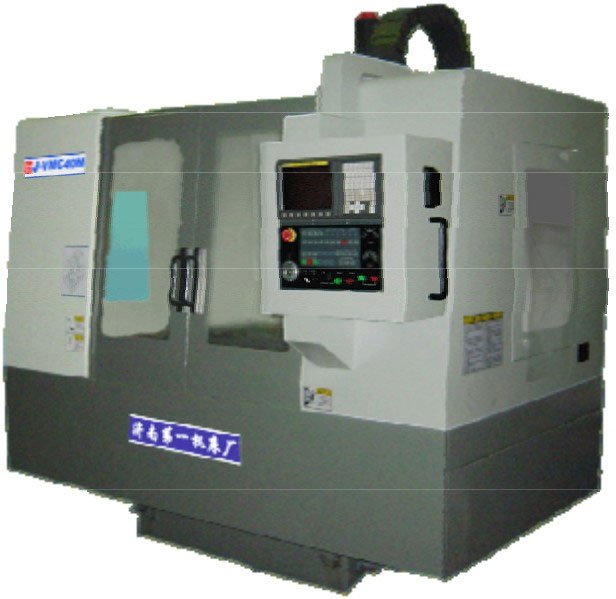
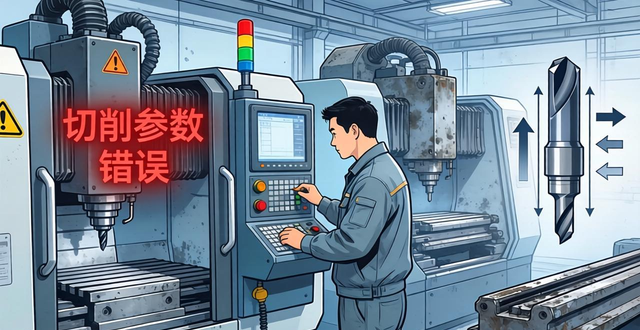
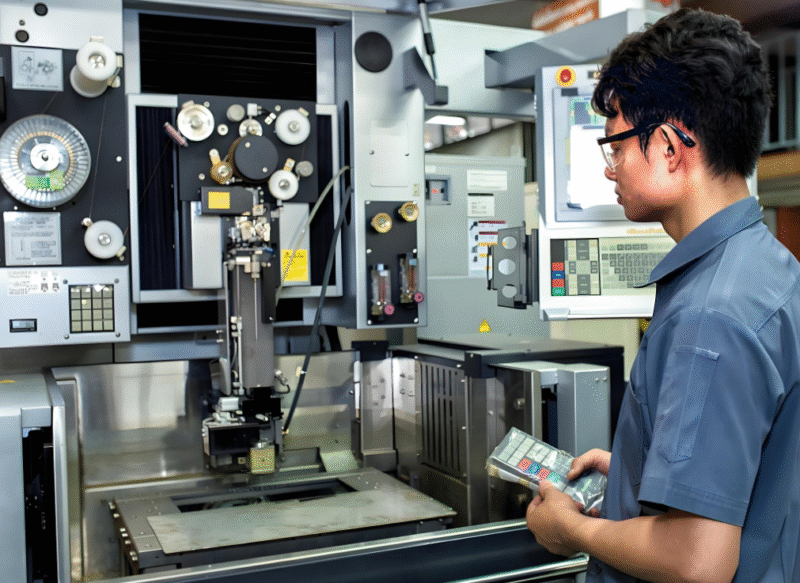
Automation control technology, is to enhance the stability of the blackening process and the core of efficiency, which mainly contains the parameter control, liquid management and production scheduling of these three aspects. Parameter control using PLC plus touch screen control system, to monitor and adjust the temperature of the blackening liquid in real time, the use of thermocouple sensors, the accuracy can reach ± 0.5 ℃, can monitor and adjust the electrolysis current and voltage, through the Hall current sensors to achieve, but also to adjust the processing time, with the help of a timer to complete it. As soon as the parameter deviates from the set value, the system automatically triggers an alarm and makes adjustments, for example, when the temperature is too low the heating device is activated. Liquid management with the help of online concentration detection sensors, such as sodium hydroxide concentration sensors, to monitor the composition of the liquid in real time, once the concentration is lower than the standard value, it will automatically open the replenishment device in order to replenish the agent; and also set up the liquid circulation filtration system, used to remove impurities in order to extend the service life of the liquid. Production scheduling using the MES system, also known as the manufacturing execution system, to achieve order management, production scheduling, quality traceability and other functions, to be able to real-time view of the production progress of each process, the rational deployment of resources. In addition, the system is equipped with remote monitoring function, the management personnel can view the production data through mobile phone APP, to achieve remote operation and maintenance, and thus further improve the management.
![图片[3]-鞍形垫圈不锈钢发黑处理316螺丝黑色氧化加工防锈耐蚀-大连富泓机械有限公司](/wp-content/uploads/2026/02/1771064055349_3.jpg)
Rework process for defective products
Need to be classified to deal with the blackening of defective products, the film layer of flowers and exposed pieces, to be retreated after reprocessing, retreated with 12% hydrochloric acid soaked at room temperature for 8 minutes, rinsed and then re-treated black; for the lighter colours but the adhesion of the pieces of the qualification can be directly supplemented by the black, but the temperature should be reduced by 5 ° C, shorten the time by 5 minutes, in order to avoid the film layer is too thick. Check the size of the workpiece before rework to ensure that there is no corrosion; rework to re-test the appearance and performance, the same workpiece rework times can not be more than 2 times. For the film layer cracked parts, because the substrate may be damaged, it is recommended to be scrapped. To establish a defective product analysis ledger, regularly go to optimise process parameters, reduce rework rate.
![图片[4]-鞍形垫圈不锈钢发黑处理316螺丝黑色氧化加工防锈耐蚀-大连富泓机械有限公司](/wp-content/uploads/2026/02/1771064055349_4.jpg)
Industry Standards and Compliance Requirements
There are a number of standards for the blackening process: GB/T 12600 - 2005 on the film adhesion test method to make provisions, GB/T 10125 - 2021 clear salt spray test requirements, JB/T 6978 - 2007 specification of process parameters, but also requires environmental protection in terms of It is also required to comply with GB 18918 wastewater emission standards and GB 16297 exhaust emission standards, food grade products need to meet GB 4806.9 - 2016, electronic products should comply with the RoHS 2.0 directive, and enterprises must establish a compliance system, regular testing of product performance and environmental protection indicators, and save the test report for at least 2 years. Export products also need to meet the standards of the target country (e.g. EU REACH regulation).
Expanding Applications in New Energy Sectors
In the new energy field, the application of blackening has become more and more widespread: photovoltaic stent blackening treatment, can reduce the reflectivity, that is, from the original 85% to 8%, and then enhance the power generation efficiency of 5%, the length of salt spray resistance can be up to 100 hours, the service life can be extended to 25 years; wind power flanges using the “blackening + closed” this treatment can be adapted to the high salt environment at sea, maintenance costs reduced by 40%; new energy vehicle battery pack shell after electrochemical blackening, surface resistance ≥ 10ฉ. Closed" this treatment, can adapt to the sea that high salt environment, maintenance costs reduced by 40%; new energy vehicle battery pack shell after electrochemical blackening, surface resistance ≥ 10 ⁸Ω, has the function of insulation, can avoid the battery short-circuit situation; charging pile shell blackening, weather resistance has been improved, can adapt to the harsh outdoor environment. After the charging pile shell is blackened, the weather resistance is improved, which can adapt to the harsh outdoor environment. Chrome-free blackening process fits the needs of green development of new energy industry, the annual growth rate of market demand reached 20%.




 Chinese
  Japanese
  English
  German
  Finnish
No comments