
When the slewing bearing of the No. 8 stacker reclaimer in a port in Liaoning Province made its first noise, maintenance team leader Xiao Wang didn't pay much attention to it. After all, this equipment has been running for 11 years, a little sound “normal”. Three months later, the slewing appeared to be obvious stalling, they just stopped the machine to check. After dismantling everyone sucked a breath of cold air: bearing raceway spalling area of 40%, cage fracture, maintenance costs from the estimated 350,000 storm to 820,000, downtime extended by 26 days.
This story is widely circulated in stacker reclaimer repair circles. Slewing bearings - thisstacker and reclaimerThe most central and expensive component, its failure is never sudden, but an accumulation of warning signs that have been ignored time and time again.
I. Five stages of development of slewing bearing failures
Damage to slewing bearings is a slow process that we have categorised into five identifiable stages using vibration monitoring data:
Stage 1: Slight pitting (can continue to operate for 6-12 months)
Characteristics: The characteristic frequency of bearing failures appears in the vibration spectrum, but the amplitude is very small. Data monitored at a power plant showed that the acceleration RMS values at this stage were typically between 0.5 and 1.0 m/s².
Treatment: Strengthen lubrication, shorten the lubrication cycle from once a month to once every half a month, use high quality grease with EP additives.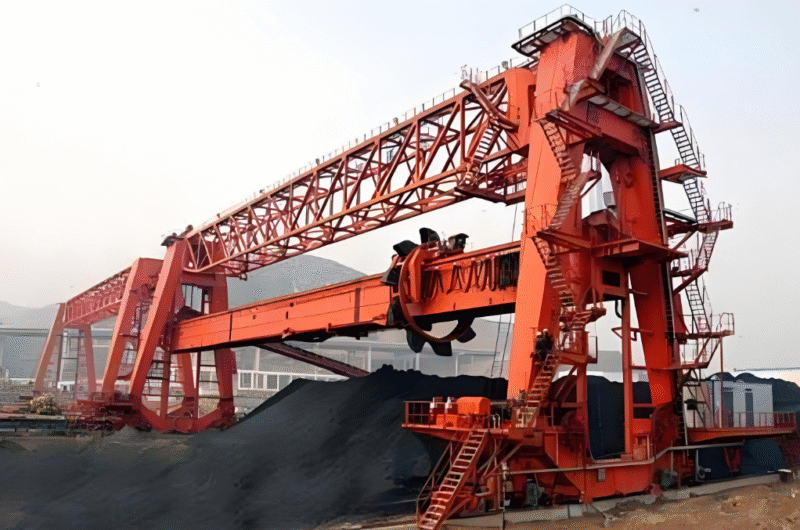
Stage 2: Moderate flaking (recommended to schedule repairs within 3 months)
Characteristics: Vibration amplitude increases significantly and harmonic components appear. Temperature monitoring shows that under the same ambient temperature and load, the temperature of the outer ring of the bearing is 8-12°C higher than normal.
Real Case: A steel plant in Jiangsu decided to advance maintenance at this stage, with a maintenance cost of 280,000 RMB and 9 days of downtime. If it had waited until the next stage, the cost would have been expected to be more than 450,000 RMB and more than 15 days of downtime.
Stage 3: severe damage (must stop immediately)
Characteristics: Periodic jamming sensation during slewing, distinctive noise. Vibration acceleration RMS value exceeds 4.0m/s².
Stage 4: Cage failure (potentially catastrophic failure)
Characteristics: Shock peaks occur in vibration, and the sound changes from a continuous noise to an intermittent thumping sound.
Stage 5: Total failure (equipment cannot be turned around)
This is the last thing we want to see. A cement plant in Hunan has experienced this, and the final repair cost was as high as 18% of the original value of the equipment.
II. Seven practical methods of on-site diagnosis (without professional instruments can also judge)
Not every enterprise has a vibration analyser, but experienced teachers have summed up a set of practical on-site judgement methods:
Method 1: Listening to the sound to recognise the position
Use a long screwdriver or stethoscope to contact the bearing housing, with the other end close to your ear. The normal sound is an even “rustle”. If there is a “thump, thump, thump” periodic sound, it may be the raceway spalling; if it is a “clatter, clatter, clatter” noise, it may be a cage problem.
A port maintenance worker Lao Zhao's masterpiece: he can judge the damage location by the sound. He said: “Which angle the cantilever is pointing at when the sound is the loudest, the damage point is at the bearing position at that angle.”
Method 2: Temperature comparison
At the same ambient temperature and under the same load, measure the temperature at several points of the outer ring of the bearing with an infrared temperature measuring gun. The normal temperature difference should be ≤5°C. If the temperature at a certain point is significantly high, there is likely to be damage at that point.
Method 3: Slewing resistance test
Remove the drive motor coupling and manually turn the slewing mechanism with a torque spanner. Record the maximum torque required to turn 360°. Test monthly to establish baseline data. Vigilance is required when torque increases above 20%.
Method 4: Grease condition check
Each time you lubricate, take a small amount of old grease from the grease discharge port and observe. Normal grease is uniformly greasy, if found:
With metal chips: increased wear
Turns grey-black: possible water ingress
Lumpy: grease deterioration or contamination
Method 5: Gap measurement
Measure the slewing clearance with a percentage gauge. New bearing clearance is usually 0.3-0.8 mm. when the clearance is >1.5 mm, the preload needs to be adjusted; when it is >2.5 mm, the bearing may be severely worn.
III. Four options for maintenance programmes and cost analysis
Once the need for repairs is identified, four options are faced:
Option 1: Adjustment of preload (lowest cost)
Applicable conditions: No damage to the bearing itself, but only loss of preload due to prolonged operation.
Method: Restore the preload by adjusting the shim thickness.
Cost: about $20,000-$50,000 with 1-2 days of downtime.
Success Rate: 85% or more if the raceway is in good condition.
Option II: Replacement of damaged parts (medium repair)
Applicable conditions: localised damage, other parts in good condition.
Real case: Tangshan, a pile reclaimer only the inner ring raceway partial spalling, they used the “replacement of the inner ring + all the rollers” programme.
Cost: $180,000 ($120,000 for new inner ring, $40,000 for rollers, $20,000 for labour), 6 days downtime.
Key point: It is important to ensure the precision of the fit of the old and new parts, preferably operated by the original manufacturer or a professional repairer.
Option 3: Bearing reconditioning (cost-effective option)
This is an option that many users are unaware of. A professional bearing reconditioning business can recondition damaged bearings:
Raceway grinding and polishing
Replacement of all rollers and cages
Reheat treatment (to restore surface hardness)
Cost: about 40-60% of new bearings, service life up to 70-80% of new products.
Note: You must choose a qualified restoration company and conduct a thorough inspection after restoration.
Option 4: Whole bearing replacement (most complete)
Applicable conditions: Severe or multiple damage to bearings.
Cost Composition (Φ3000mm slewing bearing as an example)
New bearings: $250,000-400,000 (varies greatly by brand)
Lifting cost: $30,000-$60,000
Labour cost: $40,000-80,000
Auxiliary materials: $20,000-$30,000
Total: $340,000-570,000
Downtime: 10-20 days (depending on construction organisation)
IV. 23 key control points for maintenance construction
We tracked and recorded the whole process of a successful slewing bearing replacement in a power plant in Shandong, and summarised 23 points that must be controlled:
Disassembly phase (first 3 days):
Directions must be marked and photographs taken prior to dismantling
The bolt removal sequence must be symmetrical
Hanging point selection should calculate the centre of gravity to prevent deformation
Measure the dimensions of the old bearings immediately after landing as the basis for acceptance of the new bearings
Installation phase (2 days core):
5. Requirements for cleanliness of mating surfaces: no stains when wiped with a white cloth
6. Pre-tensioning of the bolt must be carried out in three stages: 30%-70%-100%.
7. Every time after the pre-tensioning should be measured flatness, requirements ≤ 0.2mm / m
8. The final torque value must be cross-checked by two persons.
Commissioning phase (2 days after):
9. Test run with no load for at least 4 hours, checking temperature every half hour
10. Load test run to be performed in stages: 25%-50%-75%-100% loads
11. Vibration tests shall be performed at all load levels.
The three most error-prone links:
Bolt tightening sequence: A steel mill had to re-machine the bearing housings due to deformation of the bearing housings caused by the wrong bolt sequence, which resulted in a delay of 7 days.
Mating surfaces are clean: fine sand particles can lead to local stress concentrations, a port thus causing early damage to the bearing.
Grease filling: New bearings must be lubricated with the specified grease, and should be filled in several times to let the grease penetrate fully.
V. Gold standard for preventive maintenance
The best maintenance is no maintenance. The average service life of the slewing bearings of the stacker reclaimer in a benchmark power plant in China is 16 years, which is 4 years longer than the industry average, and their practice is worth learning:
Standardisation of daily inspections:
Once a day: listen for sounds, check for leaks
Weekly: temperature measurement, lubrication check
Once a month: vibration measurement, gap check
Lubrication management refinement:
They use an automatic lubrication system, but keep the manual refill port. More grease is not better, their standard is to refill each time until fresh grease overflows from the grease drain, then let the unit run for 15 minutes to allow excess grease to drain.
Intelligent condition monitoring:
An online monitoring system is installed to monitor vibration, temperature, and rotary resistance in real time. The system is set up with three levels of warning:
Level 1 Alert (email notification): Parameter exceeds baseline 20%
Level 2 alert (SMS notification): parameter exceeds baseline 50%
Level 3 Alert (telephone notification): Parameters exceeding baseline 1001 TP3T
Data for maintenance decisions:
They have established a bearing health scoring system that combines data on vibration, temperature, grease analysis, etc., and initiates the maintenance readiness process when the health score falls below 60.
Final advice: Slewing bearing repair is not a simple disassembly and replacement, but a systematic project. When choosing a repairer, don't just look at the offer, but see if they have repair cases of similar models, complete construction programmes and professional testing equipment. A successful repair can make the bearing service for another ten years, a failed repair may be half a year later to come back again.
 Chinese
  Japanese
  English
  German
  Finnish
Leave a Reply
You must be logged in to post a comment.