
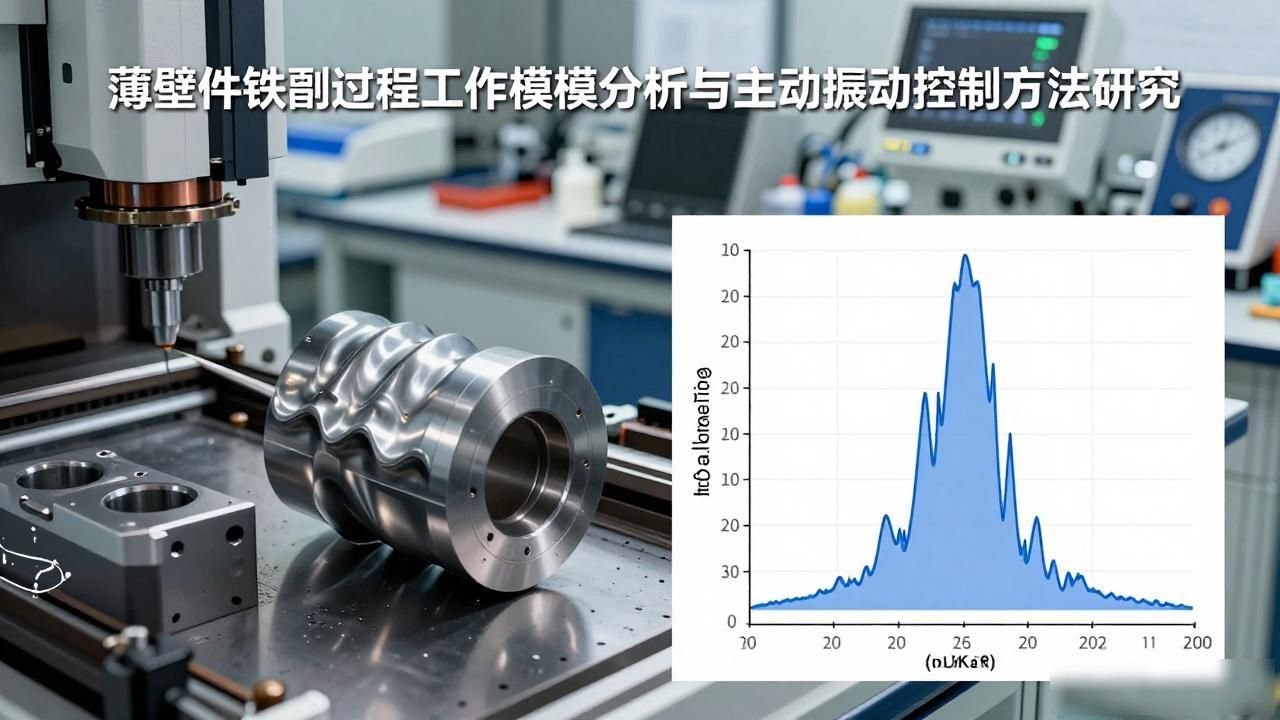

A Study on the Analysis of Operating Modes During the Milling Process of Thin-walled Parts and Active Vibration Control Methods. I. Introduction: With the rapid development of the manufacturing industry, the milling of thin-walled parts plays an increasingly critical role in high-end manufacturing sectors such as aerospace and automotive. However, given that thin-walled parts have low rigidity and are highly susceptible to deformation, vibrations and deformation are prone to occur during the milling process, which directly affects the machining accuracy and surface quality of the parts. Therefore, conducting an analysis of operational modes and exploring active vibration control methods for the milling of thin-walled components holds significant theoretical importance and practical value. The aim of this paper is to analyse the operational modes during the milling process of thin-walled components and to explore practical and effective active vibration control methods, thereby improving machining accuracy and surface quality. II. Analysis of Operational Modes in the Milling Process of Thin-walled Parts 2.1 Basic Principles of Modal Analysis: Operational mode analysis is a key method for investigating the dynamic characteristics of mechanical systems under specific operating conditions. During the milling process of thin-walled workpieces, modal analysis primarily focuses on the influence of factors such as cutting force, cutting speed and workpiece material on the vibration and deformation of the workpiece. Through the establishment of mathematical models and simulation analysis, the dynamic response characteristics of the workpiece can be understood, thereby providing a basis for subsequent vibration control. 2.2 The Relationship Between Cutting Forces and Vibration: Cutting forces are one of the primary factors causing vibration during the milling process. When milling thin-walled components, variations in cutting forces can induce vibration and deformation in the workpiece; By analysing the variation patterns of cutting forces, it is possible to gain a deeper understanding of the workpiece’s vibration characteristics, thereby providing a basis for formulating effective vibration control strategies. 2.3 By employing modal parameter identification and experimental methods validated against actual data, it is possible to obtain the required parameters for modal-related factors—such as natural frequencies, mode shapes and damping ratios—during the milling process of thin-walled components; These parameters are of great significance for understanding the dynamic characteristics of the workpiece and formulating effective vibration control strategies. At the same time, by conducting simulation analyses and comparing them with experimental results, the accuracy of the modal analysis can be verified, providing reliable evidence for subsequent vibration control. III. Research on Active Vibration Control Methods, 3.1 Principles of Active Vibration Control: Active vibration control is a method that utilises the injection of an opposing vibration signal to compensate for the original vibration. During the milling process of thin-walled components, by detecting the workpiece’s vibration signals and generating corresponding control signals, which are then applied to the actuators, active control of the workpiece’s vibrations is achieved. 3.2 Controller Design and Implementation: To achieve active vibration control, it is essential to design an appropriate controller. This paper employs algorithms from modern control theory, such as adaptive filters and Kalman filters, to achieve real-time detection and control of the workpiece’s vibration signals. Furthermore, to meet real-time requirements, consideration must be given to the hardware implementation of the controller, such as the selection of suitable sensors, actuators and processors. 3.3 Control Strategy and Experimental Validation: An appropriate control strategy is formulated based on the characteristics and requirements of the thin-walled workpiece milling process. Through experimental validation, the effectiveness and performance of the active vibration control method are assessed. At the same time, a comparison is made with traditional passive vibration reduction methods to highlight the superiority of active vibration control. IV. This paper analyses the operational modes of the thin-walled workpiece milling process and investigates effective active vibration control methods. Through the construction of mathematical models and simulation analysis, the relationship between cutting forces and vibration, as well as the dynamic characteristics of the workpiece, were elucidated. Furthermore, a suitable controller and actuator were designed and implemented, achieving active control of workpiece vibration. Experimental results demonstrate that the active vibration control method proposed in this paper can effectively improve machining accuracy and surface quality during the milling of thin-walled components. However, further investigation is required into how to optimise controller design and enhance control accuracy. Future work could be carried out along these lines, thereby driving the further development of thin-walled component milling technology. V. Directions for Further Research 5.1 Optimisation of Controller Design Although we have employed algorithms from modern control theory for controller design, issues such as insufficient control accuracy and response speed persist in practical applications. Therefore, future research could focus on further optimising the controller design, for example by introducing more advanced control algorithms—such as fuzzy control and neural network control—to enhance control accuracy and response speed. 5. Improvements to Actuators: The performance of actuators directly influences the effectiveness of active vibration control. Consequently, future research could focus on improving actuators—for instance, by enhancing their driving capacity and reducing their size and weight—thereby enabling them to adapt to more complex machining environments and meet higher machining requirements. During the milling of thin-walled components, in addition to the dominant vibration mode, other secondary vibration modes may also be present. Although the vibrations associated with these modes may be minor, their long-term accumulation can affect machining accuracy and surface quality. Consequently, future research could focus on multi-modal vibration control, that is, simultaneously controlling both the principal mode and other secondary modes, thereby further enhancing machining accuracy and surface quality. Although active vibration control methods have demonstrated significant effectiveness in the milling of thin-walled components, consideration could also be given to combining them with other vibration reduction techniques, such as damping and vibration isolation. Through the integrated application of multiple vibration-reduction techniques, the stability and machining quality of the thin-walled component milling process can be further improved. 5. A comprehensive experimental platform needs to be established to facilitate the research and validation of active vibration control methods. Future research may focus on the construction and refinement of such a platform, encompassing the selection and configuration of equipment—including sensors, actuators and controllers—as well as the optimisation of the experimental environment. This paper presents an in-depth analysis of the operational modes during the milling process of thin-walled components and investigates effective active vibration control methods. Through the establishment of mathematical models and simulation analysis, we have gained an understanding of the relationship between cutting forces and vibrations, as well as the dynamic characteristics of the workpiece. At the same time, we designed and implemented suitable controllers and actuators, thereby achieving active control of workpiece vibrations. The experimental results demonstrate that, for the milling process of thin-walled components, the active vibration control method proposed in this paper can effectively improve machining accuracy and surface quality. In the future, we will continue to monitor the emerging trends and challenges in the milling technology for thin-walled components, and will conduct more in-depth research in several directions. These include the optimisation of controller design, the improvement of actuators, research into multimodal vibration control, integration with other vibration-reduction technologies, and the development and refinement of the experimental platform. We are confident that, through continuous research and exploration, we will be able to further advance thin-walled component milling technology and make a significant contribution to the development of the manufacturing industry. VI. Summary and Outlook 6.1 Summary In this paper, we have conducted an in-depth analysis of the operational modes during the milling process of thin-walled components. Through mathematical modelling and simulation analysis, we have investigated the relationship between cutting forces and vibrations, as well as the dynamic characteristics of the workpiece. Based on this research, we have devised and implemented an effective active vibration control method. Experimental results demonstrate that our active vibration control method can significantly improve the machining accuracy and surface quality of the thin-walled component milling process. The key achievements of our research are as follows: Firstly, we conducted a detailed analysis of the operational modes during the milling process of thin-walled components, clearly defining the interrelationships between cutting forces, the dynamic characteristics of the workpiece and vibrations. Secondly, we devised and implemented suitable controllers and actuators to achieve active control of workpiece vibrations. Thirdly, we experimentally validated the effectiveness of the active vibration control method, thereby improving machining accuracy and surface quality during the milling of thin-walled components. 6.2 Outlook: Although our research has yielded certain results, there remains much work to be done and further investigation is required. Subsequent research could focus on the following key areas: Firstly, with regard to the optimised design of the controller, further optimisation of the controller design is required to enhance its adaptability and robustness, ultimately enabling the milling process to adapt to different materials and process parameters. Secondly, with regard to the improvement of actuators, research should be conducted into more efficient actuators—such as force and displacement sensors and actuators that meet requirements for high response speed and high precision—in order to enhance the performance of active vibration control. Thirdly, with regard to the research on multi-modal vibration control, given the variety of vibration modes that may arise during the milling of thin-walled components, research into multi-modal vibration control methods must be undertaken to achieve the objective of more comprehensive vibration control. (4) Explore the integration of active vibration control methods with other vibration reduction techniques, such as damping and vibration isolation, to enhance stability and machining quality during the milling process of thin-walled components. Relevant experimental set-ups should be established to investigate this integration. A more comprehensive experimental platform should be constructed, incorporating high-precision sensors, actuators, controllers and other equipment; the experimental environment should also be optimised to facilitate the research and validation of active vibration control methods. Investigate the impact of process parameters on the milling of thin-walled components and utilise optimised process parameters to further improve machining accuracy and surface quality. (7) Intelligent manufacturing technologies are applied to the milling of thin-walled components; in this process, technologies such as artificial intelligence and machine learning are utilised, thereby enabling intelligent active vibration control and leading to machining optimisation. In summary, the modal analysis of the thin-walled component milling process and the research into active vibration control methods constitute a complex and significant area of study. In the future, we will continue to monitor development trends in this field, remain mindful of the challenges involved, and persist in our research and exploration to contribute further to the advancement of the manufacturing sector. (8) To implement active vibration control more efficiently, it is necessary to establish a real-time monitoring system to continuously monitor vibration conditions during the milling process in real time, and to provide feedback on the monitored data. This involves the development of high-precision sensors designed to accurately capture and measure data—such as vibration—in real time during the milling process, as well as the development of advanced feedback control algorithms to achieve more precise vibration control. By integrating a physical model of the milling process, we will proceed to develop optimisation strategies. By constructing a precise physical model, we will analyse the patterns of change in physical quantities such as force, heat and vibration during the milling process, thereby proposing more effective optimisation strategies, such as optimising cutting parameters and improving toolpaths. (10) Adaptive control technology: Investigate the application of adaptive control technology in the milling of thin-walled components. During milling, adaptive control technology can automatically adjust control parameters in response to real-time changes, thereby achieving more precise vibration control. This involves researching the optimisation and implementation of adaptive control algorithms, as well as developing corresponding control systems. (11) Conduct research into novel vibration-damping materials and structures, and investigate their application in the milling process of thin-walled components. By developing new, ultra-high-performance vibration-damping materials and structures—such as damping materials and vibration-absorbing structures— thereby enhancing the vibration-damping performance and machining quality of thin-walled components during the milling process. This research into novel vibration-damping materials and structures aims to improve the vibration-damping performance and machining quality of thin-walled components during the milling process through the development of new, high-performance vibration-damping materials and structures, such as damping materials and vibration-absorbing structures. Addressing the multi-objective optimisation challenges in the milling process of thin-walled components—such as machining accuracy, surface quality and vibration control—research is being conducted into multi-objective optimisation methods. By comprehensively considering multiple objectives, optimal process parameters and control strategies are identified to achieve better machining results and vibration control. This multi-objective optimisation method addresses the challenges of multi-objective optimisation in the milling process of thin-walled components—such as machining accuracy, surface quality and vibration control—by researching appropriate optimisation approaches. By comprehensively considering multiple objectives, optimal process parameters and control strategies are identified to achieve superior machining results and vibration control. (13) With regard to international cooperation and exchange, efforts must be made to strengthen international cooperation and exchange, collaborate with relevant research institutions and enterprises both domestically and internationally to jointly advance the analysis of working modes in the milling process of thin-walled components and the research into active vibration control methods. By leveraging shared resources, experience and achievements, we can thereby drive the development and progress of this field. This approach, which combines simulation and experimentation, should be utilised to to conduct in-depth research into the milling process of thin-walled components. By creating accurate simulation models, it is possible to predict and analyse vibration conditions and machining quality during the milling process, thereby providing guidance and reference for experiments. At the same time, experiments are used to verify the accuracy of the simulation results, continuously optimising the simulation models and related algorithms to enhance the precision and reliability of the research. When applying the research findings to actual production and extending them to more enterprises and production lines, through collaboration with these enterprises and production lines, we will transform research findings into actual production capacity, thereby enhancing the competitiveness and technical standards of the manufacturing sector. In summary, the analysis of operational modes in the milling process of thin-walled components and research into related methods of active vibration control constitute a complex subject spanning multiple disciplines and technologies. In the days ahead, we will continue to monitor development trends and challenges in this field, whilst persisting in our research and exploration to make an even greater contribution to the development of the manufacturing sector.
 Chinese
  Japanese
  English
  German
  Finnish
Leave a Reply
You must be logged in to post a comment.