
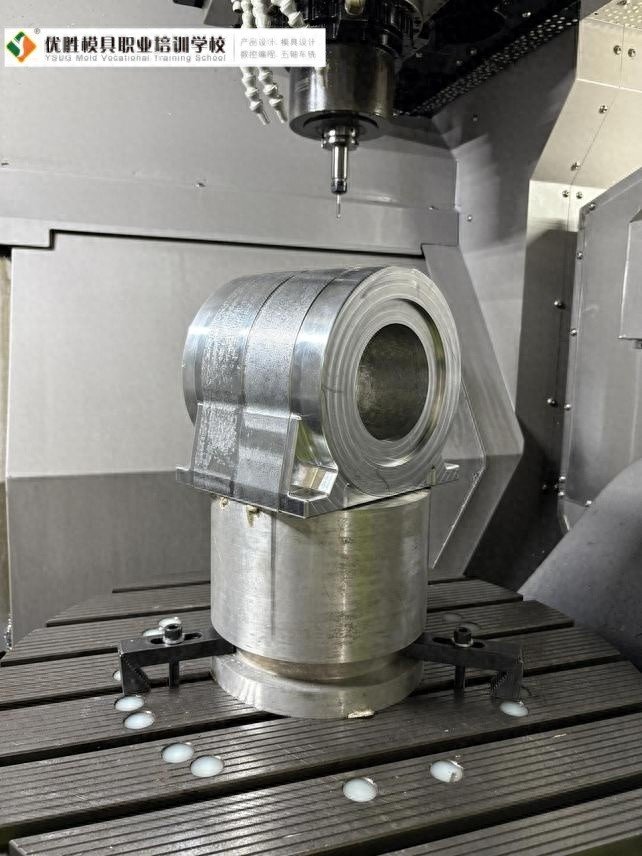
Struggling to learn five-axis programming? It’s because you’ve been practising the wrong way.
Many technicians are brimming with enthusiasm when they first venture into the field of five-axis programming. They buy books, watch videos, enrol on courses, and even spend a fortune on simulation software; yet, months later, when faced with a slightly complex impeller or integral blade disc workpiece, they are still at a loss, or the programmes they write result in tool collisions as soon as they are run on the machine.
If you, too, find yourself in this situation—where “the more you study, the more anxious you feel; the more you practise, the more lost you become”—then please slow down and take a break. The problem most likely does not lie in your intelligence, nor is it that you are not working hard enough; rather, it is that you have been engaging in practice that yields no tangible results.
What is an invalid exercise in five-axis programming?
Ineffective practice has one defining characteristic: it consists solely of repetition, without any iteration.
Many beginners tend to “copy exactly as shown”; if they see a fixed-axis machining operation in a tutorial, they simply repeat it themselves; if they see someone else resolve an interference issue by setting the “tool axis away from the straight line”, they will only try adjusting this one parameter when faced with a similar situation. With this approach to practising, you are merely replicating the steps taken by others, rather than developing your own decision-making logic.
Even more alarming is the “head-against-the-wall” approach, which involves repeatedly making inappropriate attempts to resolve the same error. It is as if the cutter axis control is constantly in an ‘over-cutting’ state; rather than analysing whether the amplitude of the cutter axis’s oscillation is too great, or whether there is a problem with the cutter tip tracking settings, you rigidly and mechanically switch from one cutter axis direction mode to the next, hoping to succeed by sheer luck. Not only is the efficiency of such practice effectively zero, but it is also bound to create incorrect muscle memory, thereby cementing and reinforcing bad habits.
Another typical manifestation of ineffective practice is “disconnection”—separating programming from the machine tool. Many people simply view the toolpath in the software and, if it “looks smooth enough”, assume the programme is acceptable, They never consider whether the machine’s range of rotation is sufficient, or whether the spindle head might physically collide with the fixture at a certain angle; nor do they verify the linear axis interpolation accuracy of the code within the post-processor. This approach produces operators who “know the software but cannot programme”, rather than genuine five-axis machining specialists.
Why is there particularly no room for ineffective practice in five-axis programming?
It focuses on three-axis programming, with the core emphasis on “toolpaths”; however, in the case of five-axis programming, the primary focus is on “attitude control”.
Five-axis machining adds two rotational axes, causing the complexity of the problem to increase exponentially. In three-axis mode, the tool vector remains fixed; in five-axis machining, each tool position corresponds to a dynamically changing tool orientation.
This illustrates that every decision in five-axis programming is non-linear. Changing the approach angle in one place may well cause the over-cut checks for the entire toolpath to fail completely; adjusting a parameter for tool axis smoothing by even a small amount may trigger severe vibration in the rotary axes, which in turn affects surface quality. If you approach five-axis machining using the linear mindset typical of three-axis machining—“draw a line, generate a toolpath, then post-process”—your knowledge base will become cluttered with inexplicable “mysteries”—“Why on earth did this work last time, but not at all this time? ”.
The greatest danger of engaging in ineffective practice is that it traps you within this complex, non-linear system, causing you to mistake chance for inevitability and to confuse luck with skill.
How can you switch from ineffective practice to effective practice?
“Deliberate practice” is the essence of effective practice; it requires clear objectives and timely feedback, and one must remain within the “zone of learning” rather than staying in the “comfort zone” in order to ultimately achieve effective practice.
1. Develop the habit of practising “reverse engineering”
Don’t start coding from scratch; instead, break down excellent examples.
When looking for a five-axis programme with well-developed features—such as an impeller toolpath that meets standard requirements—one should not simply focus on the final toolpath itself, but rather approach the task by breaking it down into three distinct steps:

Reverse-engineering the machining plan: From a programmer’s perspective, why are the flow channels machined first, followed by the blades, and finally the fillets? What is the logic behind this sequence—is it based on considerations of tool rigidity, or is it intended to relieve cutting stresses?
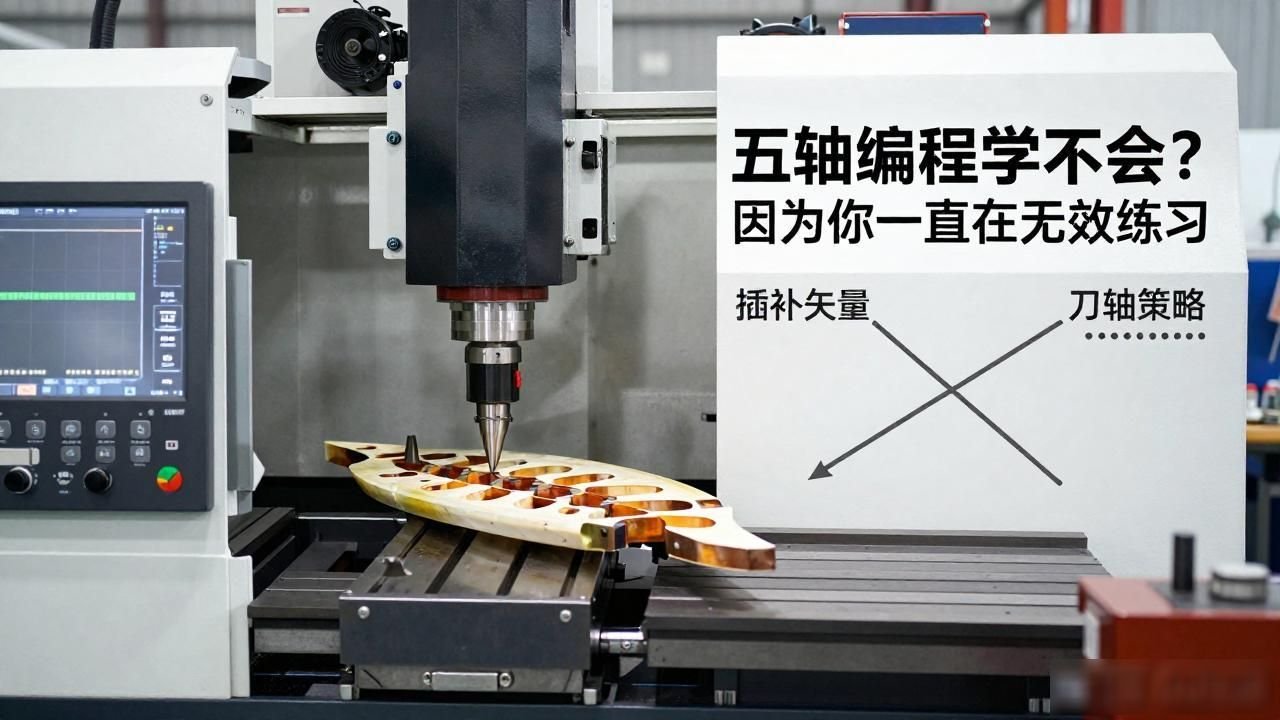
Analysing the selection criteria for cutter spindle strategies: During the blade finishing stage, why is the “forward tilt/lateral tilt” strategy used in one area, whilst in another area it switches to “interpolation vector”? What exactly are the critical conditions that trigger this switch—is it the limit on the swing angle, or the need for avoidance manoeuvres?
Starting with the simulation of extreme operating conditions, load the programme into the simulation software, deliberately alter the workpiece’s clamping position, and then observe how the tool spindle adapts and continuously adjusts. This process, known as a “destructive experiment”, enables you to gain a deep understanding of the constraints between the tool spindle vector and the geometric features, ultimately leading to a profound understanding of the subject.
Analysing a single high-quality programme is more valuable than fumbling your way through ten ordinary ones on your own.
2. Establishing the “single-variable” practice method
There are numerous programming parameters for five-axis machining, and the biggest mistake beginners should avoid is adjusting several parameters at once.
You can devise a series of extremely simple practice scenarios for yourself; for example, machining a deep, inclined cavity on a hemispherical object. Such a scenario encompasses the most critical challenges associated with five-axis machining, namely avoiding collisions, ensuring the tool axes remain in a smooth configuration, and managing the constraints on the rotational axes.
In the first round, you will focus solely on “collision avoidance” exercises. Keep all other parameters fixed and adjust only the “avoidance distance” and “tilt direction” within “cutter spindle control”, noting how the toolpath changes, until you are able to accurately predict: When the avoidance distance is increased, in which direction will the cutter axis deviate, and what new risks will this deviation give rise to?
In the second round, you will focus solely on practising “tool axis smoothing”. First, ensure that the collision avoidance checks are passed; on this basis, concentrate specifically on adjusting the “smoothing angle” and “smoothing radius”. You should also pay close attention to how abrupt changes in the tool axis are smoothed out, whilst monitoring changes in machining time.
Breaking down complex problems into sub-skills that can be practised independently is the only shortcut to overcoming the initial hurdles of the Five-Axis system.

3. Establish a closed-loop “machine tool feedback” system
No matter how well-designed the toolpath is in the software, if it cannot be executed on the machine tool, it is worthless.
Effective practice requires you to incorporate the machine tool into your practice circuit; after each programme is completed, you must always do three things:
Upon examining the actual machining marks, the toolpath appears continuous; however, it is unclear whether the workpiece surface has been affected by backlash in the rotary axis, resulting in chatter marks.
Monitor changes in the spindle load, check whether the cutting parameters are theoretically appropriate when dynamically adjusting the tool spindle, and note whether the cutting force increases sharply when the tool spindle is tilted to a certain angle.
Observe the chip evacuation: During five-axis machining, the direction in which the chips are evacuated will vary depending on the position of the tool spindle. Are there any instances of chip entanglement or secondary cutting?
Only programmes that have been verified on the machine tool are those you have truly mastered. If you do not currently have access to a machine tool, you must use high-precision simulation software that incorporates the machine tool’s actual physical parameters, and ensure that at the very least, collision detection and travel limit verification are carried out thoroughly.
4. Keep an “error log” rather than “notes”
For most people, notes focus on “how to do something”; however, the notes kept by those who practise effectively focus on “where they went wrong”.
Every time you encounter an overcut, a collision or an error, it is worth spending ten minutes documenting it in detail:
What action triggered the error?
What exactly do the error codes displayed by the system mean? (Many beginners tend to focus solely on the word “Error” and pay no attention to the “Error Code”.)
Under what conditions can this error be reproduced?
What is the complete approach to resolving this error? There are two possible scenarios here: one involves changing the machining sequence, and the other involves restructuring the coordinate system. Which one is it?
Once you have encountered more than 30 different types of errors, you will realise, to your surprise, that the “pitfalls” inherent in the five-axis programming process are, in fact, situations where data is constrained; as you repeatedly review the content of these records and the associated operational procedures, you will find that each action is essentially a means of patching the gaps and defects within your own decision-making and operational system.
Changing Your Mindset: From “Learning the Software” to “Mastering the Craft”
Finally, I would like to discuss a fundamental shift in thinking.
So many people struggle with ineffective practice because they set their goal as “learning to use five-axis programming software”; yet, in reality, the software is merely a tool, whilst the true skill lies in the ability to make technical decisions.
As a competent five-axis programmer, when looking at a drawing, the thought that goes through their mind is not “which command should I use for this feature?”, but rather:
Is this workpiece suitable for completion in a single set-up or does it require multiple set-ups?
Given the minimum radius of curvature and the depth conditions, should priority be given to ensuring tool rigidity or to avoiding interference?
Given the current machine tool configuration—which encompasses aspects such as spindle power, rotational speed and cooling methods—can it actually support this process planning scheme?
Acquiring these decision-making skills is by no means something that can be achieved simply by mechanically repeating software operations. It is only through a thorough and in-depth understanding of the principles of machining that these decision-making skills can be developed. It is only by becoming familiar with the dynamic characteristics of machine tools that these decision-making skills can be developed. Furthermore, the “case-based experience” accumulated through effective practice is the very foundation upon which these decision-making skills are built.
write at the end
Five-axis programming is indeed quite difficult; the difficulty lies in the fact that it requires you to possess, all at once, spatial visualisation skills, knowledge of metal cutting, and experience in operating the machinery. However, it is by no means an insurmountable hurdle.
If you find yourself constantly learning without making any progress, then do press the pause button without hesitation. Take a close look at your practice routine: ask yourself whether you are merely repeating actions you already know, or whether you are in the process of exploring uncharted territory. Are you fixated on “getting it done”, or are you striving for “understanding”?
Put an end to ineffective practice; this means ceasing behaviour that, whilst masquerading as diligence, is in fact self-deception. Treat every practice session as an experiment: formulate hypotheses, verify the final results, and then record any deviations in detail. Before long, you will realise that the control of the blade spindle and collision avoidance—which once left you perplexed—are no longer mysterious phenomena; rather, they have become a technical system characterised by rigorous logic, predictability and reusability.
Five-axis programming is a science, and the scientific approach to learning always begins with effective practice.
 Chinese
  Japanese
  English
  German
  Finnish
Leave a Reply
You must be logged in to post a comment.