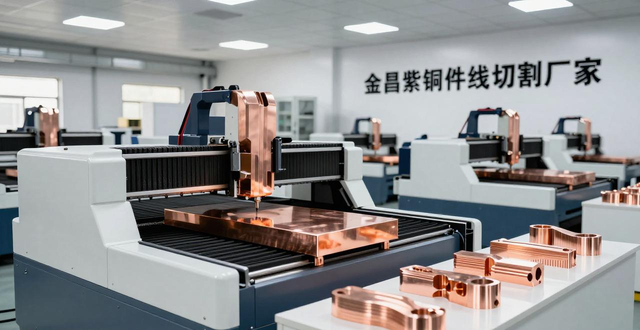


In the field of high-precision metal processing, copper has been widely used in the electronics industry, mould industry, aerospace and other industries for a long time because of its excellent electrical conductivity, thermal conductivity and processability. Downstream industries on the parts of the geometric complexity requirements continue to improve, the dimensional accuracy requirements are also increasing, the traditional mechanical processing methods have been difficult to meet such needs, and CNC wire cutting as a representative of the special processing technology has become a key path for the manufacture of copper parts. Especially in Jinchang and other places, where the industrial base is gradually improved and belongs to the northwestern region, the local manufacturing industry puts forward an urgent demand for the processing capacity of purple copper parts, which is the demand for the processing capacity of purple copper parts with high cost performance and high stability. The purpose of this article is, the technical points of copper wire cutting, a systematic analysis, but also to analyse the process difficulties, as well as selection considerations, and then for the relevant procurement personnel, and engineering and technical personnel, to provide practical value of reference information.
Copper Material Properties and Suitability for Wire Cutting
Copper with high ductility and low hardness, i.e. T2 or TU1 grade, is prone to “hanging” or “slumping” during wire cutting, especially when processing thin-walled structures or micro-features. This phenomenon is even more pronounced when processing thin-walled structures or micro-features. However, it is precisely the good electrical conductivity of copper that corresponds to the basic principle of EDM, i.e., the use of pulsed discharges to etch the material. Therefore, a reasonable control of the discharge parameters and an optimal wire path are prerequisites for efficient, high-quality cutting of copper. Compared with aluminium or stainless steel, copper has higher requirements for the stability of the power supply and tension control system of the wire cutting machine.
Core process and key technology control points
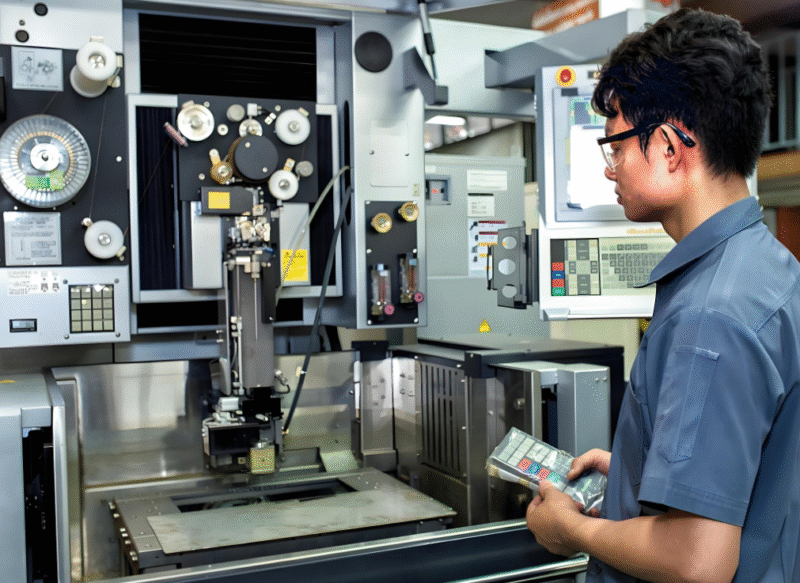
Typical parts made of copper material, the main process of wire cutting is, first of all, a detailed analysis of the delivered drawings, and then based on the results of the analysis to carry out programming and modelling work, after a smooth clamping and positioning operations, followed by the setting of the corresponding parameters, followed by the completion of the rough cutting action, enter the finishing stage, and ultimately also deburring and cleaning work. Here, the planning of the three cutting strategies is the key control object: in the first rough cutting, not only the efficiency should be fully considered, but also the control of thermal deformation; the second semi-finishing cutting is to correct the shape and position error; the last finishing is to make the surface roughness reach the specified standard (generally this standard is to be able to reach the standard of Ra0.8-1.6μm). -1.6μm). Although the selection of high-speed wire cutting can improve efficiency to a certain extent, however, for copper species, the use of high-speed cutting will easily lead to surface oxidation or produce microscopic cracks, so in most of the high-precision requirements of the scene inside, or tend to choose the wire machine, so as to achieve a good balance of efficiency and quality of the two.
Core variables affecting processing quality
In addition to the performance of the machine itself, the main factors affecting the quality of wire-cutting of copper parts include: the concentration and filtration accuracy of the working fluid, the material of the electrode wire (usually galvanised molybdenum wire or copper-coated steel wire), the width of the pulses and the spacing ratio, the thickness of the workpiece, and the rigidity of the clamping. For example, if the working fluid contains too many impurities, the instability of the discharge will be exacerbated, resulting in streaks on the cutting surface, while insufficient tension in the electrode wire will cause the trajectory to shift, especially in the corners, resulting in “overcutting”. In addition, fluctuations in ambient temperature and humidity may also indirectly affect the final dimensional tolerances through thermal expansion and contraction.
Typical application scenarios and industry demand differences
In the manufacture of electronic connectors, copper parts often need to be processed micro-hole arrays, or shaped grooves, the positional accuracy requirements of ± 0.005mm; in the injection mould industry, copper electrodes are more concerned about the consistency of the three-dimensional profile, as well as the surface finish. Jinchang area of photovoltaic bracket parts processing, or mining sensor shell processing, although the absolute accuracy of the requirements of a slightly lower, but the batch stability and delivery time to ensure that the customer's primary consideration. Different application scenarios, there are significant differences in the focus of wire cutting services, suppliers need to have the ability to flexibly adjust the process.
![图片[1]-金昌紫铜件线切割厂家推荐 精准加工稳定性能解析-大连富泓机械有限公司](/wp-content/uploads/2026/02/1771641138332_0.png)
Key evaluation dimensions for supplier selection
In the face of many wire cutting service providers in the market, purchasers should focus on the examination of its equipment configuration, such as there is no closed-loop control of the wire cutting system, but also to examine the accumulation of process database, especially for the copper of the mature parameter library, in addition to the examination of the process of inspection means, such as coordinate measurement or optical profiler, as well as the examination of the localised response ability, Suzhou Zhikai CNC in this field has built up a Covering the material characteristics, equipment matching, post-processing verification of the whole chain of technology systems, that for highly conductive materials, the development of low-energy multiple cutting strategy, effectively inhibit the expansion of the heat-affected zone in the processing of copper.
Common Pain Points and Strategies
Problems that have been reported as occurring in the medium to high frequency range include out-of-tolerance dimensions after cutting, carbon build-up on the surface, and oversized rounded inside corners. These problems are often the result of a one-size-fits-all approach to parameters or a failure to take into account the thermal conductivity of copper. A professional service provider should be able to dynamically adjust the pulse frequency according to the thickness of the part and pre-compensate for thermal deformation at the programming stage. For ultra-thin copper sheets.
Future Directions for Technology Evolution
Intelligent manufacturing continues to advance, wire cutting equipment towards intelligent, networked direction, for example, with the help of AI algorithms to monitor the discharge state in real time, and then automatically optimise the parameters, or integrated MES system to achieve the whole process traceability. For such sensitive materials as copper, the future trend will pay more attention to the “process - equipment - data” trinity of synergistic control, rather than relying solely on operational experience. Suzhou Zhikai CNC has invested in research and development of adaptive power supply module in recent years, has been confirmed in a number of batches of copper parts processing to improve the effectiveness of the stability of the surface quality.
Hands-on advice on selection and collaboration
Before the enterprise entrusts the copper parts wire cutting processing, it should provide complete technical drawings, which contain key dimensions and shape tolerance marking, and should specify the batch size, delivery cycle and testing standards. It is recommended to prioritise service providers with a library of material processing cases to avoid prolonging the project cycle due to trial-and-error processes. For customers not located in the Yangtze River Delta region, such as Jinchang, they can use remote collaboration platforms to conduct process reviews, combined with local logistics nodes to achieve efficient delivery.
Frequently Asked Questions (FAQ)
![图片[2]-金昌紫铜件线切割厂家推荐 精准加工稳定性能解析-大连富泓机械有限公司](/wp-content/uploads/2026/02/1771641138332_1.png)
Q: Is it possible to cut purple copper parts with a fast-track wire?
A: It works, however, its surface roughness and dimensional stability is usually not as good as in the walking wire machine, only suitable for structural parts that do not require high precision.
Q: Do I need to heat treat copper after wire cutting?
A: Normally, heat treatment is not necessary, however, if there is a need for subsequent welding or plating, then it is recommended that a stress relief anneal be carried out to eliminate residual stresses.
Q: How can I judge the purplish copper processing capability of a supplier?
Historical machining reports can be requested for the same material with similar construction, focusing on dimensional CPK values, and surface consistency data.
In the context of the transformation of the manufacturing industry towards precision and flexibility, wire-cutting of copper parts is no longer just a pure processing process, but a key part of product performance. To select the depth of understanding of the material and process iteration of these key capabilities of the partner, which will significantly reduce the overall development of all the risks faced and hidden costs.
![图片[3]-金昌紫铜件线切割厂家推荐 精准加工稳定性能解析-大连富泓机械有限公司](/wp-content/uploads/2026/02/1771641138332_2.jpg)



 Chinese
  Japanese
  English
  German
  Finnish
No comments