
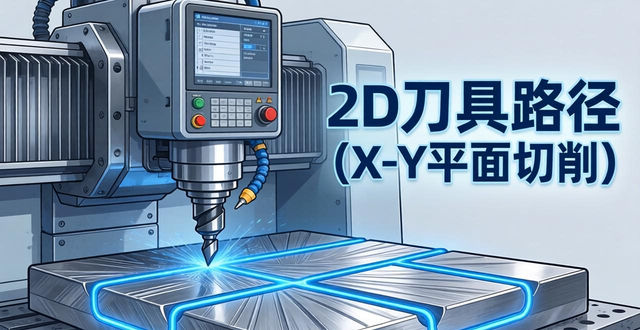
011. Importance of toolpaths
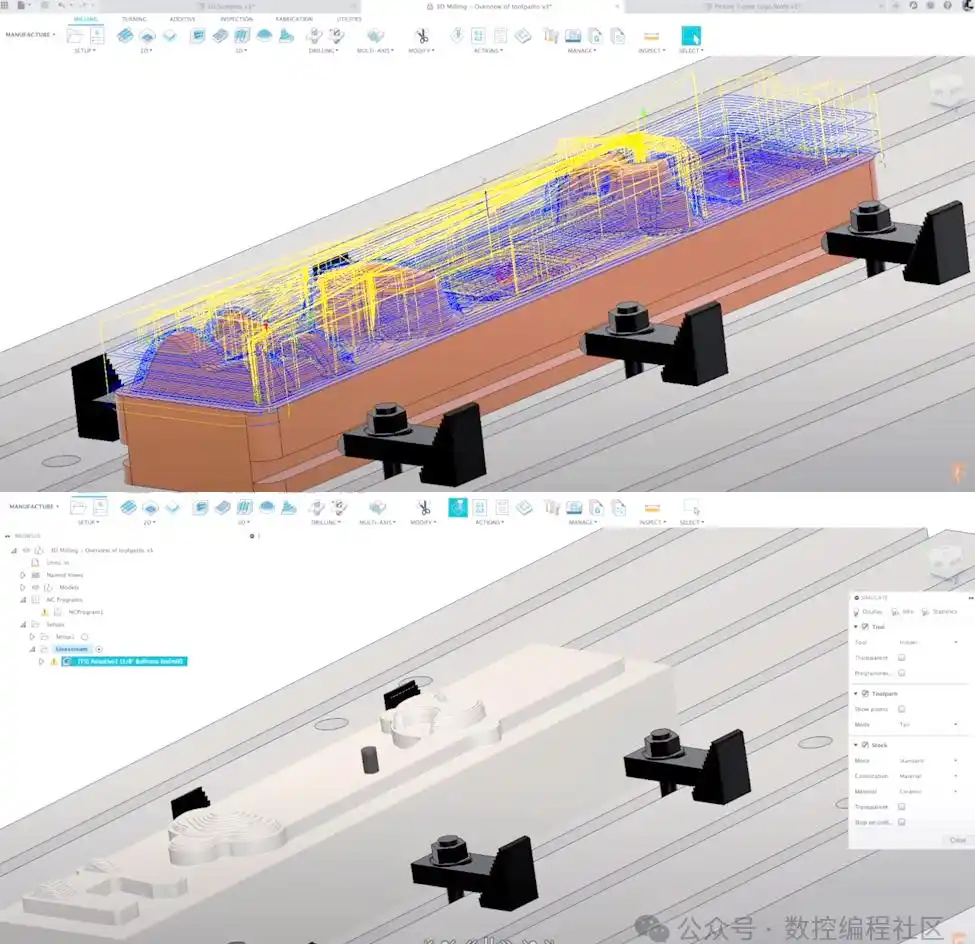
numerical control machiningToolpath planning is crucial in the machining process, as it is the trajectory that the cutting tool follows, and this path generation relies on CAD andCAM softwareThe simulation can preview the trajectory of the tool during machining, detect potential interference between the fixture and the workpiece, evaluate cutting speeds, and make adjustments in case of accidental programming that results in out-of-round cutting of the workpiece.
022.2D Toolpath Analysis
> 2D path definition and application
For CNC milling, the type of toolpath is determined by the number of axes and their movement. 2D paths are operations limited to the X-Y planes and are characterised by cutting in these planes. Figure 4 presents an example of a 2D toolpath, which gives a more intuitive idea of the characteristics of such paths and their application scenarios.

2D toolpaths are particularly important in certain situations, and make sense when focusing on the cutting operation, as the cutting action only occurs in the X-Y plane, i.e. the workpiece is cut in the direction perpendicular to the tool, although some people may refer to 2D toolpaths as 2.5D in order to better characterise them. change the nature of cutting in the X-Y plane, a distinction that becomes particularly obvious when machining a part's recess.
> 2D path specific operations
The 2D operations that can often be found cover surface milling, contour milling, cavity milling, slot milling, chamfering and filleting. Planar milling lays the foundation for subsequent operations, 2D contouring operations focus on roughing and finishing the external walls of the part, cavity milling concentrates on removing material to create the desired cavity, and slot milling creates a slot with a specific shape in a specific location. In addition, chamfer milling and rounding (filleting) milling are also common operations.
033.3D Toolpath Analysis
> Importance of 3D paths
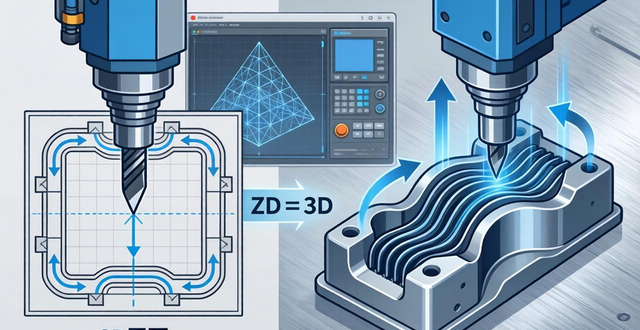
If Z-axis motion is introduced, 2D paths are transformed into 3D paths. These paths are important for processing complex shapes such as moulds, die tools, topologies and geometries with complex circles. Similar to the way a 3D scanner works, the CAM software builds a triangular mesh to represent the geometry to be processed. This mesh is then used to calculate 3D toolpaths.
> Specific applications of 3D operations
The 3D operations that are often seen cover roughing, as well as finishing, and other complex operations. Roughing operations are mainly associated with rough milling, which aims to remove most of the material from the top side of the workpiece. Among these, the adaptive roughing strategy removes large areas of material one by one, starting from the bottom, by dividing the workpiece into different Z-axis heights, while the cavity roughing also uses CAM software to divide the Z-axis heights. Finishing operations are aimed at further improving the surface quality of the workpiece, which includes finish, as well as dimensional accuracy and tolerance control.
Contours, slopes, parallels, planes, spirals and radials are common 3D operations that are defined and executed according to specific machining requirements and CAM software parameters, especially for workpieces with complex surfaces.
 Chinese
  Japanese
  English
  German
  Finnish
Leave a Reply
You must be logged in to post a comment.