
titaniumIt possesses a range of excellent properties, including light weight, high specific strength and good corrosion resistance, and is therefore widely used in numerous fields such as aerospace, shipbuilding, mechanical engineering and the chemical industry. However, its surface hardness is relatively low, abrasion resistanceTheir poor corrosion resistance means that titanium alloys often fail to meet the requirements of practical applications in many situations, which has significantly hindered their further adoption. Currently, surface treatment technologies for enhancing the wear resistance of titanium alloys primarily include ion implantation, electroless plating, laser cladding, plasma spraying, vapour deposition and micro-arc oxidation. Each individual surface treatment technique has its own specific limitations. In recent years, the use of composite treatment processes to modify the surface of titanium alloys has gradually improved their performance, thereby addressing the issue of surface strengthening. Consequently, this paper provides a detailed discussion of several current methods for both single and composite surface strengthening treatments of titanium alloys.
1. Wear-resistant surface modification and coating technologies for titanium alloys
1.1 Ion Implantation
Ion implantation technology was first developed in the 1960s. Under vacuum and at low temperatures, this technology involves the high-speed injection of high-energy charged ions into the near-surface layer of a metal, causing a series of complex reactions between the ions and the substrate, thereby forming a new surface-modified alloy layer. This newly formed alloy layer exhibits strong adhesion to the substrate, significantly enhancing wear resistance. It preserves the inherent properties of the metal substrate, ensures that the macroscopic dimensions of the material remain unchanged, is environmentally friendly and non-polluting, whilst also greatly improving the material’s surface corrosion resistance and oxidation resistance; these are the outstanding benefits of this process. The ion source may consist of non-metallic ions such as B, C and N, or metallic ions such as Zr, Mo and Re. In the case of non-metallic ion implantation, when elements such as B, C or O are implanted into the surface of a titanium alloy, corresponding hard compounds (TiB, TiC, TiO) are formed, thereby enhancing the surface hardness and wear resistance of the material. Luo Yong and colleagues injected N³⁻ onto the substrate surface to improve the material’s mechanical properties; the resulting TiN film significantly increased the microhardness of the titanium alloy surface, with the average hardness rising by nearly 251 TP3T, whilst the wear resistance was 2.5 times that of the titanium alloy substrate.
1.2 Chemical Plating
Electroless plating, also known as autocatalytic plating, is a form of chemical plating that utilises a reducing agent in the plating bath, and utilising the autocatalytic action exhibited by the metal itself, to reduce free metal ions into metal without the application of an external current, thereby achieving uniform deposition onto the surface of the workpiece. Currently, in the field of wear-resistant modification of titanium alloys, electroless plating has evolved from the initial single-metal Ni plating to surface treatment processes involving a variety of metals, alloys and composite plating, such as Cu, Ag, Au and Sn plating. Composite electroless plating involves adding solid hard particles, such as Al₂O₃, Cr₂O₃ and SiC to the original plating bath, so that when subjected to external forces, they co-deposit with the metal, thereby yielding coatings with superior mechanical properties compared to those without the addition of particles.
Image source: the internet
Firstly, Madar et al. undertook an experiment involving the use of electroless plating technology to deposit a Ni–P – polytetrafluoroethylene (PTFE) composite coating on the surface of a titanium alloy using electroless plating technology. They investigated various factors, including the concentration of the plating solution, temperature and surfactant concentration, to examine their effects on coating formation; at the same time, they also examined the friction and wear characteristics of the samples. The final results showed that the co-deposition of Ni–P and PTFE significantly reduced the coating’s coefficient of friction, minimised wear, and improved lubrication performance.
Among plating methods, chemical plating, compared with electroplating, are characterised by their uniform and dense nature; they do not require an external power supply; they are simple to operate; they offer the advantage of being able to deposit coatings on non-conductors such as plastics; and they are less polluting and lower in cost. Currently, as chemical plating can produce coatings with excellent corrosion and wear resistance, this method is widely used in the aerospace, automotive and mechanical engineering sectors, as well as in various branches of the chemical industry.
1.3 Laser Cladding
There is a surface modification technique known as laser cladding, which combines laser technology with metal heat treatment. This technique involves either spraying or bonding powdered material onto the substrate surface in advance, or ensuring the synchronised delivery of the powder and the laser beam, a high-energy-density laser beam is then directed at the material surface to melt the powder, ultimately forming a well-bonded metallurgical layer on the substrate metal. As only a minimal portion of the substrate is melted during laser cladding, there is virtually no impact on the substrate’s properties. To date, the number of materials capable of improving the wear resistance of titanium alloys via cladding remains limited. Typically, these include hard ceramics (such as SiC, TiC, Al₂O₃, TiN and TiB₂), nickel-based self-fusing alloys, and composite materials combining ceramics and alloys. Among these, cladding layers formed by laser cladding using a single type of hard ceramic alone are excessively brittle, and is incompatible with the coefficient of thermal expansion of the titanium alloy, thereby generating extremely high residual stresses, which can very easily lead to cracking in the cladding layer or even its detachment. This is why materials comprising a combination of ceramics and alloys are frequently used to enhance the wear resistance of titanium alloys; amongst these, self-fusing alloys are most commonly employed to achieve this.
Weng et al. applied SiC in varying concentrations to the surface of a TC4 titanium alloy using laser cladding. Throughout the cladding process, the SiC reacted with the substrate to form TiC; the formation of this reaction product, TiC, significantly enhanced the hardness and wear resistance of the titanium alloy substrate. The experimental results show that, following laser cladding with SiC, the hardness of the titanium alloy coating reached 1,200 HV—more than three times that of the substrate—and the coating’s wear resistance improved by a factor of 18.4 to 57.4; Furthermore, as the SiC content increased (at levels below 20% by mass fraction), the coating hardness gradually rose to between 1,300 and 1,600 HV, whilst its wear resistance was further enhanced.
1.4 Thermal Spraying
A heat source is used to heat the spray material; when the material to be sprayed becomes fluid, it is accelerated by the flame jet, and subsequently lands in a spatter-like manner onto the surface of the previously treated substrate. Through deposition, this process enables the formation of coatings with specific functional properties; this method is known as thermal spraying. In the process of wear-resistant modification of titanium alloys, the spray materials commonly used generally include the non-metallic material nickel-coated graphite, the elemental metals aluminium and nickel, and the alloy material TiN, amongst others. Following thermal spraying, the coating exhibits a smooth profile at the interface with the substrate and demonstrates relatively good adhesion; and during the subsequent high-temperature oxidation process, the sprayed materials diffuse into the substrate, ultimately forming a diffusion layer with metallurgical bonding, thereby significantly enhancing wear resistance. Huang et al. have previously reported that applying an aluminium coating via thermal spraying to the surface of a titanium alloy can deposit a protective layer on the substrate’s surface; however, this layer is hard and brittle at low temperatures, and due to a mismatch in the coefficients of thermal expansion, it is prone to spalling.
1.5 Physical Vapour Deposition

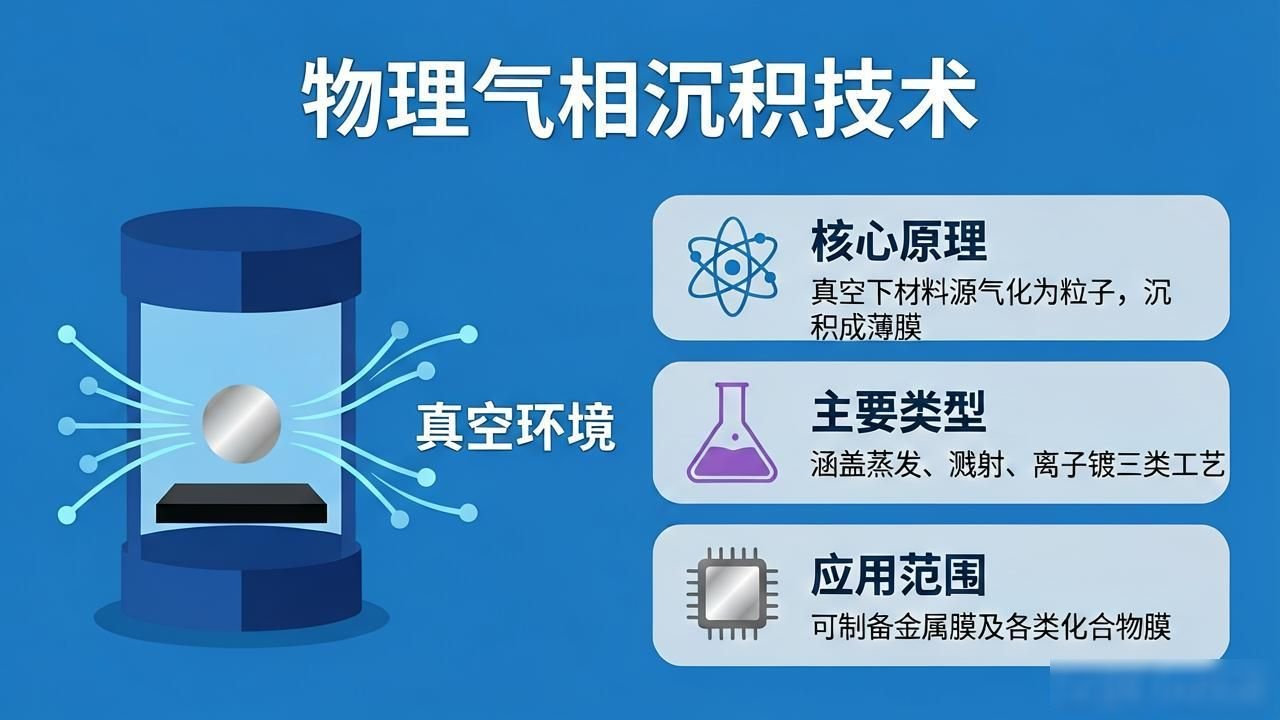
It is a technique that operates under vacuum conditions using physical methods, whereby the surface of a material source—be it a solid or a liquid—is vaporised into gaseous atoms and molecules, or partially ionised, and then transported to the surface of a substrate to form a solid-phase thin film; this is known as physical vapour deposition (PVD). Physical vapour deposition technology primarily encompasses evaporation, sputtering and ion plating, and is capable of producing both metallic and compound films.
In physical vapour deposition (PVD) techniques, sputtering and ion plating are two common methods; each has its own advantages. Ion plating offers benefits such as good toughness, high ion energy and high bond strength; however, the films produced by this method are prone to defects such as melt droplets; Not to mention that the benefits of sputtering include low operating temperatures, controllable film composition, minimal material deformation and a wide range of available target materials; the only drawback being that the deposition rate is relatively slow; Xi Yuntao and colleagues employed magnetron sputtering and ion plating to deposit TiN films onto the surface of TC4 titanium alloy and compared their friction and wear properties. They also compared these friction and wear properties and analysed the results. The results showed that both the multi-arc ion plating TiN coating and the magnetron sputtering TiN coating improved the wear resistance of the TC4 titanium alloy surface; however, the coating obtained via the multi-arc ion plating method exhibited superior performance.
In summary, although surface wear-resistant modification techniques for individual titanium alloys can significantly improve the microhardness and wear resistance of these alloys, certain shortcomings are unavoidable. For example, the thickness of the implanted layer formed by ion implantation is too shallow, being limited to the micrometre range, which restricts its application; at the same time, there are certain limitations on the size of the test specimens. The bond strength between the chemical deposit and the substrate is low; the deposit is thin and prone to hydrogen embrittlement. The control of process parameters in laser cladding technology is relatively complex, and cracks and porosity are prone to form within the cladding layer. Thermal spraying technology is not suitable for substrates that cannot withstand high temperatures; furthermore, the resulting coatings exhibit low adhesion, high porosity and poor uniformity. Some of the composite technologies described below can further address the aforementioned shortcomings.
2. Wear-resistant composite treatment technology for titanium alloys
At present, driven by ever-growing industrial demand, composite coating technology is gradually replacing single-layer coating technology. Micro-arc oxidation, also known as micro-plasma oxidation, is a technique that utilises high voltage, high current and instantaneous high temperatures to produce ceramic layers with excellent metallurgical properties on the surfaces of light metals such as Al, Mg and Ti, as well as their corresponding alloys. The ceramic layer consists primarily of oxides grown in situ from the substrate, and components of the electrolyte are also incorporated into the micro-arc oxidation film. The electrical parameters of the micro-arc oxidation process—such as the solution formulation, voltage, current, duty cycle and pulse frequency—all have a significant impact on the formation and microstructure of the micro-arc oxidation film. This method is characterised by its safety, ease of operation and environmentally friendly solutions; at the same time, it offers numerous advantages over other treatment methods, including a uniform and dense coating, as well as few restrictions on workpiece dimensions.
Micro-arc oxidation coatings on titanium alloys are characterised by high hardness and strong adhesion to the substrate; they are also corrosion-resistant and wear-resistant. However, the surface of the coating is rather rough and porous, and the coefficient of friction is relatively high. Consequently, this reduces the coating’s wear resistance, thereby shortening the service life of the oxide coating, which is detrimental to the application of titanium alloys in wear-prone environments. Currently, several research institutes within the Russian Academy of Sciences have undertaken extensive work to address these shortcomings in titanium alloy micro-arc oxidation coatings, whilst interest in this issue within China is only just beginning to emerge. This paper focuses on introducing relevant composite treatment technologies based on micro-arc oxidation, combined with sealing methods, aluminium plating, pulsed electron beam deposition, hydrothermal processing and electrophoretic deposition.
2.1 Micro-arc oxidation + sealing method
As the surface of micro-arc-oxidised titanium alloy coatings is loose and porous, some researchers have attempted to use physical, chemical or electrochemical methods to fill the pores of these coatings with lubricating substances, thereby achieving self-lubrication. Among these, polytetrafluoroethylene (PTFE) possesses excellent thermal stability and outstanding chemical stability in a wide range of environments, making it an ideal material for achieving self-lubrication.
Zhao Hui and colleagues filled the pores of a titanium alloy micro-arc oxidation coating with PTFE particles and subjected it to a curing treatment to prepare a PTFE composite self-lubricating coating. Following pore sealing, observations using a scanning electron microscope (SEM) revealed a significant reduction in the number of pores in the composite coating, and the surface topography became smoother. In the subsequent friction and wear tests, the coefficient of friction for the micro-arc oxidation coating was approximately 0.4, whereas that of the sealed composite coating was merely 0.15. Du Nan et al. added trace amounts of Cr₂O₃ particles to the micro-arc oxidation electrolyte; through the sealing method, they also achieved an improvement in the wear resistance of the titanium alloy micro-arc oxidation composite coating. Currently, the sealing agents used in the sealing method are mostly insulating organic compounds; consequently, there are considerable limitations regarding their applicability to conductive materials. At the same time, when using the sealing method to treat parts with complex structures or large dimensions, the process is time-consuming, and it is difficult to ensure thorough coverage.
2.2 Micro-arc oxidation + hydrothermal method
The hydrothermal method involves placing a reaction medium in a sealed vessel and continuously heating the vessel using a heat source to create high-temperature, high-pressure conditions inside. Under these conditions, sparingly soluble or insoluble substances dissolve and subsequently recrystallise. et al. investigated the wear resistance of a composite modified coating on TC4 titanium alloy produced by combining micro-arc oxidation and hydrothermal technology. Compared with the micro-arc oxidation-treated coating, the composite coating consists of a TiO₂ layer containing hydroxyapatite. When friction was applied under a load of 1 N at a speed of 6.5 cm/s, the composite treatment reduced the coefficient of friction of the coating from 0.6 to 0.4 and the wear rate from 0.25 to 0.18, significantly enhancing the coating’s wear resistance. However, the wear resistance of this composite coating diminishes under high loads, rendering it unsuitable for applications involving high-load conditions.
2.3 Micro-arc oxidation + pulsed electron beam
Pulsed electron beam (HCPEB) surface treatment technology utilises high-speed electrons as the carrier to apply incident energy to the material surface within an extremely short time, thereby triggering a series of phenomena, This series of phenomena encompasses melting, condensation, vaporisation, strengthening and diffusion, amongst others, thereby achieving physical, chemical and mechanical properties that are difficult to attain through other heat treatment methods. The preparation of a composite modified layer involves applying the HCPEB method to a micro-arc oxidation (MAO) coating on a titanium alloy; this falls within the scope of coating remelting, that is, a micro-arc oxidation coating is first prepared, followed by the application of HCPEB to the oxide film and subsequent electron beam remelting. These operations improve the uniformity and density of the coating, refine its grain structure, enhance the bond strength between the coating and the substrate, and endow the coating with properties such as wear resistance and corrosion resistance.
Du Chunyan applied the HCPEB method to treat micro-arc oxidation coatings on titanium alloys. SEM observations revealed that, following treatment, the characteristic pores and particles in the micro-arc oxidation coating had clearly disappeared; the hardness reached a maximum of 1695 HV, and signs of abrasive wear were reduced. However, both the surface and cross-section of the composite coating exhibited some cracking, which consequently led to a reduction in the coating’s bond strength. At the same time, the HCPEB method imposes relatively high requirements on the surface roughness of the micro-arc oxidation coating. At present, there are few examples of combining HCPEB with MAO, and relevant research is also scarce.
2.4 Micro-arc oxidation + aluminium plating
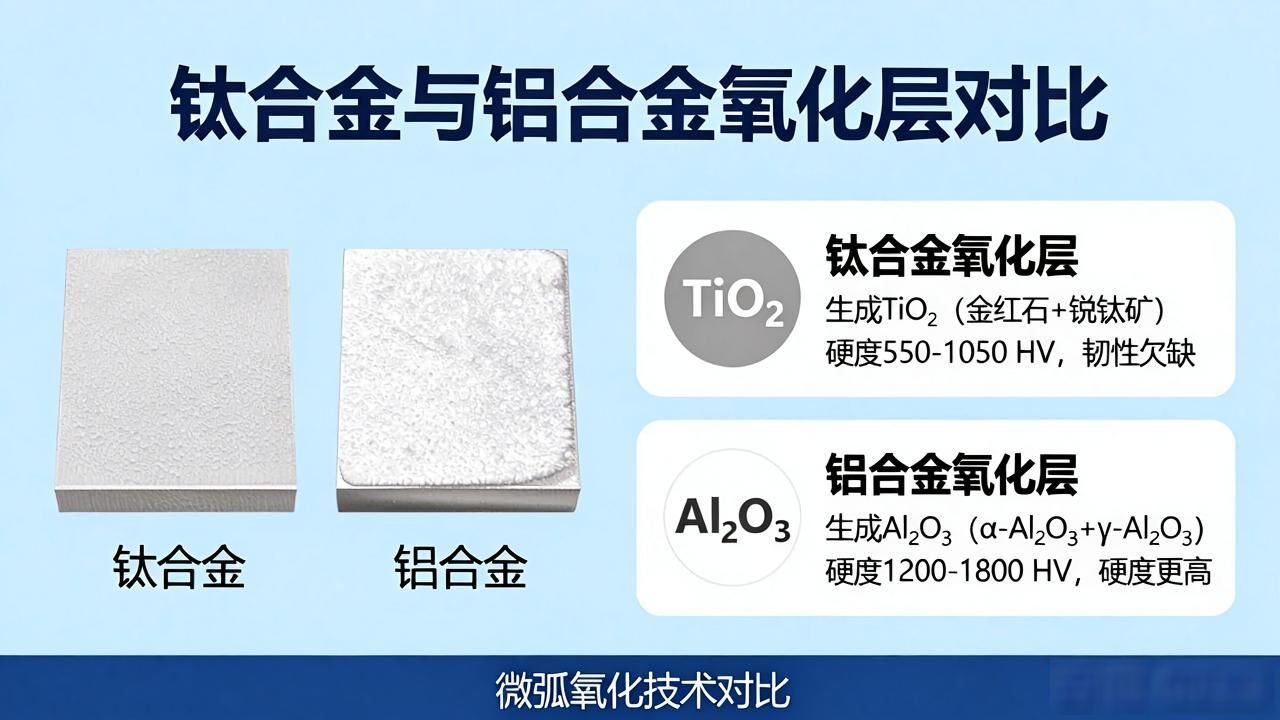
Titanium alloys and aluminium alloys, whilst both being valve metals characterised by low density and high specific strength, are used in numerous similar fields and account for a significant proportion of applications within the valve metal sector; whilst the two share a considerable number of similar properties, the oxide layers formed on them following micro-arc oxidation treatment exhibit markedly different characteristics. The oxide films formed on titanium alloys via micro-arc oxidation consist primarily of TiO₂ (in the rutile and anatase forms); whereas the main products of micro-arc oxidation on aluminium alloys are Al₂O₃ (in the α-Al₂O₃ and γ-Al₂O₃ forms). The hardness of Al₂O₃ falls within the range of 1,200 to 1,800 HV, which is significantly higher than that of TiO₂, the hardness of which ranges from 550 to 1,050 HV; At the same time, TiO₂ lacks sufficient toughness, whereas γ-Al₂O₃ possesses high structural integrity and toughness. Consequently, in terms of hardness and wear resistance, micro-arc oxidation coatings on titanium alloys are inferior to those on aluminium alloys.
If aluminium plating technology and micro-arc oxidation technology could be combined in an appropriate manner to produce a composite coating, thereby fully utilising and maximising the respective advantages of both technologies, this would significantly improve the wear and corrosion resistance properties inherent in titanium alloys following micro-arc oxidation. At the same time, this would broaden the scope for the future application of titanium alloys in the aerospace sector.
Aluminium-coated layers possess excellent properties; their preparation methods are diverse; they offer considerable economic benefits; and as aluminium is an extremely abundant raw material, they have consistently remained a focal point of research into coating modification technologies. At present, there is a wide variety of aluminium plating methods applied to the surfaces of micro-arc-oxidised titanium alloy films. Common aluminium plating techniques combined with micro-arc oxidation primarily include hot-dip plating, multi-arc ion plating and magnetron sputtering.
2.4.1 Micro-arc oxidation + magnetron sputtering aluminium coating
Ouyang Xiaoqin and colleagues were the first to carry out aluminium sputtering on the surface of TC4 titanium alloy; the duration of the aluminium sputtering process was set at 2.5 hours. Following completion of the aluminium sputtering, the coating underwent micro-arc oxidation treatment, The micro-arc oxidation treatment lasted 30 minutes, with the current density set at 5 A/dm² during the process. A comparison was made of the mechanical properties of the micro-arc oxidation film on the TC4 substrate and that on the sputtered aluminium-coated substrate. The results indicate that: The hardness of the TC4 titanium alloy is typically around 360 HV; following micro-arc oxidation, the hardness of the titanium alloy has reached 1.69 times that of the base titanium alloy, however, the surface hardness of the composite coating formed by micro-arc oxidation has increased to over 1,700 HV; at the same time, the coefficient of friction has also changed, with the original value of 0.38 now reduced to 0.25. Furthermore, adhesion analysis indicates that when the coating undergoes MSD/MAO composite treatment, its bond strength is superior to that of a single-layer titanium alloy micro-arc oxidation coating.
2.4.2 Micro-arc oxidation + hot-dip aluminium plating
During hot-dip aluminium plating on a titanium alloy surface, a series of reactions occur at the surface of the titanium alloy substrate within the molten aluminium bath, involving the diffusion of liquid aluminium into the titanium alloy substrate and interactions between the two. Following high-temperature thermal diffusion treatment, a titanium-aluminium alloy layer with high hardness and high-temperature resistance is formed on the metal surface. If combined with micro-arc oxidation technology to produce a multi-layered composite film on the surface of the titanium alloy, the presence of a transition zone will greatly improve the film’s adhesion, and the overall performance of the coating will also be significantly enhanced.
Hu et al. subjected pure titanium, which had undergone hot-dip aluminium plating for 2 minutes, to micro-arc oxidation treatment, with the current density varying as follows: 10 A/dm² in the forward direction and 5 A/dm² in the reverse direction, with treatment times of 10, 20, 30 and 40 minutes respectively. The resulting coating exhibited a distinct layered structure, with the outer layer being loose and porous, whilst the inner layer was compact and dense. As the micro-arc oxidation time increased, the thickness of the oxide layer continued to grow, whilst the surface roughness remained between 1.0 and 1.2; At 30 minutes, the composite coating’s roughness was approximately 1.1, the surface microhardness reached 750 HV, the coefficient of friction was approximately 0.2, and the wear rate was 0.39; At 40 minutes, the highest coating hardness and optimal wear resistance were achieved, with an average hardness of 820 HV, a coefficient of friction of approximately 0.3, and a wear rate of merely 0.29 × 10⁻⁴. Wu Yuan utilised hot-dip aluminium plating technology to deposit a layer of titanium-aluminium intermetallic compound on the surface of TC4 titanium alloy, followed by micro-arc oxidation treatment, thereby achieving a gradient composite structure comprising the substrate, TiAl₃ alloy and ceramic film; Following a full 40 minutes of micro-arc oxidation treatment, the surface microhardness reached 980 HV, approximately four times that of the substrate; Under test conditions with a load of 50 N and a rotational speed of 60 r/min, the wear rate of the composite film was merely one-quarter that of the substrate, whilst the average coefficient of friction decreased from 0.45 for the substrate to 0.25.
Today, the hot-dip aluminium plating process is well established; however, it still suffers from drawbacks such as high costs and environmental pollution. Furthermore, due to the poor fluidity of the plating bath, it is difficult for the plating solution to fully penetrate workpieces with complex geometries. With the continuous development of aluminium diffusion technology, a number of novel aluminium diffusion methods—such as electrophoretic diffusion spraying, vacuum liquid-phase aluminium diffusion, thermal spray diffusion aluminium diffusion and vacuum evaporation—are gradually beginning to replace the hot-dip aluminium plating process and are now being put into practice.
2.4.3 Micro-arc oxidation + multi-arc ion plating of aluminium
Ion plating technologies include multi-arc ion plating, which is widely used in the field of cutting tools and has yielded numerous successful applications. This method enables rapid coating deposition, produces highly dense coatings, and ensures strong adhesion between the coating and the substrate, thereby significantly enhancing the coating’s bond strength. Combining micro-arc oxidation with multi-arc ion plating can enhance the wear resistance of composite coatings.
On the surface of TC4 titanium alloy, Bu Tong et al. first carried out multi-arc ion plating of aluminium, followed by micro-arc oxidation, and investigated various aluminium plating processes, examining their impact on the wear and corrosion resistance of the composite oxide film. The processes were primarily centred on treatment temperatures of 25 °C and 250 °C, and substrate bias voltages of –200 V and –300 V. Under these conditions, the duration of the multi-arc ion plating was 20 minutes, whilst the micro-arc oxidation treatment was carried out at a current density of 6 A/dm². The results of the study indicate that if the negative bias voltage is increased and the treatment temperature is raised, both factors can enhance the coating’s performance. Consequently, under conditions of 250 °C and –300 V, the micro-arc-oxidised film exhibited the most outstanding wear and corrosion resistance, with a coefficient of friction of 0.801 and a volume of friction wear of merely 0.042 m³; In the droplet test, discolouration did not occur until 34.47 minutes had elapsed. At present, the combined modification technology of multi-arc ion aluminium deposition and micro-arc oxidation is not yet fully mature, but it does offer certain technical advantages in terms of wear resistance modification. As the composite treatment process continues to be optimised, the wear resistance of titanium alloy surfaces will continue to improve.
3. Summary and Outlook
(1) Among the surface treatment techniques used to enhance the wear resistance of titanium alloys, micro-arc oxidation offers a number of advantages, including a relatively low processing temperature, a relatively simple equipment configuration, and environmentally friendly solutions; the resulting coating is uniform and dense, and there are few restrictions on the dimensions and shape of the workpiece; consequently, it offers significant technical advantages.
(2) If micro-arc oxidation is combined with other techniques, this can improve the properties of the coating produced by micro-arc oxidation alone, both in terms of wear resistance and corrosion resistance. Therefore, hybrid techniques represent a future direction for the development of wear-resistant technologies for titanium alloys.
 Chinese
  Japanese
  English
  German
  Finnish
Leave a Reply
You must be logged in to post a comment.