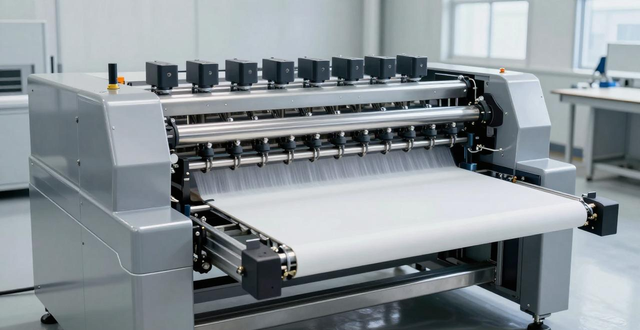


Widely used in textiles, plastics, rubber and other industries is the heat-setting machine, its main role is to carry out the material with the help of heating and cooling process, cooling process is a key link in the heat-setting process, which will directly affect the product quality and production efficiency, in order to reach an effective cooling, heat-setting machine is often used in a variety of cooling technologies and strategies, the following will be a detailed discussion of the heat-setting machine how to Effective cooling.
-
1. Choice of cooling method
The cooling method of the heat sizing machine is mainly divided into natural cooling and forced cooling, natural cooling depends on the ambient temperature, the cooling speed is slow, suitable for the cooling speed is not high requirements of the scene, and forced cooling with the introduction of external cooling medium (like air, water or cold air) to speed up the cooling process, suitable for the rate of production.
1.1 Natural cooling
There is a passive form of cooling called natural cooling, it is mainly through the ambient temperature and air convection to reach the cooling, the advantage of this method is simple equipment, low energy consumption, but the cooling rate is slow, very easy to cause the production efficiency is not high, so the natural cooling is generally used in the cooling rate does not require a high number of low production cases.
1.2 Forced cooling
Forced cooling is achieved by actively lowering the temperature of the material by external equipment (e.g. fans, cooling rollers, water cooling systems, etc.). This method of cooling is fast, increases productivity and is suitable for mass production. The choice of cooling medium and method for forced cooling can be tailored to the specific requirements.
-
2. Selection of cooling medium
The choice of cooling medium plays a crucial role in the cooling effect. Air, water and cold air are commonly used as cooling media.
2.1 Air cooling
Air cooling is one of the more common cooling methods used, whereby cool air is blown towards the surface of the material with the help of a fan or blower to achieve rapid cooling. The advantages of air cooling are that the equipment is simple and inexpensive, and can be used in most situations. However, air cooling has a relatively slow cooling rate and is easily affected by ambient temperature.
2.2 Water cooling
Water cooling is achieved by immersing the material in cooling water or spraying it with cooling water to achieve rapid cooling. The cooling rate of water cooling is much higher than that of air cooling, and is suitable for situations where a high cooling rate is required. However, water cooling requires additional water treatment equipment and may have adverse effects on certain materials, such as deformation or contamination.
2.3 Cold air cooling
Cold air cooling, which has the advantages of air cooling and water cooling, is achieved by blowing cold air treated with refrigeration equipment onto the surface of the material, and it cools quickly without contaminating the material, making it suitable for production scenarios that combine high precision with high efficiency.
-
3. Design of cooling equipment
The cooling equipment of a heat setting machine has to be carefully designed to achieve effective cooling, which includes cooling rollers, cooling chambers and air ducts.
3.1 Cooling rollers
Cooling rollers used in heat-setting machines are commonly used as cooling devices to reduce the temperature of the roll surface with the help of internally recycled cooling water or cold air to achieve rapid cooling of the material, but the design of the cooling rollers has to take into account the degree of uniformity of the temperature of the roll surface as well as the efficiency of the cooling.
3.2 Cooling chamber
Cooling chambers are enclosed spaces in which the material is cooled by cold air or cold wind, and the design of the chambers takes into account the uniformity of the air flow and the controllability of the cooling rate.
3.3 Air duct design
Air duct design, the cooling effect has a direct impact on the reasonable air duct design, can ensure that the cold air blowing uniformly on the surface of the material, to avoid uneven cooling caused by deformation or quality problems.
-
4. Control of the cooling process
Control of the cooling process is central to effective cooling. By controlling the cooling temperature, as well as the cooling time and the cooling rate, the quality of the material and the production efficiency are ensured.
4.1 Temperature control
The cooling temperature must be controlled in accordance with the material properties and process requirements. If the cooling temperature is too high, the material may not be completely shaped; if the cooling temperature is too low, the material may become brittle or deformed.
4.2 Time control
The cooling time is adjusted according to the thickness of the material, the cooling medium and the cooling speed. If the cooling time is too short, the internal temperature of the material may not be balanced, and if the cooling time is too long, the productivity may be reduced.
4.3 Speed control
The cooling rate has to be optimised according to the characteristics of the material and the requirements of the process. If the cooling rate is too fast, there is a risk of stress concentration in the material; if the cooling rate is too slow, it will probably have an impact on productivity.
-
5. Optimisation of cooling effects
To achieve the cooling effect, the following optimisation measures can be taken:
5.1 Improvement of the homogeneity of the cooling medium
![图片[1]-热定型机如何实现有效冷却?-大连富泓机械有限公司](/wp-content/uploads/2026/02/1771669461485_1.png)
Optimising the design of the cooling equipment ensures that the cooling medium, such as air or water, acts uniformly on the surface of the material and prevents localised overheating or overcooling.
5.2 Reduction of material deformation
During the cooling process, the material may be deformed due to temperature changes. Optimisation of the cooling process and the design of the equipment reduces material distortion and improves product quality.
5.3 Reduced energy consumption
In general, cooling processes are often energy-intensive. Through the use of cooling devices (such as heat exchangers) and the optimisation of the cooling process, it is possible to reduce energy consumption and thus increase productivity.
-
6. Maintenance of the cooling system
Maintenance of the cooling system plays a crucial role in ensuring the cooling effect. Cooling equipment (such as cooling rollers, fans and water-cooled systems) needs to be checked and maintained regularly, otherwise equipment failure can occur, leading to a reduction in cooling effectiveness.
6.1 Cleaning of cooling equipment
Some cooling equipment, such as cooling rollers and air ducts, can easily accumulate dust and impurities that can affect the cooling effect. Regular cleaning of the cooling equipment ensures that the cooling medium has fluidity and that cooling efficiency is maintained.
6.2 Checking the cooling medium
The quality of the cooling media, such as water and cold air, has a direct impact on the cooling effect. Checking the temperature, flow rate and cleanliness of the cooling medium at regular intervals will help to ensure that the cooling effect remains stable.
6.3 Maintenance of cooling equipment
Cooling equipment fitted with fans and cooling rollers must be maintained regularly to ensure that it operates correctly, and that the wear and tear of the equipment and its operation are regularly checked to prevent malfunctions and a reduction in the cooling effect.
-
7. Summary
Ensuring effective cooling of the heat sizing machine is the key to achieving high quality and high efficiency production. Specifically, the cooling effect can be guaranteed by selecting the appropriate cooling method, optimising the design of cooling equipment, controlling the cooling process and regularly maintaining the cooling system. In the actual production operation, according to the characteristics of the material and process requirements, flexible to adjust the cooling strategy, and thus achieve the cooling effect.



 Chinese
  Japanese
  English
  German
  Finnish
No comments