
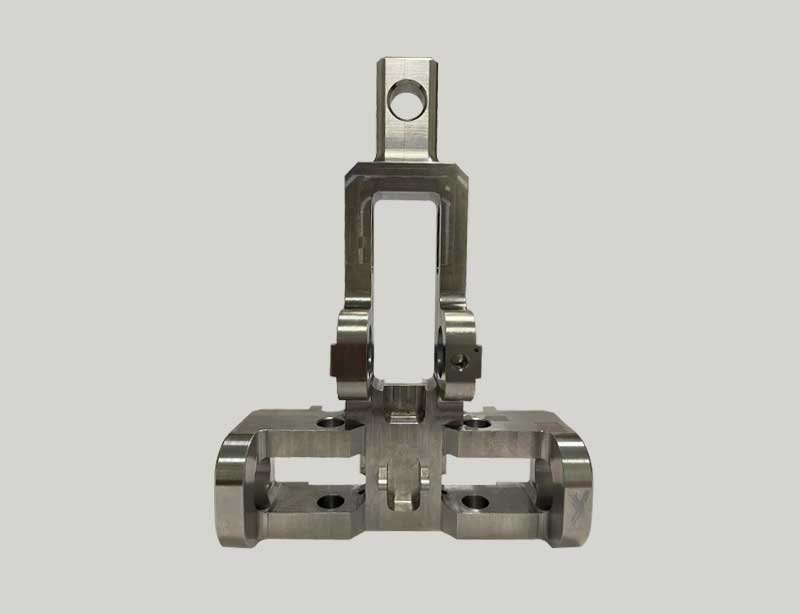

what is calledNon-standard parts processingThis is for customer-specific needs to carry out customised production of parts processing process, such parts generally have complex geometry, with special material requirements, or the existence of unique performance requirements, so its processing technology requirements are quite high, need to rely on a variety of equipment and technology to support, the following is to support the non-standard parts machining process technology required for the main equipment and its role:
1. CNC machine tools(CNC machine)
The core equipment used for non-standard parts processing is CNC machine tools, which is controlled by the computer programme of the tool movement to achieve high precision and high efficiency of the processing, and its variety of CNC lathes, CNC milling machines, CNC grinding machines, CNC drilling machines, etc., to meet the needs of different shapes and sizes of non-standard parts processing.
Can be used for cutting and other situations, under the control of the CNC system, the basic operation of the tool, including feed and speed, etc., have a normative role, and ultimately achieve the perfect processing of complex shapes and internal fine structure of these more special and difficult parts, CNC lathe is suitable for those with rotationally symmetrical characteristics of the parts, such as shafts, discs and other parts.
The type of CNC milling machine that is suitable for machining flat surfaces is also suitable for machining curved surfaces, as well as for machining slots, and for machining parts with complex geometries, such as holes. Multi-axis CNC milling machines, such as five-axis milling machines, can achieve more complex spatial surface machining.
This is a machine for machining high-precision surfaces, such as precision bearings and moulds, and is capable of achieving not only micron-level machining accuracy, but also the surface finish and dimensional accuracy required to meet high demands.
2. EDMEquipment (EDM)
A processing method that removes material by means of the principle of galvanic corrosion is EDM, which is suitable for the processing of highly complex shaped parts or high hardness materials, and the EDM processing equipment mainly covers EDM wire cutting machines and EDM moulding machines.
EDM wire cutters used to cut out complex shaped parts have a set of devices designed specifically to achieve their function device is to use the discharge corrosion between the wire electrode and the workpiece, this set of devices is suitable for processing hard-to-machine materials such as carbide, hardened steel to complete the cutting.
EDM machine, with the help of discharge corrosion between the electrode and the workpiece, to process the same shape as the electrode of the cavity or surface, it is suitable for mould manufacturing, but also for the processing of complex internal cavities.
3. laser processingappliances
There is a non-contact processing method called laser processing, which is suitable for cutting, punching, welding and surface treatment with high accuracy and efficiency. Laser processing equipment includes laser cutting machines, laser marking machines, and laser welding machines.
- Laser cutting machine: with the help of high-energy laser beam to cut materials, it is suitable for metal, plastics, ceramics and other precision processing of these materials, laser cutting has a fast cutting speed, small heat-affected zone, smooth kerf and many other advantages.
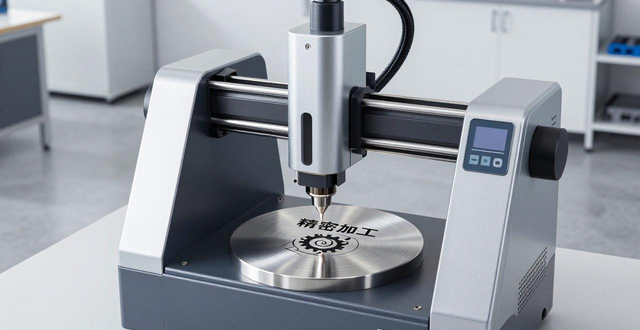
Laser marking machines are used to permanently mark the surface of parts with text, patterns, and 2D codes. Laser marking has the characteristics of high precision, high speed, and no pollution.
Laser welding machines, which can be used for welding, are suitable for high-precision welding work and are capable of high-quality welding operations, especially for welding of thin-walled parts, and also especially for welding of precision parts.
4. 3D printingEquipment (additive manufacturing equipment)
3D printing technology is a processing method for manufacturing parts, which is achieved by stacking materials layer by layer, and is suitable for rapid prototyping of complex shaped parts as well as small batch production.3D printing equipment includes metal 3D printers, plastic 3D printers and so on.
Metal 3D printers, with the help of lasers or electron beams, melt metal powders and then build them up layer by layer to create metal parts, which are suitable for high-performance and complex parts manufacturing, such as aerospace and medical devices.
Plastic 3D printers that produce plastic parts, with the help of technologies such as fused deposition moulding, also known as FDM, or light-curing moulding, also known as SLA, are suitable for prototyping, as well as for functional testing, and also for small batch production.
5. Precision measuring equipment
The key tool to ensure the accuracy and quality of non-standard parts processing is precision measuring equipment, commonly used precision measuring equipment contains coordinate measuring machine (CMM), has an optical measuring instrument, with surface roughness meter and so on.
Coordinate Measuring Machines, or CMMs, are used to measure three-dimensional geometric dimensions and shape errors of a part by using a probe to contact the surface of the workpiece.CMMs are characterised by high accuracy and efficiency, and are suitable for dimensional inspection of complex parts.
A non-contact measuring instrument that uses optical principles to carry out measurements is called an optical measuring instrument, which is suitable for the measurement of small parts and high-precision surfaces, and has the advantages of fast measurement speed and high accuracy.
A tool that can be used to measure the surface roughness of a part to ensure that the surface quality of the part meets the requirements of the design, this tool is called a surface roughness gauge.
6. Heat treatment equipment
The internal organisation of the material is altered by heating and cooling to improve the material's properties, a process known as heat treatment. Separately, heat treatment equipment includes quenching furnaces, tempering furnaces, annealing furnaces, vacuum heat treatment furnaces, and so on.
Hardening furnaces are used to improve the hardness and strength of materials by means of rapid cooling and are suitable for the treatment of materials such as tool steels and mould steels.
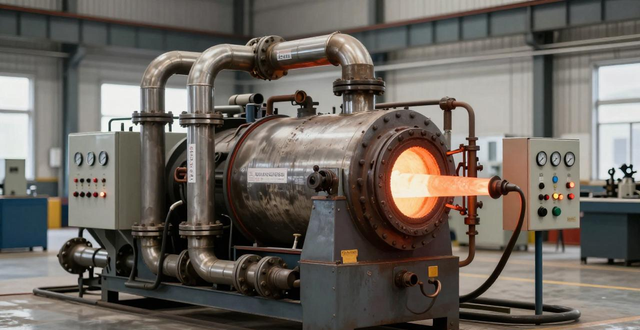
Tempering furnaces are used to reduce the brittleness of materials by heating them and then holding them in order to increase their toughness and improve their stability.
Vacuum heat treatment furnaces for heat treatment are devices that carry out this process in a vacuum environment to avoid oxidisation and decarburisation of the surface of the material, and are suitable for heat treatment of parts with high precision and performance requirements.
7. Surface treatment equipment
The process of improving the surface properties of parts through physical or chemical means is called surface treatment. Such as electroplating equipment, spraying equipment, polishing equipment, etc., these are commonly used surface treatment equipment.
Electroplating equipment that uses an electrochemical method to deposit a metal coating on the surface of a part to improve its corrosion resistance, wear resistance, and aesthetics.
Coating devices, which form a protective layer on the surface of a part by spraying paint or powder, improve the erosion resistance of the part, as well as its abrasion resistance and decorative qualities.
Polishing equipment that mechanically or chemically polishes the surface of a part to improve its finish and aesthetic properties.
8. Auxiliary equipment
Throughout the machining process, non-standard parts machining needs some auxiliary equipment to be supported, like tool grinding machines, such as fixtures, and cooling systems and so on.
A machine tool, called a tool grinder, which has the function of grinding the tool, but also of dressing the tool, ensuring that the sharpness and geometry of the tool meet the requirements of the process, is such a machine tool.
Fixtures, which are used to hold and position the workpiece, are designed to ensure stability and accuracy during the machining process.
The coolant system is specially used to cool the tool and the workpiece. It can prevent the high temperature during the machining process to avoid affecting the quality of machining, but also can not let the life of the tool is affected.
reach a verdict
First of all, non-standard parts processing technology is required is the support of a variety of equipment, which has a CNC machine tools, and EDM equipment, in addition to laser processing equipment, and then there is 3D printing equipment, and then precision measuring equipment, followed by heat treatment equipment, followed by surface treatment equipment, as well as auxiliary equipment. Each of these equipment to perform their duties, together to ensure that non-standard parts can achieve high precision, high quality and high efficiency processing. As technology continues to progress, non-standard parts processing equipment is also continuing to upgrade, which gives more possibilities for the manufacture of complex parts.
 Chinese
  Japanese
  English
  German
  Finnish
Leave a Reply
You must be logged in to post a comment.