
After obtaining the canonical equations (3 - 35), it was then possible to investigate the generation of grinding chatter by means of a discussion of the amplitude B(T1, T2). Polar coordinate transformations were introduced:
Substituting equation (3 - 36) into equation (3 - 35) and separating its real and imaginary parts can give.
where α is equal to α(T1, T2), β is equal to β(T1, T2), and Re(-) and Im(-) denote the real and imaginary parts of -, respectively.
According to equation (3 - 24), α and β in equation (3 - 37) represent the amplitude and frequency correction terms of the approximate solution of the quivering motion, respectively, and it is obvious that there are two different steady state solutions for α in equation (3 - 37).
They represent grinding stability and grinding chatter, respectively.
Next, after a discussion of the stability of the solutions of α, we are able to derive the stability of the quivering motion.
Simply put, when

At that time, the lifting of α1 is in a steady state, a state that corresponds to the steady grinding process explored in the previous chapter, at which time there is no chattering motion generated. However when.
At that time, this grinding process begins to lose its steady state and chatter ensues, at which point the amplitude α gradually increases. If it appears again.
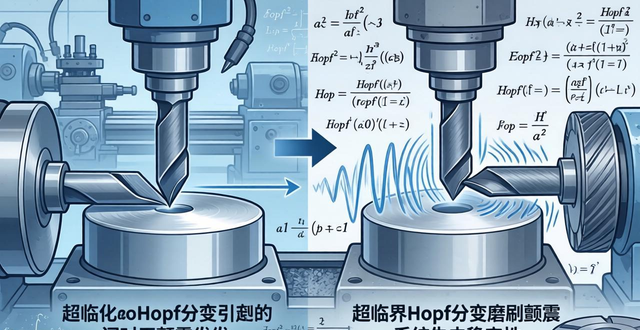
Then, α will stabilise at α2, which is the amplitude of the periodic chirp and is said to be where the supercritical Hopf bifurcation occurs.
Next, this style of vibrational motion is illustrated by several examples, such as zooming in on regions I and II in Fig. 2-7, which are plotted in Fig. 3-1. In addition, arrows A, B, and C are labelled in Figure 3-1 to facilitate subsequent analysis.
()
Figure 3-1 Magnified stability boundaries and arrow markings
Arrow A, where κ1 is equal to 0.9, τg is 14, τwc is 16.732, and ω is 1.678.
The pointing arrow is B, where the value of κ1 is 0.9, the value of τg is 11.6, the value of τwc is 17.638, and the value of ω is 1.048 5.
is represented by the arrow C, where κ1 is equal to 0.9, the value of τg is 11.6, τwc is 18.391, and ω is equal to 1.531.
Along the arrows in Fig. 3-1, for the case where εκ1ε is equal to 0 in equation (3-9), the system parameters slide towards the unstable region from the stable region, and the grinding process accordingly changes from steady grinding to chattering motion. Corresponding to the arrows A, B and C, the solutions we obtain with the help of equation (3 - 37) for the steady chattering motion are, respectively.
Since the arrows A, B, and C correspond to cases of crossing different stability boundaries, they induce different flutter modes. According to equations (3-39), (3-40) and (3-41), the frequencies and amplitudes of these different flutter modes are very different. For example, the amplitude of the vibrational oscillations corresponding to arrow A is about ten times the amplitude of the vibrational oscillations corresponding to arrow B. Another interesting result is that the larger amplitude vibrations in equations (3-39), (3-40), and (3-41) correspond to higher vibration frequencies. In terms of physics, high amplitude corresponds to high energy, and in this case, high frequency corresponds to high energy, so it can be seen that the vibration energy possessed by these different periodic vibrations varies a lot, so the selection of parameters in the grinding process is also a very important period for reducing the intensity of vibratory motion.
The original equations were integrated numerically to verify the previously obtained theoretical results, and then the numerical and theoretical results were compared, all of which are plotted in Figure 3-2. In particular, Figures 3-2(a), (b), and (c) correspond to the bifurcation diagrams with arrows A, B, and C. This bifurcation diagram reflects the relationship between the amplitude of the chirp, y1max, and the parameter, τw. Figures 3-2(d), (e), and (f) show the time series of possible flutter oscillations in the system, which correspond to three different points in the bifurcation diagram, while Figures 3-2(g), (h), and (i) show the phase diagrams corresponding to the time series. This figure shows that the results of the theoretical analyses are in fairly good agreement with the results of the numerical integration. In addition, the phase diagrams 3-2 (g), (h) and (i) show that the grinding wheel and workpiece displacements are in relative motion when chatter occurs, which is similar to a kind of anti-synchronous motion. This means that the relative positions y1 - y2 of the grinding wheel and the workpiece change considerably during chatter, and consequently, the depth of grind and the cutting force change in magnitude are also relatively large.
Figure 3 - 2 presents the bifurcation diagram, in the left column, as well as the time course diagram, in the middle column, and the phase diagram, in the right column, where the solid lines represent the theoretical results, which are represented by equations (3 - 39), (3 - 40), and (3 - 41) and the dots represent the results of numerical integration.
 Chinese
  Japanese
  English
  German
  Finnish
Leave a Reply
You must be logged in to post a comment.