
What is it?machining? An Introduction to Basic Concepts and Common Processes
Machining is a manufacturing process that involves the use of machinery to remove material in order to produce parts or products with specific shapes, dimensions and surface finishes; it is an extremely important processing method in modern industrial production. This process is not only widely used in the manufacturing sector, but also extends to many other fields such as aerospace, automotive manufacturing and precision instrumentation. The core objective of the machining industry is to utilise a variety of different machining processes to produce precision parts that meet the required specifications.
Basic Concepts of Machining
Machining is a process that involves using various machine tools to physically process raw materials such as metals and plastics, thereby removing or altering the material’s shape, size and surface finish to meet design specifications. A key characteristic of this process is that it utilises mechanical force to convert the relative motion between the cutting tool and the workpiece into an operation that removes material. Common machining methods include turning, milling, drilling and grinding.
Compared with traditional manual machining, machine machining offers greater precision and efficiency; particularly in high-volume production, its efficiency and consistency are particularly notable. Machine machining is widely used in numerous industries, including the automotive, electronics, aerospace and mould-making sectors.
Common machining processes
Depending on the specific methods used, machining processes can be divided into several broad categories. The following are some of the most common ones:
1. Turning
The process of removing material from the surface of a workpiece through the relative movement of the lathe and the cutting tool is known as turning. It is typically used for machining cylindrical workpieces and can produce surfaces of various shapes, such as external cylinders, internal bores and threads. It is suitable for high-precision, high-volume production. The key to the turning process lies in selecting the appropriate cutting tool, cutting speed and feed rate to ensure the desired machining results.
2. Milling
Milling is a machining process that removes material through the relative movement between a rotating milling cutter and the workpiece. It can be used to machine a variety of complex shapes, including flat surfaces, grooves and gears. Milling machines can be classified into vertical and horizontal types. The choice of milling machine depends on the part’s shape and machining requirements. The milling process offers the advantage of high machining accuracy and is capable of machining complex geometric shapes.
3. Drilling
Drilling is a process in which a drill bit utilises rotational motion to create holes in a workpiece. Drilling is commonly used to produce through holes, as well as various other types of holes such as blind holes and countersunk holes. The drilling process has a wide range of applications, particularly in manufacturing processes, wherever precise hole positioning is required or the hole diameter needs to be increased.
4. Grinding

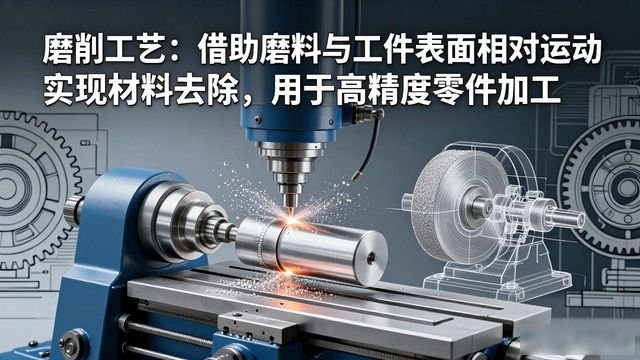
The process of removing material is known as grinding, which is achieved through the relative movement of the abrasive and the workpiece surface. It is generally used to meet requirements for high precision and fine surface finish. Grinding is commonly employed in the machining of precision parts, particularly where high surface finish and strict dimensional tolerances are required. Common grinding equipment includes surface grinders and external cylindrical grinders.
5. Electrical discharge machining
Electrical discharge machining is a process that utilises electrical energy—such as in electrical discharge machining (EDM) and electrochemical machining (ECM)—to remove material. Electrical discharge machining is primarily suitable for materials with high hardness or those that are brittle. It works by creating a high-temperature electrical discharge between the electrode and the workpiece, causing localised melting and thereby removing material. This process is particularly well-suited for the machining of parts requiring high precision and complex shapes.
6. Laser processing
Laser processing involves directing a laser beam onto the surface of a workpiece to heat a specific area. Once this area reaches a high temperature, the material melts or vaporises, thereby achieving the removal of material. Laser processing is suitable for non-contact machining and is characterised by high precision, high speed and high flexibility; it is widely used in numerous fields, including electronics and aerospace.
Key Technical Points in Machining
In the machining process, successfully completing the machining of a workpiece requires more than just precision instruments and advanced tools; it is also necessary to apply a number of technical principles. Below are several key technical principles in machining.
1. Tool Selection and Wear Control
The choice of cutting tools has a direct impact on machining results and product quality. High-quality cutting tools not only enhance machining precision and improve operational efficiency, but also extend service life, thereby reducing production costs. Tool wear is a common occurrence in machining; effectively managing wear can improve machining quality and production efficiency.
2. Optimisation of cutting parameters
Fine-tuning cutting parameters is key to improving the efficiency of the machining process and enhancing part quality. Careful selection of parameters such as cutting speed, feed rate and depth of cut can effectively reduce tool wear, improve surface finish and, at the same time, lower machining costs.
3. Machining accuracy and tolerance control
During the machining process, strict control must be exercised over the machining accuracy and tolerances of parts. With the aid of advanced machine tools, measuring instruments and machining techniques, it is possible to ensure that the dimensions and shape of parts meet design requirements. This is particularly important for products that demand a high degree of precision, such as those in the aerospace and precision instrument sectors.
Applications of machining
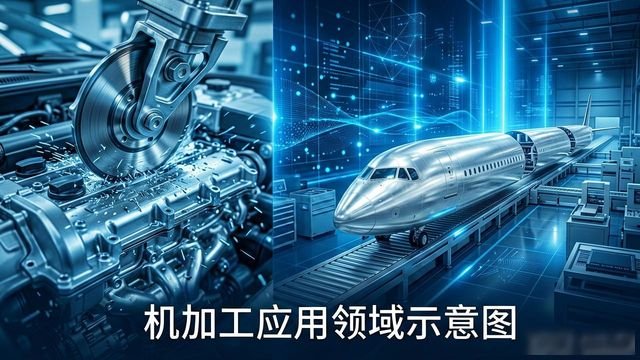
Machining is widely used across various industries; the following are its main areas of application:
1. The automotive industry
In the automotive industry, machining is used to produce engines, bodywork, chassis and various other components, such as braking systems. High-precision machining guarantees the performance of a vehicle and ensures its safety.
2. Aerospace
In the aerospace sector, the requirements regarding the precision and quality of components are extremely stringent. Machining technology has the capability to manufacture aircraft engines with precision, as well as to produce structural components for aircraft and other critical parts with the same level of accuracy.
3. Electronic equipment
In the manufacturing process of electronic devices, machining is used to produce precision components such as circuit boards, connectors and housings; the precision requirements for machining are generally extremely high, in order to ensure the stability and performance of the electronic devices.
4. Medical equipment
Medical devices such as surgical instruments, implants and diagnostic equipment must all be manufactured using precision machining processes to ensure their safety and effectiveness.
Summary
Machining, as a vital component of modern manufacturing, is widely applied across various industries, thereby driving technological progress and industrial development. The core objective of machining is to produce precision components that meet specific requirements through a variety of processes, including turning, milling, drilling and grinding. With continuous technological advancements, machining processes are becoming increasingly sophisticated and automated. Understanding and mastering the fundamental principles and practical techniques of machining not only enhances production efficiency but also contributes to improved product quality.
 Chinese
  Japanese
  English
  German
  Finnish
Leave a Reply
You must be logged in to post a comment.