
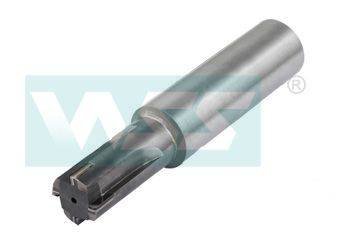
Nowadays, deep-hole machining has become increasingly complex and challenging. Parts often require additional features, such as extremely low surface roughness, complex internal chambers, bore diameters with steep and distinctive transitions, intricate contour shapes, specific slot profiles, threads with regular patterns or varied configurations, and bore orientations of diverse orientations—all of which constitute non-standard additional requirements. To efficiently produce such holes with extremely tight tolerances, it is not only necessary to possess extensive experience and sufficient R&D resources, but also to engage clients with strong capabilities, comprehensive application facilities and substantial resources, working together to achieve this goal.

Several methods for machining complex deep holesEfficient processingmethodologies
Deep Hole Machining (DHM)
Deep-hole machining is a field dominated by cutting tools specifically designed for existing applications. It is used across a wide range of industries, though it is most prevalent in the energy and aerospace sectors. Initially, certain features of deep-hole parts appeared impossible to achieve; however, bespoke tooling solutions devised by experts have not only resolved these process challenges but also ensured that operations proceed efficiently and flawlessly.
The growing demand for complex bores, coupled with the pressing need for shorter machining times, has driven the development of modern deep-hole drilling technology. For decades, deep-hole drilling has been an effective machining method utilising carbide tools; however, bottom boring has now begun to emerge as a bottleneck.
Today, success in this machining sector is often based on a combination of standard and specialised tool components, drawing on experience in the design of specialised deep-hole drilling tools. These tools feature extended, high-precision shanks with support, extended, high-precision shanks with integrated reamers, combined with innovative cutting edge grooves, combined with insert materials, combined with efficient coolant, combined with chip control, and, thanks to high penetration rates and process reliability, achieve the required high-quality results.
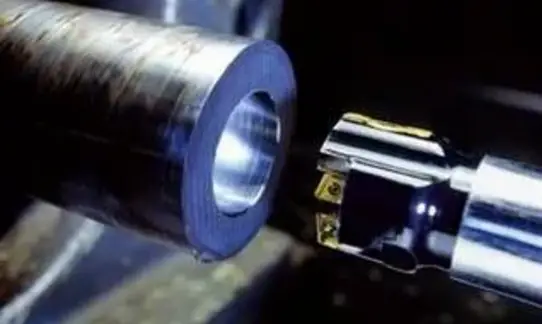
Several high-efficiency machining methods for complex deep-hole machining
Firstly, the workpiece shown in Figure 1, where deep drilling has been halted, requires further deep-hole drilling, followed by the machining of various complex features. Successful deep-hole drilling is generally achieved through a combination of specifications and standard tool elements, which are designed based on experience with non-standard tooling. This non-standard tool, based on the T-MAX 424.10 drill bit, forms part of a single-tube application.
When drilling deep holes, holes with diameters of less than 1 mm are typically machined using carbide gun drills; however, for holes of 15 mm and above, welded-tip drills are generally used, whilst for holes of 25 mm and above, indexable insert drills are employed to ensure efficient drilling. Modern indexable insert technology, along with drill rod systems, has also opened up new possibilities for specialised deep-hole drilling tools.
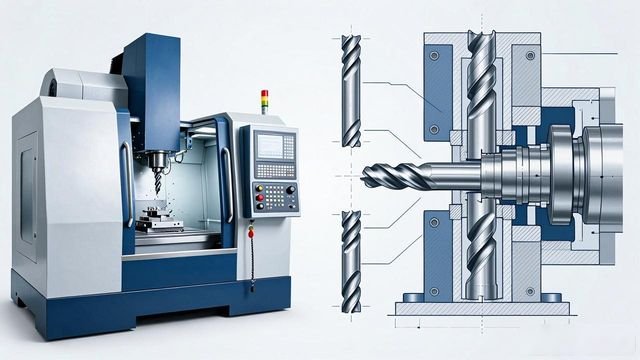
There is a situation where, when the depth of a hole exceeds ten times its diameter, the hole is generally considered to be very deep. In specific cases where the hole depth is as much as 300 times the diameter, specialised techniques are required to support the machining process, and single-tube or dual-tube systems may be employed for the drilling operation. Given the lengthy machining process required for the bottoms of these holes, specialised motion mechanisms, tool configurations and the correct cutting edges are essential to complete the machining of cavities, grooves, threads and recesses. Support plate technology is another key area within the field of deep-hole drilling, and has now become highly advanced as an integral part of deep-hole machining technology. This encompasses qualified tools suitable for this field, which are capable of delivering superior performance.
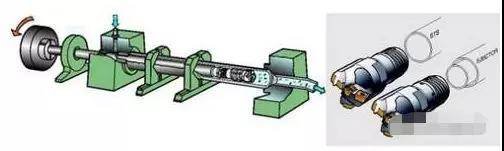
Several high-efficiency machining methods for complex deep-hole machining
In deep-hole drilling, carbide gun drills must be used for holes with small diameters of less than 1 mm; However, for holes of 15 mm and above, welded-edge drills are typically used for machining, whilst for holes of 25 mm and above, indexable insert drills are employed. These methods can be applied very effectively in both single-tube systems and dual-tube jet systems.
Craft opportunities
Modern manufacturing demands a deep-hole machining solution that is entirely different from deep-hole drilling. Deep-hole drilling typically requires a single-edge boring process on a separate machine tool; even on a multi-tasking machine, a dedicated fixture is required. For example, to machine a hole with a diameter of approximately 100 mm and a depth of several metres, one end of the hole must be threaded, whilst the diameter of the bore deep within the hole must be larger. Normally, once the drilling is complete, these features are added to the hole via a boring process after the part has been transferred to a lathe. Today, deep-hole machining combines the tool’s ability to perform subsequent operations without the constraints of machine tool adjustments. Conversely, this entirely new tool technology expands its operational capabilities, enabling these demanding features to be machined more effectively within a much tighter tolerance range.
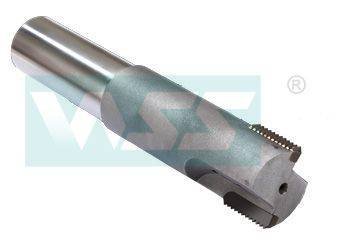
Several high-efficiency machining methods for complex deep-hole machining
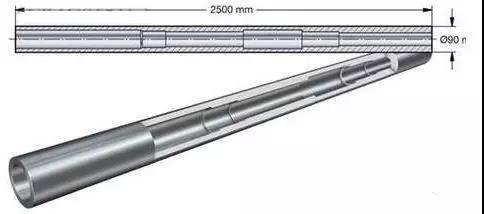
The oil exploration sector provides an example of the use of deep-hole machining technology to carry out high-efficiency feature machining. These components are approximately 5.2 metres in length, feature complex geometries and have extremely tight tolerances. To achieve these tight tolerances and an excellent surface finish, the tooling solution initially involved drilling a 90-millimetre diameter hole, followed by finishing with a floating reamer. At a depth of 1.5 metres, reaming is performed on a 115-millimetre-diameter hole; a partition is inserted approximately halfway into the hole, after which reaming is carried out again, and the process is completed with chamfering. Finally, boring operations are carried out, followed by reaming, to form two chamfered chambers, which are also reamed to the finished dimensions.
Universal deep-hole cutting tools, suitable for deep-hole machining centres worldwide, have delivered a bespoke solution for the power industry. Cutting time has been reduced from over 30 hours to 7.5 hours. Throughout the relatively complex bore, this bespoke tooling solution delivers the required tight tolerances and surface finish. The process involves deep-hole drilling, followed by finishing with a floating reamer. Once a depth of 1.5 metres is reached, reaming and boring cease for the 115 mm diameter hole. Subsequently, reaming continues on another, shorter section of the deep hole, and chamfers are formed. Finally, drilling and reaming operations were carried out to form two chamfered chambers (also reamed to finished dimensions).
In conventional machining, some of the work has to be carried out on the machine, which takes over 30 hours. However, with a deep-hole machining solution using specialised tools, the time required has been drastically reduced to 7.5 hours.
Several high-efficiency machining methods for complex deep-hole machining
Figure 3
Improved efficiency
In stark contrast to multi-operation clamping, the widespread use of deep-hole drilling technology can actually boost production efficiency. With cutting times reduced by 80 per cent, this comes as no surprise. A relevant example that demonstrates this capability is the use of proprietary technology in tool and insert design to maximise the safety of the cutting edge under load. By distributing the load across an optimal number of inserts and optimising the cutting action, higher penetration rates can be achieved, thereby reducing machining time. In terms of precision, tight tolerances are a hallmark of deep-hole drilling: 70 per cent of holes feature concentric inner diameters, with a typical tolerance of 0.2 millimetres and a diameter tolerance of 20 micrometres.
Deep holes offset from the centre line
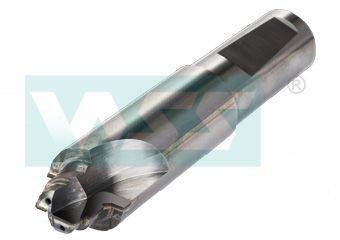
Several high-efficiency machining methods for complex deep-hole machining
Another example of drilling, which places extremely high demands on both the tools and the expertise required, involves machining a very deep hole in the shaft of a generator at a power station. In this situation, there is no alternative but to machine the 90-tonne forged steel component asymmetrically; the hole in this component is nearly 5.5 metres long and just over 100 millimetres in diameter. Deep holes such as this must be drilled at a specific angle and reamed to within a tolerance of 8 millimetres.
In this application, the direction of drilling, chip breaking and chip evacuation, as well as the absolute absence of waste material on the pre-machined shaft, are all of critical importance. This tooling solution comprises a specialised drill bit and a new support plate. Drilling tests conducted prior to application on the shaft proved to be more effective and reliable, with the exit position within 2.5 mm of the target.
In many cases, the use of modern drilling technology has significantly reduced machining times—from several hours to less than an hour—and has made it possible to machine many complex features.
Drilling:
 Chinese
  Japanese
  English
  German
  Finnish
Leave a Reply
You must be logged in to post a comment.