

How to Diagnose Excavator Faults – Methods for Identifying Common Excavator Faults
What are the common faults associated with machinery equipped with excavation functions? How can one determine whether such machinery is experiencing faults? Below, our editorial team will outline the methods for identifying common faults in machinery equipped with excavation functions, and we hope this proves helpful to you!
Common Fault 1: Engine speed drops and power is insufficient during operation
Engine speed drops during operation
Phenomenon:
This fault is primarily caused by a problem with the speed sensor. Check the display to see if the speed is being shown; there are two possible scenarios: either the speed is not displayed, or an extremely high speed is shown.
Recommendations:
1. The speed is not displayed; the sensor or sensor circuit is open.
2. The RPM reading is very high; this indicates that the RPM sensor circuit is short-circuited to the positive terminal of the power supply.
Insufficient engine power
Phenomenon:
1. Poor-quality fuel; the fuel filter is blocked.
2. The fuel injector is faulty.
3. Low fuel pressure.
4. Incorrect valve clearance.
5. Incorrect fuel injection timing.
6. There is a problem with the turbocharger.
Recommendations:

Check the oil; review the maintenance records to see whether the CAT filter has been replaced on time.
Common Fault 2: Blue smoke from the engine
Phenomenon:
1. First of all, you need to check whether the engine oil consumption has been unusually high recently. If this is the case, it may be a sign that the engine is burning oil.
2. If oil consumption has not increased, please check the turbocharger.
Recommendations:
If the engine emits blue smoke, this is usually caused by wear to the cylinder liners and piston rings, resulting in excessive clearance, or perhaps by wear to the turbocharger seals, leading to excessive axial play. In such cases, please contact a customer service representative.
Common Problem 3: High Engine Oil Consumption
Phenomenon:
1. Check for any external leaks or black smoke.
2. If everything appears normal, inspect all the air hoses leading into the tank for any build-up of dust.
3. If there is no build-up of dust, please compile an engine oil consumption chart; you will need to request this from a customer service representative.
Recommendations:
If you notice a significant build-up of dust around the air intake pipe, take it to the workshop for servicing. If the machine is operating normally but the dust exceeds the standard limit, an investigation must be carried out and repairs made.
Common Problem 4: Difficulty starting the engine when it is warm
Phenomenon:
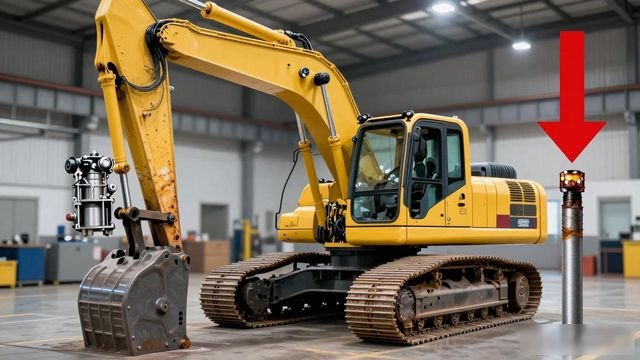
1. Difficulty starting the engine when it is warm is mainly caused by wear to the fuel pump plunger.
2. In fuel-injected engines, this is primarily evident in the fuel injectors.
Recommendations:
1. This fault occurs in direct-injection engines; the main cause is wear to the fuel pump plunger caused by impurities and moisture in the fuel, particularly moisture.
2. As with fuel-injected engines, the principle is the same and the symptoms are identical; to diagnose this fault, one must compare the time taken to start the engine when it is cold with that taken when it is warm.
[How to diagnose excavator faults – Methods for identifying common excavator faults] Related articles:
How to Tell if an Excavator Has Broken Down – Excavator Maintenance Tips 20 July
Common Car Faults: Diagnosis and Troubleshooting 22 January
Troubleshooting Techniques for Common Faults in Electronic Fuel Injection Excavators 01-12
Common Faults in Excavator Hydraulic Components 25 May
How to determine whether a forklift has developed a fault, common methods and principles for forklift fault diagnosis, 31 May.
How to Identify Faults in Water Purifiers – Methods for Repairing Water Purifiers 23 July
How to Troubleshoot an Excavator That Won’t Start 03 June
How can one determine whether a CNC machine tool has malfunctioned? What methods are used to diagnose faults in CNC machine tools? The scope covered ranges from 10 to 25.
Common Faults and Troubleshooting for Excavator Engines 09-05
Diagnosis and Troubleshooting of Common Faults in Hydraulic Excavator Drive Axles 23 July
 Chinese
  Japanese
  English
  German
  Finnish
Leave a Reply
You must be logged in to post a comment.