
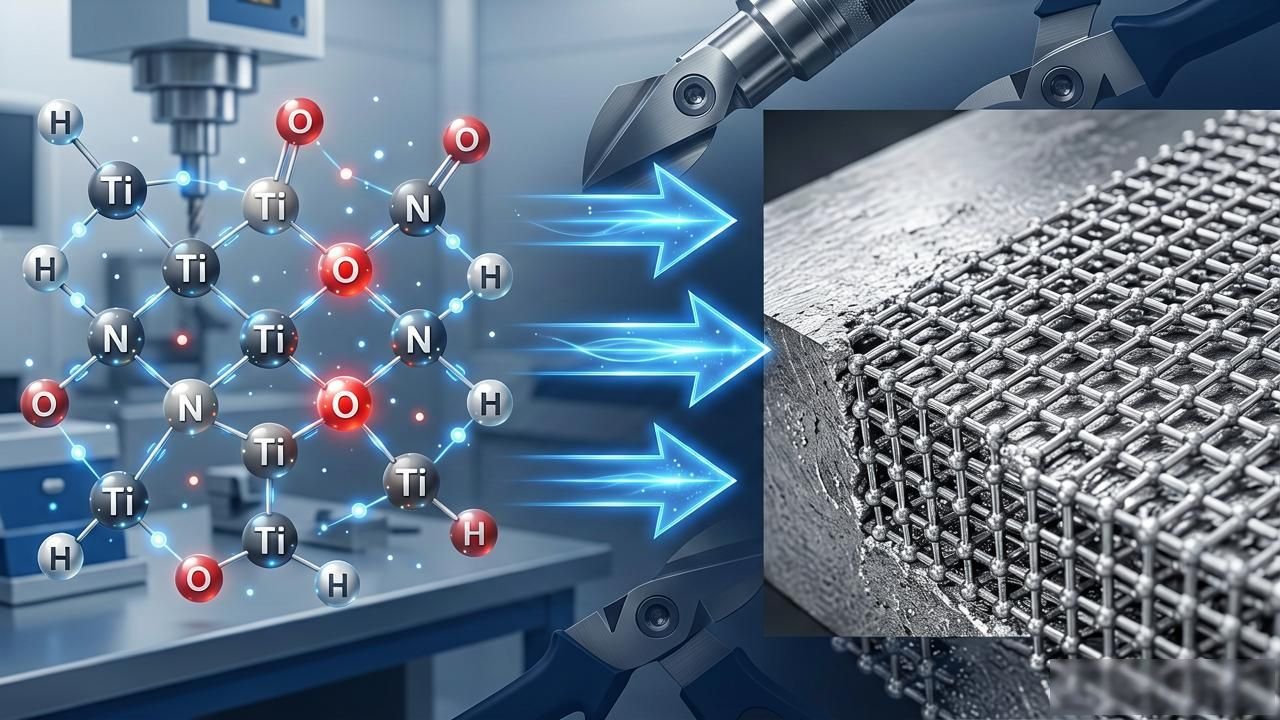
titaniumTurning Techniques
Abstract: Titanium alloys are characterised by their low density, high thermal strength and good corrosion resistance, and are widely used in numerous industries such as aviation, aerospace and chemical engineering. However, the turning of titanium alloy components is extremely challenging, and machining efficiency is also very low. This paper explores measures for the turning of titanium alloys, which may prove helpful in determining how to machine this widely used yet difficult-to-machine material.
Keywords: titanium alloy materialsmachiningTool materialsTool Geometric Parameters
The Chinese Library Classification number is TG5, the document identifier code is A, the article number is 1672–3791, and it can be found in Issue 4, Part A, of 2013; it corresponds to 0128–01.
Titanium alloys are characterised by their low density, high thermal strength and excellent corrosion resistance; however, turning titanium alloy components is extremely difficult and results in low machining efficiency. So, how exactly can we overcome the difficulties and low efficiency associated with machining titanium alloys? We have conducted research and analysis into the effects that the properties of titanium alloys have on the turning process. Based on this, we have devised the following strategies for the turning of titanium alloys, which have yielded favourable results during actual machining operations.
1. Types and Properties of Titanium Alloys
1.1 Types of Titanium Alloys
Titanium alloys are alloys formed by adding other elements to a titanium matrix. Titanium exists in two allotropic forms: α-titanium, which exhibits a face-centred hexagonal structure below 882 °C, and β-titanium, which exhibits a body-centred cubic structure above 882 °C. By utilising the distinct characteristics of these two structural forms of titanium and adding suitable alloying elements, titanium alloys with different microstructures can be produced. Based on their basic microstructure, they are classified into the following three categories: α-titanium alloys, (α+β) titanium alloys and β-titanium alloys, denoted by TA, TC and TB respectively.
1.2 Properties of Titanium Alloys
1.2.1 High strength and thermal strength
Titanium alloys are characterised by their high density and high strength; consequently, their specific strength—that is, the ratio of strength to density—is far greater than that of other structural metals. Titanium has a melting point of 166 °C and possesses high thermal strength, enabling it to operate at temperatures below 550 °C.
1.2.2 Good corrosion resistance
At temperatures of 500 °C and below, titanium alloys readily form a dense oxide film, which makes them resistant to further oxidation. It exhibits particularly strong resistance to pitting corrosion, acid corrosion and stress corrosion; it also possesses excellent corrosion resistance against various substances such as alkalis, chlorides, organic chlorine compounds, nitric acid and sulphuric acid.
1.2.3 Low thermal conductivity and low modulus of elasticity
On average, the thermal conductivity of titanium alloys is half that of industrially pure titanium; their modulus of elasticity is approximately half that of steel, and they are characterised by a relatively low modulus of elasticity.
1.2.4 High chemical reactivity

Titanium is highly chemically reactive and undergoes vigorous chemical reactions with O, N, H, water vapour, ammonia and other substances in the atmosphere. When the carbon content exceeds 0.2%, hard TiC forms within the titanium alloy; at higher temperatures, reaction with nitrogen can also form a hard TiN surface layer, whilst an increase in hydrogen content can lead to the formation of a embrittlement layer. Titanium also exhibits high chemical affinity and is prone to adhesion to friction surfaces.
2 Factors Affecting the Machining of Titanium Alloys
(1) The thermal conductivity is relatively low, and heat dissipation conditions are not ideal; this leads to an increase in temperature during cutting, which accelerates tool wear and ultimately reduces the tool’s service life.
(2) When the temperature rises above 600 °C, an oxide layer forms; this oxide layer causes extremely severe wear to the cutting tool.
(3) Titanium alloys have a low modulus of elasticity; when machined, they are prone to bending deformation under radial forces, which in turn triggers vibration, leading to increased tool wear and affecting the accuracy of the workpiece.
(4) Titanium is highly chemically reactive; under high cutting temperatures, it readily forms bonds with the metals it comes into contact with, leading to adhesion and diffusion, which in turn accelerates tool wear.
3 General Principles for the Machining of Titanium Alloys
Given the characteristics of titanium alloys and the issues that arise during machining, there are several factors that need to be taken into account during the machining process:
(1) The cutting speed should not be too high; experiments have shown that the higher the cutting speed, the higher the cutting temperature becomes, which directly affects tool wear and service life. Therefore, it is important to select an appropriate cutting speed.
(2) A relatively large cutting depth can be employed; as the cutting depth has a relatively minor effect on cutting temperature, increasing the cutting depth as much as possible—provided that the cutting speed is selected appropriately—allows the tool tip to operate below the hardened layer, thereby improving the tool’s durability.
(3) The machining system must possess sufficient rigidity; the machine tool spindle must have minimal play and minimal run-out; the tool overhang should not be excessive, in order to maintain sufficient rigidity; and the clamping force of the fixture must be moderate—it must not be excessive to prevent deformation.
(4) As titanium alloys reach very high temperatures during the machining process, and are highly chemically reactive; combustion is likely to occur during fine machining. It is therefore essential to apply an adequate supply of coolant, and sufficient cutting fluid must be used. Commonly used cutting fluids include emulsions and extreme-pressure water-soluble cutting fluids.
4. Selection of cutting tool materials, geometric parameters and cutting parameters
4.1 Selection of cutting tool materials
As titanium alloys are characterised by low thermal conductivity and low plasticity, and are prone to conditions such as work hardening, when machining titanium alloys, efforts should be focused on reducing cutting temperatures and minimising adhesion. Consequently, cutting tools with good red hardness, high flexural strength, excellent thermal conductivity and low affinity with titanium alloys; cemented carbide tools are typically selected for this purpose. Commonly used cemented carbide tool materials include YG8, YG3, YG8W, YG10H, YG6A, YS2T, YGRM and YD15, amongst others.
(1) During the rough machining stage, one should select YG8, YG8W, YG10H and YG6A, amongst others.
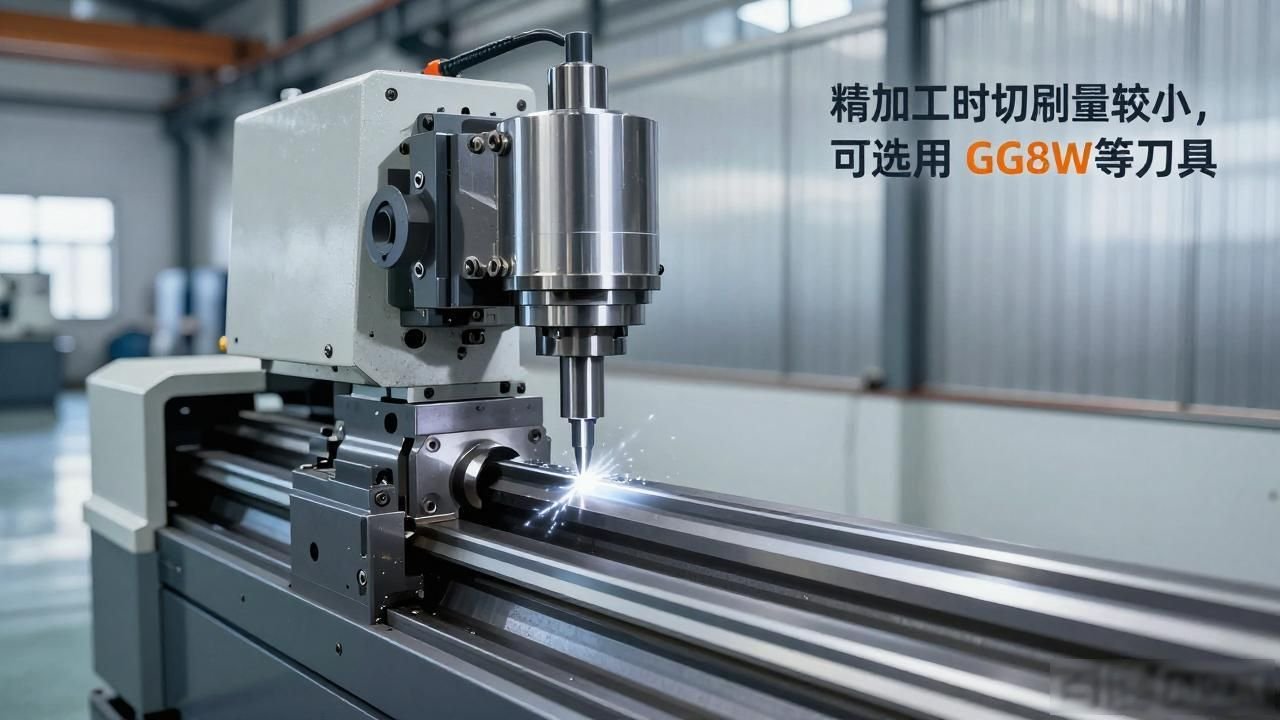
(2) For finishing operations, where the cutting depth is small, grades such as YG8W and YD15 may be selected.
4.2 Selection of Tool Geometric Parameters and Cutting Parameters
Take a cylindrical turning tool as an example.
For rough machining, the front angle should be between 3° and 7°, the rear angle between 8° and 15°, and the radius of the arc at the cutting edge between 0.5 and 1.0 mm; The cutting speed is set at 25 to 38 m/min, the cutting depth is 3 to 5 mm, and the feed rate is 0.3 to 0.5 mm/r.
When performing the finishing operation, the front angle is selected within the range of 10° to 15°, whilst the rear angle is specified as 8° to 15°; the tool tip radius has a specific value, ranging from 0.3 to 0.5 mm; The cutting speed is specifically 50 to 75 m/min, the cutting depth is specified as 0.2 to 0.5 mm, and the feed rate is 0.1 to 0.15 mm/r.
4.3 Selection of Other Parameters
(1) Grind a negative chamfer of 0.05–0.1 mm to enhance the strength of the cutting edge.
(2) During rough turning, the range of the rake angle λ is from minus 3 degrees to minus 5 degrees, whereas during finish turning, the range of the rake angle λ is from minus 3 degrees to 0 degrees.
5 Points to Note When Turning Titanium Alloys
(1) As titanium alloys have a relatively low modulus of elasticity, workpieces are subject to significant clamping deformation and deformation under load during machining. This can lead to a reduction in machining accuracy; therefore, the clamping force should not be excessive when mounting the workpiece, and auxiliary supports may be added where necessary.
(2) When turning the outer diameter, the tip of the cutting tool must not be higher than the centre of the workpiece, in order to avoid a phenomenon known as ‘tool digging’.
(3) Cutting fluids containing hydrogen must not be used; if such fluids are used, appropriate safety precautions must be taken. Furthermore, parts must be thoroughly cleaned with a chlorine-free cleaning agent immediately after machining.
(4) When turning thin-walled workpieces and during finishing operations, the tool’s main rake angle should not be too small.
(5) After cleaning, titanium alloy components must be protected from grease and fingerprints to prevent stress corrosion cracking caused by salts.
6. Conclusions
Taking into account the overall impact of titanium alloy properties on the turning process, to successfully turn titanium alloys, the key lies in selecting appropriate tool materials and optimal tool geometry parameters, whilst employing the lowest possible cutting speed, the greatest possible depth of cut and feed rate, and ensuring an adequate supply of coolant; this will ultimately result in excellent machining results.
 Chinese
  Japanese
  English
  German
  Finnish
Leave a Reply
You must be logged in to post a comment.