
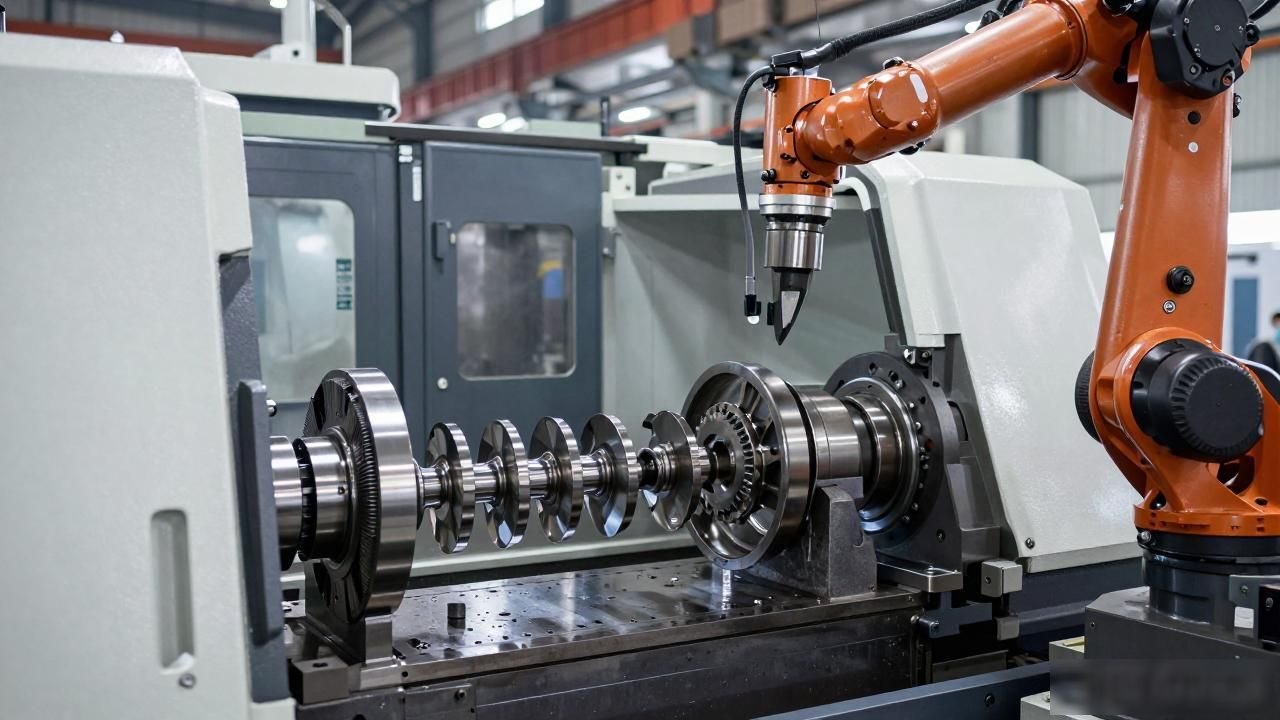
The Application of Combined Turning and Milling Technology in Crankshaft Manufacturing
Document Information
The topic is “Manufacturing” within the context of “Automotive, Mechanical Engineering or Manufacturing’Processing”Sample essay."
Regarding the file format, it is a Doc file, presented in Doc format. The main text contains 2,772 characters. It is of excellent quality and offers good value for money. Please feel free to download it!
Applicable; it serves as a reference guide for content writing, thereby addressing a range of related tasks, such as how to approach writing, how to format copy correctly, and how to extract content.
directory (on computer hard drive)
TOCo”1–9”hz\l”” Table of Contents 1
l””Main text 1
l””I. Analysis of the Advantages of Combined Turning and Milling CNC Machining Technology 2
l””II. Analysis of Precision Requirements for the Manufacture of Crankshaft Components 3
l””III. Analysis of Issues to be Addressed in Turning-Milling Hybrid Technology and Its Applications 3
l”” (1) Applications of turning-milling hybrid technology 3
l”” (ii) Issues to be addressed 4
l””IV. Analysis of the Effectiveness of Combined Turning and Milling Technology in Crankshaft Manufacturing 5
l”” (1) Shortens the production cycle, thereby promotingproduction efficiencyImprovement 5

l”” (ii) Effectively improving the precision of product manufacturing 5
l”” (3) Reducing staff workload and saving on manufacturing costs 5
l””V. Conclusion 6
main body (of a book)
The Application of Combined Turning and Milling Technology in Crankshaft Manufacturing
In the crankshaft manufacturing process, turning-milling hybrid technology is employed, which effectively enhances and optimises both manufacturing efficiency and the quality of the components produced; it is therefore essential to emphasise the application of this technology in crankshaft manufacturing. This paper first analyses the advantages of turning-milling composite CNC machining technology, and then further examines its integration with traditional machining processes, to analyse the application of turning-milling composite technology in crankshaft manufacturing. It is hoped that this will provide valuable guidance for improving the efficiency and quality of crankshaft manufacturing, thereby achieving more efficient production and higher-quality output in this manufacturing sector.
Turning-milling composite technology is an advanced machining technique that enables the turning, drilling and milling of workpieces in a single set-up on a single machine. In the manufacturing of crankshafts, the application of turning-milling composite technology offers distinct advantages, as it not only enhances machining efficiency but also effectively reduces production costs. Consequently, an analysis of the application of turning-milling composite technology in crankshaft manufacturing, as presented in this paper, is of considerable value.
I. Analysis of the Advantages of Combined Turning and Milling CNC Machining Technology
As early as the 1990s, combined turning and milling technology was already in place; this technology falls within the realm of mechanical machining processes. The key to this technology lies in utilising a single machine as the basic platform to perform various machining operations on a workpiece—such as turning, drilling and milling—through a single set-up. The main advantages of combined turning and milling CNC machining are as follows: It plays an extremely significant role in the machining of workpieces with complex geometries, those requiring numerous processing steps, and those with particularly high precision requirements. On the one hand, it effectively ensures machining accuracy; on the other, it significantly enhances production efficiency whilst delivering substantial cost savings.
To gain a thorough understanding of the advantages of combined turning and milling CNC machining technology and to compare it with traditional conventional machinery, the following points can be observed: (1) By consolidating multiple machining operations onto a single machine tool, changeover and waiting times are eliminated, thereby effectively reducing the machining cycle time; (2) The time required to repeatedly position and set up workpieces on different machine tools is significantly reduced, thereby effectively improving machining accuracy; (3) By completing machining operations on a single machine tool, the number of machines required is effectively reduced, thereby substantially alleviating the workload of operating staff; (4) In terms of turning and milling technology, flexibility is a standout feature; when faced with product updates or model changes, it is sufficient to modify only certain software functions and add-ons, without the need for repeated investment; (5) This technology features an automatic measurement function, enabling online measurement of workpiece dimensions and precision, thereby effectively improving the precision of the workpiece.
II. Analysis of Precision Requirements for the Manufacture of Crankshaft Components
In the course of the above analysis, it has been observed that turning-milling composite technology offers numerous advantages; however, in the manufacturing process of crankshaft components, it is still necessary to be aware of certain precision requirements. Taking a typical diesel engine crankshaft as an example, its manufacturing process can be divided into two types: the first involves an eight-journal crankshaft, and the second is a nine-journal crankshaft. The overall length can reach [...], with the connecting rod journal diameter at 210 mm, the main journal diameter at 230 mm, a centre-to-centre distance of 143 mm, and a vertical phase angle. The weight can reach [...], making it a large and complex crankshaft, model 131. During manufacture, the key precision requirements are as follows: firstly, the surface roughness of the shaft diameters must be controlled within the specified range, with the surface roughness of each crank surface being μm; secondly, the roundness of each journal must be controlled within specified limits; thirdly, the parallelism of each connecting rod journal relative to the No. 1 and No. 9 main journals must be controlled within specified limits in all directions; and fourthly, the radial runout of the No. 1 and No. 9 main journals must be controlled within the corresponding ranges.
III. Analysis of Issues to be Addressed in Turning-Milling Hybrid Technology and Its Applications
In the process of applying turning-milling composite technology, in addition to meeting the relevant precision requirements, it is essential to focus on the practical application of the technology in order to address certain real-world issues. Below, we will analyse turning-milling composite technology and the issues that need to be resolved during its application:
(1) Applications of Combined Turning and Milling Technology
In the process of applying turning-milling composite technology, the aim is to use a single machine as the basis, carry out a single set-up, and subsequently complete the machining of workpieces with complex shapes, numerous machining operations and high precision requirements. With regard to turning-milling composite technology, operations such as turning, drilling and milling are carried out within the system. In the case of the diesel engine crankshaft discussed here, primarily centralises equipment such as the main journal lathe, connecting rod journal lathe and rocker arm drilling machine onto a single turning and milling machining centre, thereby efficiently completing the machining of the free end, output end and connecting rod journals in a single operation; in practice, this takes 16 days. Meanwhile, the drilling of oil holes in the main journal takes 3 days. Similarly, the drilling of oil holes in the connecting rod journal also takes 3 days. Furthermore, this technology requires grinding operations. This grinding operation completes the machining of the main journal. This grinding operation completes the machining of the connecting rod journal. In this way, the precision requirements for the main journal are effectively met. In this way, the precision requirements for the connecting rod journal are effectively met.
(2) Issues to be addressed
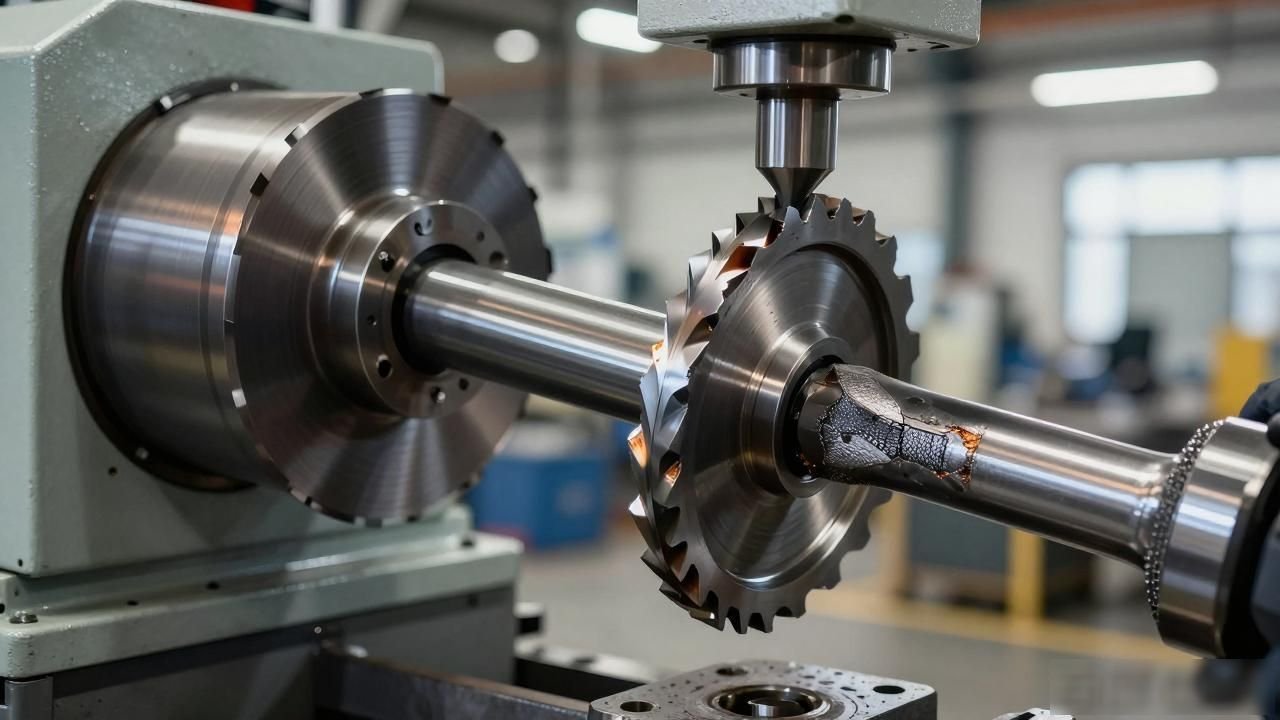
During the roughing and semi-finishing stages of crankshaft turning and milling, the machining of the crank arms and connecting rod journals presents extreme difficulty; this machining accounts for 75% of the total roughing operation. During crankshaft machining, the initial machining operation requires the use of a four-fluted disc-type end mill, and an eccentric follow-up milling method must be employed. Due to the large eccentric radius of the crank arm—which can reach 45 mm—and the maximum speed of 55 revolutions per minute for the three-axis interpolation, the machining allowance is relatively large, particularly at the root of the connecting rod journal, where the maximum allowance can reach 15 mm to 20 mm. From the perspective of actual machining operations, the amplitude of vibration generated during machining is considerable, and the cutting inserts used suffer from severe wear; consequently, the final machining results are extremely poor. In view of these circumstances, it is essential to optimise the machining process.
A thorough analysis of the forces involved in follow-up milling has revealed that, during the milling process, the principal rake angle at various points on the cutting edge varies; this is primarily manifested as radial forces during machining. Consequently, this type of crankshaft has relatively low structural rigidity and a slender design; furthermore, the cutting forces exerted by the disc milling cutter are relatively high, particularly during multi-edge cutting, which makes the machining process prone to significant vibration. Furthermore, during milling, as the cutting depth at each point on the arc-edged insert varies and is uneven, the chip formation progresses from thin to thick, which can easily lead to instability and, consequently, significant tool chipping.
In light of the above and based on the actual circumstances, a double-segment circular arc cutting path was designed, a four-axis interpolation machining programme was written, and the machining methods for the connecting rod shaft diameter and side walls were optimised, converting them to a follow-up turning method. This effectively improves the stress conditions on the workpiece during the machining stage. Through debugging and verification via actual machining, the issues of machining vibration and tool wear were effectively resolved.
IV. Analysis of the Effectiveness of Combined Turning and Milling Technology in Crankshaft Manufacturing
In the manufacture of crankshafts, the use of combined turning and milling technology has yielded significant results. When compared with traditional techniques, the main benefits are evident in the following key areas:
(1) To shorten the production cycle, thereby promoting an increase in production efficiency
According to traditional machining techniques, the rough turning of the main spindle journal is a time-consuming process, as is the finish turning of the main spindle journal; however, the time required for turning-milling combination technology is significantly shorter. As production time is reduced, a large number of processes can be effectively eliminated, thereby significantly improving production efficiency.
(2) To effectively improve the precision of product manufacturing
Although traditional machining techniques can be used to manufacture internal combustion engine crankshafts that meet quality standards, the process requires multiple repeated installations and positioning operations, which presents significant safety challenges. In contrast, the turning-milling combination technology utilises a single-clamping and positioning technique, which effectively eliminates the cumulative errors caused by repeated repositioning, thereby significantly improving the precision of the final product.
(3) Reducing staff workload and cutting manufacturing costs
The use of turning-milling combination technology enables CNC machining, whilst workpiece dimension inspection and accuracy compensation are carried out using automatic measurement technology, thereby significantly reducing the workload on staff. At the same time, the use of turning-milling composite technology in conjunction with flexible CNC machining equipment enables automatic interpolation movements, which not only simplifies the operator’s workflow but also leads to effective savings in manufacturing costs.
V. Conclusion
Based on the in-depth analysis presented in this paper, it is evident that the application of turning-milling composite technology in crankshaft manufacturing offers significant advantages. It enables production cycles to be shortened, thereby boosting production efficiency, whilst simultaneously enhancing manufacturing precision and reducing production costs. Therefore, it is appropriate to apply turning-milling composite technology in a timely and scientifically sound manner to the crankshaft manufacturing process. It should be noted, however, that when utilising this technology, it is essential to have a thorough understanding of the precision requirements for crankshaft manufacturing and to fully address the challenges encountered during its application, thereby achieving a comprehensive improvement in the efficiency of crankshaft manufacturing.
”The Application of Combined Turning and Milling Technology in Crankshaft Manufacturing“ is a document sourced from the internet, which I have edited and compiled. In accordance with guidelines for the protection of the author’s intellectual property rights, this document is intended solely for educational and exchange purposes and must not be used for commercial purposes. Should there be any infringement of the author’s rights, please leave a comment or send a private message to contact me, and I will remove the document as soon as possible. Thank you for reading and downloading!
 Chinese
  Japanese
  English
  German
  Finnish
Leave a Reply
You must be logged in to post a comment.