
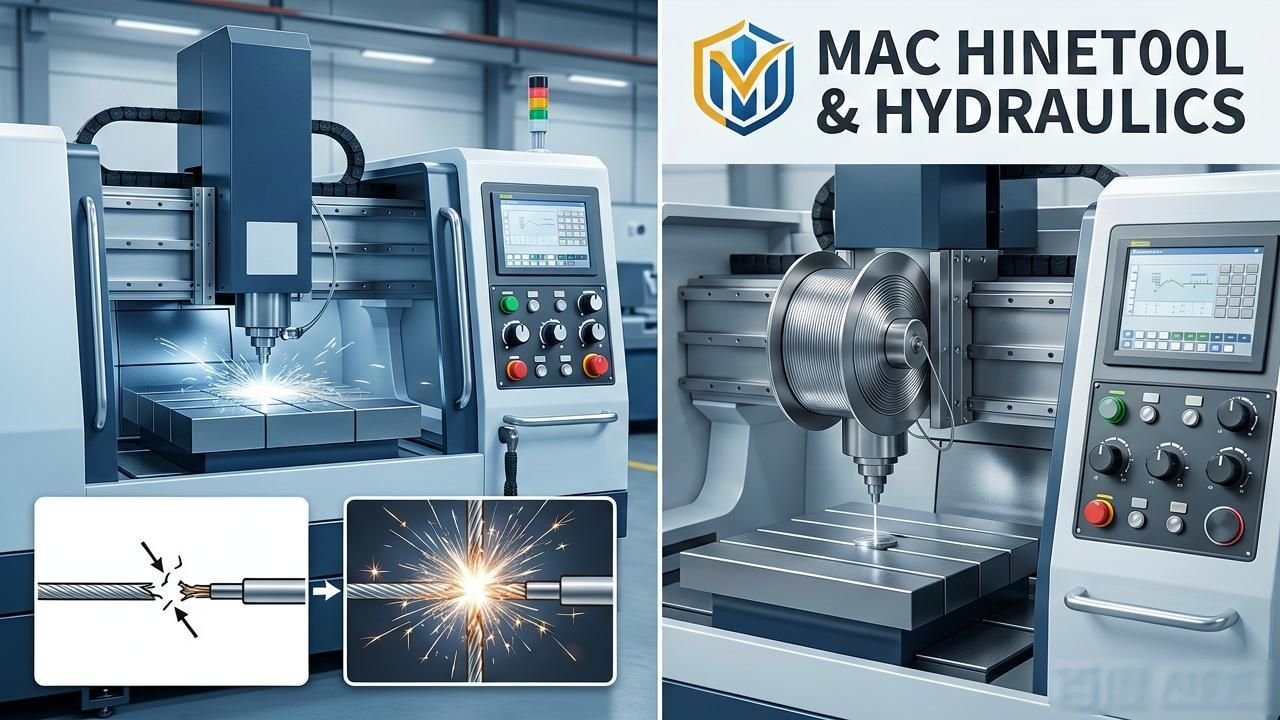

In March 2007, Volume 35, Issue 3 of *Machine Tool & Hydraulics* (published under the English title *MACHINE TOOL & HYDRAULICS*) was published. This issue contained wire erosionAnalysis and Solutions to Common Process Problems in Machining. This article was written by Bao Zhongguan, who is affiliated with Hubei University of Automotive Technology, located in Shiyan, Hubei. The abstract states that, in response to common process issues such as wire breakage and frequent short circuits during wire-cut EDM, slow cutting speeds and poor surface roughness, poor machining results for cemented carbide materials, and poor machining results for aluminium, this paper provides scientific and effective solutions based on analysis and practical production experience. Keywords: wire-cut EDM, process issues, Chinese Library Classification: TG66, Document Identification Code: B, Article Number: 1001—3881(—225—1, 0 Introduction: Currently, wire-cut EDM machines, both domestically and internationally, account for over 60 per cent of all electrical discharge machining (EDM) machines. During wire-cut EDM machining, various factors often give rise to process issues that directly affect machining quality and efficiency. Analysing common process issues in wire-cut EDM and identifying practical and effective solutions is crucial for ensuring machining quality and improving machining efficiency, and is certain to attract increasing attention. Among these issues are wire breakage and frequent short circuits. Firstly, this may be due to poor-quality electrode wire, characterised by inconsistent thickness, low tensile strength, a tendency to bend and snap, and exceeding its shelf life; the solution is to select high-quality electrode wire. Secondly, it may be caused by wear on the guide wheels. The radius of the fillet on the V-shaped groove of the guide wheel exceeds that of the electrode wire, causing the wire to vibrate and leading to frequent short circuits; this is particularly likely to result in wire breakage at the moment the wire spool changes direction. The solution is to replace the guide wheel and bearings with new ones. (3) Electrical parameters are set too high. Electrical parameters should be selected appropriately according to the workpiece being machined. If the pulse interval is too short whilst the pulse width is too wide, this can easily lead to wire breakage and frequent short circuits. The solution is to select appropriate electrical parameters. (4) Workpiece deformation: Deformation of the workpiece can cause the wire to become pinched or result in short circuits, thereby leading to wire breakage. With regard to the workpiece, the solution is to select, where possible, an alloy steel that undergoes heat treatment with good hardening penetration and minimal deformation. For raw blanks, forging operations are required to avoid workpieces with defects such as laminations or impurities. In some cases, the feed rate may be set inappropriately. When over-tracking occurs, the short-circuit voltage waveform is pronounced; the workpiece’s erosion rate is lower than the feed rate, and the gap approaches a short-circuit state, which can easily lead to frequent wire breaks and short circuits. When under-tracking occurs, the workpiece removal rate exceeds the feed rate, and the gap approaches an open-circuit state, causing the electrode wire to vibrate; this is also likely to result in frequent wire breakage and short circuits. The solution is to select the optimal tracking speed and adjust the variable-frequency feed rate to a suitable level. (6) If the working fluid is contaminated—particularly if it is excessively so—this results in an excessive amount of suspended machining swarf. This impairs the ability to eliminate ionisation in the gap and reduces the fluid’s cleaning efficacy, which hinders swarf removal and further deteriorates the gap conditions, adversely affecting the EDM process and leading to frequent wire breaks and short circuits. The solution is to replace the working fluid with a fresh supply and prepare it appropriately in accordance with the operating procedures. (7) Poor current supply typically refers to issues with the contact between the current-conducting blocks or deep grooves worn into the blocks themselves, resulting in wire breaks. The solution is to replace the conductive block with a new one or to rotate the existing block by an angle before reuse. (8) Vibration of the wire spool is often caused by wear or damage to the spool bearings, which in turn causes the spool to vibrate, leading to wire tangling and breakage. The solution is to replace the bearings and recalibrate the wire spool for accuracy. Faults in the pulse power supply—such as damaged transistors, current leakage, excessive negative-wave amplitude, or altered electrical parameters—can all lead to wire breakage and frequent short circuits. The solution is to replace the transistors and repair the pulse power supply. There are mechanical faults: wear on the Y-axis lead screw, wear on the wire spool lead screw, and wear on the drive gears. This not only affects machining quality and precision but also makes wire breakage and frequent short circuits highly likely. The solution is to replace the lead screws or drive gears and carry out the necessary mechanical repairs to ensure the machine operates normally. 2. The cutting speed is relatively slow. The surface roughness of the machined surface is poor. (1) Cutting speed and surface roughness are two process parameters that are inversely proportional to one another; therefore, it is essential to ensure that surface roughness requirements are met before seeking higher cutting speeds. It is crucial to select the appropriate electrical parameters based on the specific workpiece being machined. A slightly slow cutting speed and poor surface roughness are closely related to the feed rate. If the feed rate is set too high, exceeding the workpiece’s material removal rate, short circuits will occur frequently, causing the machining process to become unstable. This, in turn, reduces the actual cutting speed, causes the machined surface to char and turn brown, and results in overburning at the top and bottom faces of the workpiece. If the feed rate is set too low—that is, below the workpiece’s material removal rate—the system operates in an under-current state, resulting in low pulse utilisation. This leads to a slow cutting speed and poor surface finish, with unstable striations or ablation occurring. Therefore, the feed rate must be adjusted to the correct level to ensure stable machining conditions, achieve high cutting speeds, and produce a fine, bright machined surface with uniform threading, thereby obtaining good surface roughness and high cutting speeds. Machining results are less than ideal for the three types of cemented carbide materials. As these materials contain tungsten carbide and titanium carbide—which have high melting points—machining speeds are relatively low and micro-cracks are prone to form on the surface. The solution is to use a specialised pulsed power supply and select appropriate electrical parameters based on the equipment in use; for example, choosing a narrow pulse width, high peak current and increased peak voltage, so that the majority of the cemented carbide is ejected via vaporisation and explosion whilst in a gaseous state, before condensing again after melting.
 Chinese
  Japanese
  English
  German
  Finnish
Leave a Reply
You must be logged in to post a comment.