
Among the various methods of joining metal structures, welding occupies an irreplaceable central position. Welding involves the application of heat, pressure, or a combination of both to bring about a permanent bond at the atomic level between two or more separate metal components, thereby forming an assembly or structure. Unlike bolted or riveted joints, welding creates a metallurgical bond with continuous mechanical properties through the local melting and subsequent solidification of the base metal. Welded joints offer superior integrity,密封性 and strength-to-weight ratio compared to other joining methods, making them the preferred solution in fields such as pressure vessels, steel structures in construction, piping systems, heavy machinery and transport equipment.

Main Types of Welded Components and Their Process Characteristics
Depending on the state of the base metal during the welding process and the energy source employed, welding processes can be classified into three main categories: fusion welding, pressure welding and brazing.
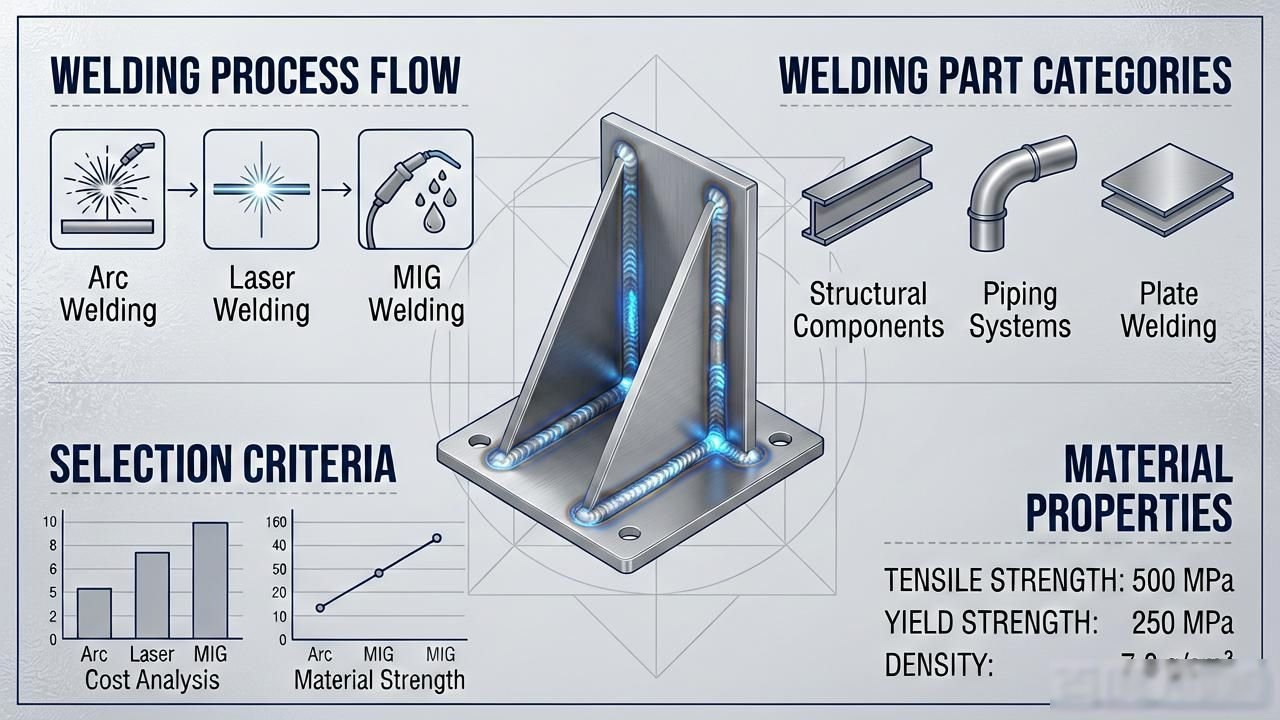
The most common form of welding is fusion welding. Manual arc welding equipment is simple and flexible to operate, making it suitable for on-site construction of low-carbon steel and low-alloy steel structures. Gas shielded arc welding, which uses a shielding gas to isolate the weld from the atmosphere, produces higher-quality welds and is widely used for welding thin sheets, stainless steel and non-ferrous metals; Submerged arc welding, owing to its high deposition efficiency, has become the process of choice for long, straight welds on pressure vessels, spiral-welded pipes and similar components; laser welding and electron beam welding, with their extremely narrow heat-affected zones and minimal distortion, have established a firm foothold in the manufacture of precision components.
Press welding is characterised by the application of pressure during the welding process. Resistance welding is a key process for joining thin metal sheets; welded joints can be seen throughout car bodies and the casings of domestic appliances. Friction welding is particularly well-suited to the butt joining of dissimilar metals, whilst flash butt welding is used to join large-section profiles such as railway rails and chains.
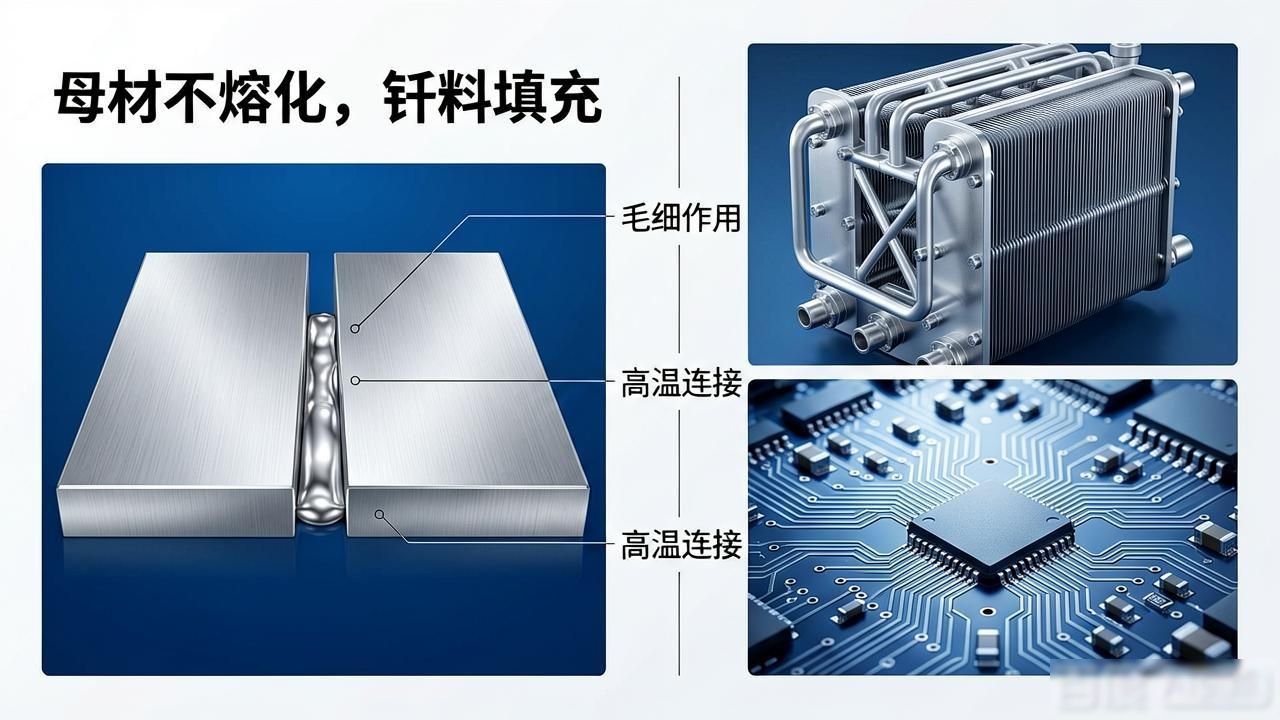
The mechanism of brazing differs from that of the previous two processes; the base metal itself does not melt; rather, the molten filler metal fills the joint gap via capillary action. Brazed joints exhibit minimal deformation and can join dissimilar materials; however, the joint strength is relatively low, and the process is primarily used in applications such as heat exchangers and electronic components.
In terms of structural form, welded components can be further categorised into: welded beams and columns, welded tubular components, welded shells, and welded assemblies.
Welded componentsquality controlKey points
Weldability is the first hurdle for the base metal; carbon equivalent is a commonly used indicator designed to assess the weldability of steel. When the carbon equivalent is below 0.4%, the tendency for cold cracking during welding is relatively low; whilst when it exceeds 0.61 TP3T, a series of measures such as preheating, slow cooling or post-weld heat treatment must be implemented. For stainless steels, attention must be paid to intergranular corrosion, whilst for aluminium alloys, the focus should be on addressing the tendency for porosity and hot cracking.
Joint strength is directly related to the groove design and weld configuration; butt welds can achieve the same strength as the base metal and are suitable for areas subject to principal stresses; Fillet welds are frequently used in lap and T-joints; the groove angle, fillet dimension and root gap must be set whilst taking into account both the accessibility of the welding torch and the penetration depth.
Once welding is complete, there are a number of common inspection methods available, including visual inspection, non-destructive testing—such as penetrant testing, magnetic particle testing, ultrasonic testing and radiographic testing—as well as destructive testing, such as tensile testing, bending testing, impact testing, hardness testing and macroscopic metallographic analysis.
Selection of Welded Components and Economic Considerations
For structures subjected to large dynamic loads, full-penetration butt welds should be prioritised, supplemented by ultrasonic or radiographic testing; For pressure vessels with stringent sealing requirements, welded components must undergo pneumatic or hydrostatic testing; for thin-plate structures with high aesthetic requirements, TIG welding or laser welding may be employed to minimise distortion and spatter.
Distribution and Procurement of Specialised Welded Components
In the fields of industrial manufacturing and engineering maintenance, demand for welded components is characterised by a wide variety of product types, small batch sizes and tight delivery deadlines. Purchasing organisations must not only ensure that the materials and processes used in the welded components comply with standards, but must also take into account the supplier’s geographical reach, supporting machining capabilities and the speed of response to after-sales service requests.
Xinghua International Hardware and Building Materials Exhibition and Trade Centre is the region’s leading distribution hub for hardware and building materials, bringing together numerous specialist suppliers of welded components. The exhibition and trade centre offers a comprehensive range of products, including welded pipe fittings, flanges, structural welded components, and custom-shaped and non-standard welded parts, alongside welding consumables, welding machines and protective equipment, thereby forming a complete procurement chain from raw materials to finished products. Most of the traders within the exhibition and trade centre possess the capability to process materials to specification, enabling them to undertake customised welding projects based on client drawings using materials such as carbon steel, stainless steel and aluminium alloys, thereby meeting diverse requirements ranging from the prefabrication of steel structures for construction to the maintenance of industrial equipment. For engineering firms and manufacturers requiring bulk purchases of welded components, Xinghua International offers product comparison services, technical consultancy and logistics coordination – a one-stop service that effectively reduces both procurement and communication costs.
 Chinese
  Japanese
  English
  German
  Finnish
Leave a Reply
You must be logged in to post a comment.