

Overview of welding materials
Principles for the selection of welding materials
Specification of proportioning of welding materials
Example of selection and proportioning of welding materials
Welding material selection and proportioning ofPoints to Note
Overview of welding materials
01
Various metal materials can be joined by welding materials to achieve a permanent connection of the workpieces, thus meeting the requirements of the engineering structure.
connectivity
conductivity
protective effect
The welding material conducts current and heat in the weld, which ensures that the welding process can be carried out smoothly.
Certain components in the weld material have the ability to protect the molten pool from atmospheric contamination and thus prevent welding defects from appearing, thus achieving the corresponding effect.
03
02
01
Principles for the selection of welding materials
02
To ensure that the strength of the welded joint is not lower than that of the base material, then the base material to be welded with it should match the strength of the welding material.
intensity matching
The toughness of the base material to be welded needs to be matched by the toughness of the weld material to ensure that the welded joint has a sufficient degree of toughness when it is subjected to low temperatures or dynamic loads.
Toughness Matching
The hardness of the base material to be welded should be similar to the hardness of the weld material. Otherwise, if the difference in hardness is too great, there will be problems and the welded joint will be deformed or cracked.
Hardness Matching
Welding material in the alloying element content it, should be welded with the base material is almost similar, this is to ensure that the chemical composition of the welded joints can be consistent with the base material, and thus avoid the emergence of electrochemical corrosion of this situation.
The content of harmful elements, such as sulphur and phosphorus, in welding consumables should be strictly controlled in order to reduce the brittleness of welded joints as well as the susceptibility of welded joints to cracking.
Harmful element control
Alloy element matching
The materials used for welding should have excellent welding process properties, such as easy slag removal, low spatter generation and a beautiful weld seam after welding.
Welding processability
The welding material should be easy to handle, such as the wire feed should be smooth, the electrode should be easy to ignite, and the arc should be kept stable.
Welding operability
Welding materials need to meet the requirements of all types of welding methods, to meet the provisions of the welding position, but also to adapt to the conditions of the welding environment, such as to adapt to the all-position welding as well as field work in this case.
flexibility
Specification of proportioning of welding materials
03
Depending on the welding requirements, different types of flux skins are selected, such as acidic, alkaline or special flux skins.
Type of skin
The flux skin contains, arc stabiliser, slagging agent, gas generator, deoxidiser, alloying agent, binder, etc., which form its main components.
composition
It is important to ensure that the ratio of flux casing to weld core is appropriate in order to obtain excellent welding process performance and weld seam quality.
proportioning principle
03
proportioning principle
According to the composition of the base material and welding performance requirements, reasonable adjustment of the content of each element in the wire.
01
Wire Type
According to the welding needs, according to the composition of the base material, to pick different kinds of wire, such as carbon steel wire, and low alloy steel wire, and stainless steel wire.
02
chemical composition
The chemical composition of the wire, to comply with the relevant standards, the main elements contained in the carbon, silicon, manganese, phosphorus, and sulfur.
Depending on the welding method and the type of base material, different types of fluxes are selected, such as fusion fluxes, sintered fluxes, ceramic fluxes and so on.
Flux Type
Oxides, fluorides, silicates, etc. make up the flux, which is used to protect the weld and also to provide the necessary metallurgical reaction conditions.
composition
Based on the welding process, combined with the characteristics of the base material, select the appropriate flux composition, determine the appropriate ratio value, so as to obtain excellent weld seam forming effect, to achieve excellent mechanical properties indicators.
proportioning principle
Example of selection and proportioning of welding materials
04
Used in the case of mild steel welding, in the choice of welding electrodes, usually choose the E43 series of welding electrodes, such as E4303 electrodes, and E4315 electrodes and so on.
Welding Rod Selection
Welding Wire Selection
Flux Selection
Proportioning norms
Welding wire can be H08A, if you need to carry out gas shielded welding, the choice of welding wire can be CO2 gas shielded wire.
For submerged arc welding, high manganese and high silicon type flux can be used, such as HJ431.
Depending on the welding process and the thickness of the base material, the diameter of the electrodes to be used, as well as the current and voltage during welding, and the welding speed are specified.
When welding high-strength steel, you need to use the kind of welding rod that matches the strength of the base material, such as the E50 series, and the E55 series.
Welding Rod Selection
Use welding wires of similar composition to the base metal, e.g. or etc.
Welding Wire Selection
High-strength steel submerged arc welding, can choose low manganese and high silicon type flux, such as HJ350.
Flux Selection
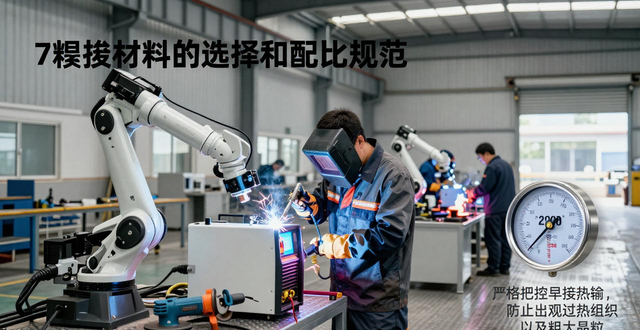
![图片[1]-7焊接材料的选择和配比规范-大连富泓机械有限公司](/wp-content/uploads/2026/02/1771756231880_1.png)
Strictly control the welding heat input, to prevent the emergence of overheating organisation and coarse grains, and at the same time, the use of preheating, post-heating and other methods to reduce welding stress.
Proportioning norms
Choose welding rods with similar composition to the stainless steel base material, such as A002, A102 and so on.
Welding Rod Selection
Use stainless steel welding wires of similar composition to the base material, such as etc.
Welding Wire Selection
For submerged arc welding of stainless steel, alkaline or neutral flux can be used, such as HJ260.
Flux Selection
The welding current and voltage are precisely controlled, and the welding speed is maintained at a low level to obtain excellent seam formation and corrosion resistance.
Proportioning norms
Considerations for the selection and proportioning of welding materials
05
Chemical composition of the parent material
When selecting welding consumables, it is important to take into account the chemical composition of the base material, including the content of major and impurity elements. This helps to ensure that the welded joint has a similar chemical composition to the base material, thus preventing undesirable metallurgical reactions and welding defects.
Mechanical properties of the parent material
According to the base material has the strength, toughness and other mechanical properties, to select the appropriate welding material, for example, for high-strength steel, the need to select the strength of the welding material to match each other to ensure that the mechanical properties of the welded joints can be matched with the base material.
Welding method
Various welding methods require different welding materials. For example, for electrode arc welding, welding rods are used as the welding consumables, while for gas shielded welding, welding wires and gas are used as the welding consumables. Therefore, when selecting welding consumables, the welding method must be taken into consideration.
Process parameters
Process parameters such as welding current, voltage, welding speed, etc. have an impact on the deposition efficiency of the welding consumables and also influence the shape of the weld seam. Therefore, when selecting welding consumables, the matching of process parameters should be considered.
equipment condition
Equipment conditions such as the power of the welding machine, wire feeding mechanism, can also have an impact on the selection of welding consumables. For example, for high-power welding machine, you can select a larger diameter of the wire used to improve welding efficiency; however, for small power welding machine, you should choose a smaller diameter of the wire to avoid overloading the welding machine.
Temperature, pressure, corrosive media and other conditions of use of the product will have an impact on the performance of welded joints. Therefore, in the selection of welding consumables, we have to consider the conditions of use of the product, to select the welding consumables with corresponding corrosion resistance, heat resistance, cold resistance and other properties.
Conditions of use
The technical requirements of the product, such as the appearance of the weld, non-destructive testing of these aspects, will also have an impact on the choice of welding consumables. For example, for the requirements of the appearance of the weld has beautiful qualities of the product, it should be selected slag good, weld shaping can show beautiful state of the welding material; However, for the requirements of non-destructive testing of the product, you need to go to the selection of low-hydrogen, low impurity content of the welding material, so as to reduce the rate of defects in the weld.
technical requirement
security principle
When selecting and proportioning welding materials, safety guidelines must be followed to ensure that the welding materials used are non-toxic, non-hazardous, non-flammable and non-explosive, and do not pose a hazard to the human body or the environment during transport, storage and use.
Environmental principles
Along with environmental protection awareness can be improved, select environmentally friendly welding materials has become a trend, in the selection and proportion of welding materials, should give priority to select with low smoke, low dust, low toxicity, low pollution characteristics of environmentally friendly welding materials, in order to cut down on the environment caused by the pollution and the hazards to the human body.
The principle of economic efficiency
Under the conditions of meeting the technical requirements of the product and the safety and environmental protection standards, welding materials should be selected at the right price, from a wide range of sources, and easily available, so as to reduce production costs and improve economic efficiency. At the same time, it is also necessary to consider the utilisation of welding materials and the feasibility of recycling, in order to further save resources and reduce costs.
Thanks for watching.

 Chinese
  Japanese
  English
  German
  Finnish
No comments