
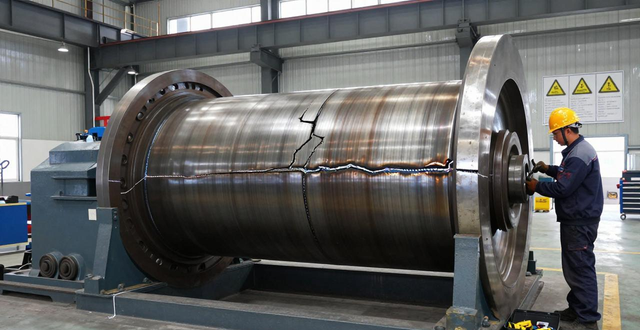
Treatment of open welds on the main drum of the winding hoist
Abstract: During the long-term use of the hoist, fatigue occurs due to the force, which leads to the welding of the drum wheels and the internal support plate, which is then analysed, and then reinforced by a reasonable method, so that the drum can be used normally and safely in the end.
Keywords:Elevator; Drum weld;soldered;conversion
The main carrying part of the mine hoist is the hoist drum, which has the role of winding the wire rope, bear all the lifting load, to complete the lifting of minerals, gangue, lifting and lowering of personnel, transport equipment and materials and many other tasks. Elevator drum normal operation or not, directly related to the mine's safe production and production tasks can be completed.
In Binchang company Xiaozhuang mine wind shaft project project, China Coal Fifth Construction Co., Ltd. a use of 2JK-, the hoist drum is an early anti-Su products, has been leased by the construction unit to use, because of a long time more than one place to use as well as transport, the current discovery of the drum inside the wheel vice and the existence of the support plate welded phenomenon, found immediately after the reinforcement of the welding, but not for long, always in the position of the reinforcement of the welded However, it was not long before the welded position was strengthened and welded again.
Due to this situation, the project department quickly contacted with the Luomin factory personnel, and then analysed the reasons for the welding of the drum, and then the factory personnel arrived at the site for inspection, and then gave a solution for the treatment of the welding problem.
1. Study of the problem and measures to transform it
This hoist is the equipment leased out by the equipment leasing party, which has been in service in a number of mines under construction. After an in-depth understanding of the hoist is mainly used in vertical shaft drilling project, in the period of drilling, are using a single drum, until the bottom of the vertical shaft into a flat road and change the winch installation, only as a double-drum hoist to be used.
The main drum, which was welded to the inner surface of the cylinder shell with the support ring, had cracks mainly in this area, while no cracks were found in the secondary drum support wheel. The long period of transit transport in the hoist and the overloading of the single drum caused fatigue of the main drum, which in turn led to the drum welding phenomenon. The internal structure of the drum is as follows: the drum shell is made of steel plate with a thickness of 30mm, there are two round wheels welded inside the drum shell distributed along the circumference, the drum is divided into two halves, welded internally by the support plate, and the two halves of the drum are connected to a whole with the help of high-strength bolts. Although the design of the hoist had already taken into account the use of wheel chairs to reinforce the weak points of the drum, the design of the hoist was not yet complete. However, with the extension of the service life of the hoist, the height of the lift increases, and there are often overloading, moving the installation site, etc., resulting in fatigue stresses in the main drum of the hoist, which requires to focus on how to effectively strengthen the support, to decompose and equalise the loads on the hoist drum.
For the cracking problem of the hoist drum, we adopt the following measures.

On the one hand, in the cracked part of the drum, take effective unloading measures, replace the support plate, increase the thickness and width of the support plate, so as to improve the bearing capacity of the support plate, and add two pieces of support plate along the circumferential direction, and once again, the stress concentration of the wheel to be homogenised.
On the other hand, to take the correct welding process, to use the unloading hole, the end of the crack with an electric drill with a diameter of Φ8mm small hole, so that the end of the weld stress evenly spread to the surrounding area, rather than extending in one direction, thus avoiding the phenomenon of weld cracking continue to lengthen.
Relying on the above analysis, in accordance with the actual situation of the hoist drum cracking, analysis of the drum in the dynamic load condition, in the direction of the width of one half of the position is the concentration of stress, it is reasonable to think of the internal support plate of the drum to be reinforced. The following design is made for the technical transformation programme of the cracked drum:
That elevator welding condition, is along the circumference of the direction of radial distribution, before the use of welding direction ah with the direction of stress generation that is just the same, so we have to change the corresponding measures to make it with the direction of welding and the direction of the stress to adapt to each other. In this way, it can be achieved to offset or reduce the stress concentration phenomenon arising from welding deformation. In order to achieve the goal of reducing the degree of stress concentration and fatigue stress, it is necessary to carry out a reasonable decomposition and unloading operation of the load borne by the drum, the specific method is to weld a reinforcing plate inside the drum to support the drum shell, so as to achieve the purpose of decomposition of the load, the support plate in the drum inside the installation position, as shown in the following graphic as well (also attached a CAD file). (CAD drawing file is also attached).
, to the original hoist
 Chinese
  Japanese
  English
  German
  Finnish
Leave a Reply
You must be logged in to post a comment.