
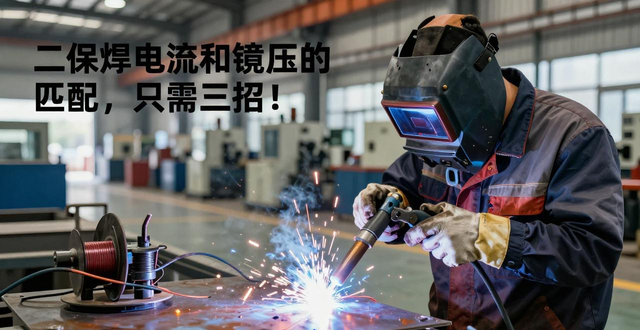
Novice regulators do not adjust the current and voltage match, the main reason is not clear about the relationship between the two, not clear about what role each of these two play.
The current can be used to control the depth of the weld (here the current can be interpreted as the speed of wire feeding, when the current is higher, under the condition that the voltage is kept constant, the number of wires fed per unit of time will be higher, provided that the voltage is sufficient to allow the wire to achieve melting), and the voltage is used to control the width of the melt.
Knowing how these two work, I'll come back to an approach that may seem foolish on the surface, but is the most effective:
The first step is to adjust the knob of the current state to the minimum degree, and the knob of the voltage state to the maximum degree to carry out the test welding operation, do not change the knob of the voltage state at this time, but gradually adjust the knob of the current state, until it can achieve the normal welding situation, then stop.
Secondly, in contrast, the knob responsible for current regulation is set to the maximum level, then the knob used to regulate the voltage is adjusted to the minimum state, to carry out a test weld operation, during which do not change the current knob, and then gradually increase the voltage value until it can be achieved when the normal welding is stopped.
Do you feel that after this kind of debugging, you should have appreciated the role played by the electric current, as well as the role played by the voltage?
The third step, the current knob to a very small, the voltage knob is also adjusted to a very small, and then gradually increase the voltage, and gradually increase the current, in the process need to be repeatedly adjusted, until you find the best state of the weld moulding in the best state, the sound presents the most soft state, and is the kind of match that you can control yourself.
I can congratulate you now that you have found a solution. You have been able to adjust the current and voltage for vertical welding, the current and voltage for flat welding, the current and voltage for horizontal welding, and the current and voltage for back welding.
Specific phenomena and causes
(1) If the voltage is low, the right hand holding the welder will notice a hardening of the welder's head, a strong vibration of the welder's head, a popping sound that can be heard during the process, resistance to movement of the welder, observation through the mask, and more spattering when the wire is stuck in the molten pool.

[Tip] This is due to the voltage is too low state, resulting in the wire feed rate to a great extent more than the melting speed, when the arc is ignited, but also because of the wire will be stamped out and thus the kind of sound.
(2) At that time, the voltage was on the high side, the welding head appeared to be extremely soft, so soft that there was almost no vibration, and because of this almost vibration-free state, it was possible to move the weld as one wished, and when observing it through the mask, the wire drifted above the molten pool, and a large molten ball was formed at the end of the wire, and large molten droplets always appeared to be splattered from time to time.
[Tip] If the melting speed than the wire feeding speed exceeds too much, the arc will continue to burn back to the conductive nozzle, resulting in the wire and the conductive nozzle fused together, the wire feeding stops, the arc is extinguished. This will cause damage to the conductive nozzle as well as the wire feeding mechanism, so make sure the voltage is not too high when starting the arc.
(3) welding operation, when the voltage and current to match the state, will show some of these phenomena: the arc can be stable for combustion, at the same time issued the kind of fine ZiZi sound, the welding head will feel a slight vibration in the hand, the degree of softness and hardness of the right degree, the voltmeter needle will not be more than 5 volts, the ammeter needle will not be more than 30 amperes, and in the hand hold the There will be no vibration at the position where the handles are held.
[Live operation]
(1) turn the knob to adjust the welding voltage, you need to slowly increase the welding voltage, so that the wire melting speed will be accelerated, and burst when the crackling sound, will gradually evolve into a smooth state of the sound of ZiZi.
2) Check the voltmeter and the ammeter, if the current is lower than the preset value, then increase the welding current first, and then increase the welding voltage; if the current is higher than the preset value, then first reduce the welding voltage, and then reduce the welding current.
How to determine whether the welding current is appropriate
Theoretical formula for current regulation
Welding current to how to adjust it, generally can be based on the empirical formula I = (35 - 55)d to calculate the current value, where I represents the welding current unit for A, d represents the electrode diameter unit is mm la, the use of this formula to calculate an approximate welding current, and then carry out a test weld on the steel plate for adjustment, until the determination of the appropriate current.
How to determine the size of the welding current
audible
At the time of welding current is large, issued a “clattering” sound, just like a large river like that; in the welding current is small, issued a “rustle” sound, and mixed with crisp crackling sound.
Observation of splash conditions
When the welding current is too large, the arc blowing force will be large, there will be larger particles of molten liquid towards the molten pool outside the splash out, and in the welding when the bursting sound will be large, the surface of the weldment is not clean; when the welding current is too small, the electrode melts slowly, the arc blowing force is small, the slag and the molten liquid is extremely difficult to separate.
Observe the melting condition of the electrode
Because of the welding current is too large, in the welding rod continuous melting off half of the root, can be found in the remaining part of the red condition; because of the welding current is too small, the arc combustion shows unstable situation, the welding rod is easy to stick in the weldment above.
Look at the shape of the melt pool
When the welding current is high, the long axis of the elliptical molten pool will be longer, when the welding current is low, the molten pool will be flat, and when the welding current is suitable, the molten pool will be similar to the shape of a duck egg.
Inspection of weld formation
When the welding current is too high, the weld metal presents a low state, but the depth of fusion is large, easy to produce the phenomenon of biting edge; for a moment when the welding current is too low, the weld metal becomes narrow and high, and the two sides of the weld metal with the base material bonding condition is poor; when the welding current is in the middle of the welding current, the weld metal obtains a high degree of the situation of the middle of the weld metal, the weld metal on both sides of the weld metal and the base material bonding is quite good.
 Chinese
  Japanese
  English
  German
  Finnish
Leave a Reply
You must be logged in to post a comment.