
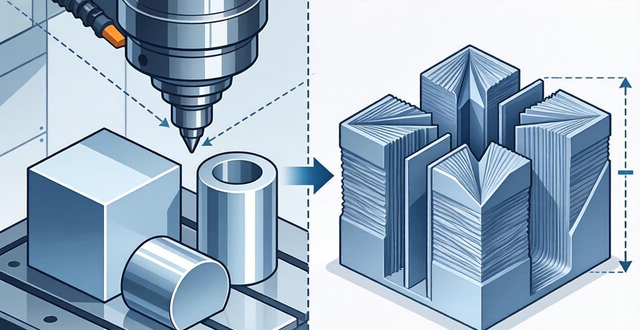
In response to rapid prototyping technology, also known as RP, and theCNC machiningWhen comparing the characteristics of RP and CNC, there are many different opinions, with RP supporters highlighting the advantages of their favourite technology and CNC supporters highlighting the advantages of their favourite technology, which is the key to choosing the right tool for the job.
In the beginning, most RP technologies had significant speed advantages, but problems with accuracy and material properties limited further development. Since the advent of RP, CNCs have been able to bring known benefits in terms of improved speed, given the threat of some competition. Similarly, RP has delivered improvements in accuracy, material properties and surface finish. Understanding these two technologies is essential to selecting the right machining tool for the job.
Material ! d. r) w( ” V
; M5 s R0 r- @& ?5 F) V# t
Material research has gone through a long period of time, this part of the material selection coverage has been expanded, the quality can also be ensured, the current use of materials including metal components, plastics, ceramics and composite materials, etc., but the selection of materials is still subject to certain restrictions, and most of the character of the material is not a very good match with the material processing, moulding and casting level of character.
What you have provided does not appear to be a complete sentence, please provide the specific sentence so I can rewrite it.
For CNC, there are virtually no constraints on `3k-U-A ”h$P;}6N ”d7u`.
Machining centres are capable of making cuts in almost all materials.
Maximum size of parts
‘ Z8
- K) + ^
& ` Correspondingly, with F2, o#, _-, @RP, whose maximum dimensions are 600 mm, and 900 mm, and 500 mm, & f, g9, o(, b4, i5, i, X.
Although there is no industrial equipment available for the production of dashboards or fenders, prototypes are available for the production of most everyday and industrial products. If the part to be produced is too large, it is possible to produce the individual components first, and then eventually piece them together to form a complete part. It is important to note that size has an impact on time, and larger parts take longer to manufacture.
9 T
* k6 M5 F/ $ y5 h: N1 f
capable of producing aircraft parts is CNC ”$x-*g1Z5y.
When machining with a CNC machine, it is possible to produce actual parts and mouldings in a range of sizes from the size of a benchtop unit to the size of a bridge type machine. In this way, the limitations on the size of a CNC machine are due solely to the machine tool used.
What you provided doesn't seem to be a complete sentence yah, please provide meaningful complete sentences that can be rewritten.
# e” E9 x! L! w
RP Unrestricted : {% W9 H: C) w, J7
Assuming that a sample exists that can be moulded with the aid of design software, there is virtually no impact on manufacturing time and virtually no impact on cost. Producing complex parts quickly and cheaply is one of the biggest advantages of RP.
What you have provided does not seem to be a complete comprehensible sentence, please provide the correct sentence so that I can rewrite it as required.
CNC is restricted
CNC machining has to deal with all the detailed features of the part. When the complexity of a part increases, the number of machines required and tooling variations will increase accordingly. Large aspect ratios, deep grooves, deep holes, and square corners increase the cost of CNC cutting equipment. Five-axis cutting tools and certain techniques can overcome these deficiencies, but simple operations such as undercutting can also create problems.
2 `. m0 P% n0 m% X4 t” b
Detailed features
2 ^’ n$ g& @/ t
) m3 p: d” w/ n7 B5 R: z8
5 s# LRP has its own unique features

Unlike CNC, IRP is able to achieve details that CNC cannot. For example, RP is capable of machining features with large aspect ratios, including sharp internal corners, deep and narrow channels, and tall and thin walls and prisms.
* ? + w/ r;
What you have provided does not look like a complete comprehensible sentence yah, please provide meaningful sentences for me to rewrite.
4 f3 ?
CNC has its differences . v# T2 j* v6 _
CNCs have a number of features that go beyond RP, such as sharp edges, smooth overlays, and clean chamfers. These are particularly important when evaluating details related to accuracy, i.e. surface finishing.
Accuracy $ `%
( n+ @* {6 }) i% D” y
RP with an accuracy in the range of 0.125 mm to 0.75 mm.
2 c) For some individual dimensions of p1, the accuracy may exceed 0.125 mm, however, the general deviation is in the range of 0.125 to 0.75 mm. The accuracy varies depending on the RP equipment and the size of the dimensions. As the size increases, so does the accuracy.
The accuracy of the CNC machining centre is within the range of 0.0125 mm to 0.125 mm.
If the machining equipment is used properly, it is possible to achieve high accuracy. Generally, CNC is more accurate than RP, and the accuracy is usually related to the cost of the equipment.
Repeatability : m6 P” D; `1 H1 l
RP is highly sensitive to a number of factors that can affect the quality of a prototype, and manufacturing a part at a different time may yield different results, with temperature, humidity, positioning, and placement being just a few of the factors that can affect the repeatability parameters of a product.
) Z1 U4 C3 c% z: w5
G, ` CNC with high repeatability % l.
# L) f- k8 }; v; J) }4 F, C
The repeatability of RP products when the toolpath, tooling and material used remain the same is far less than the repeatability of CNC. Environmental conditions and human factors can have an impact on the results. For some materials, temperature and humidity can affect the accuracy of the equipment used by the technician, so temperature and humidity can affect the yield.
Surface finishing
1 t4 A” q” j @! i5 B
Objects of size QRP have Ra values in the range of 2.5 µm to 15 µm, where the µm is a unit of length used to accurately represent this range of values.
If no secondary treatment has been carried out, some, if not all, of the surfaces are extremely rough, and RP can, with the help of certain technologies, increase the thickness range of the plates to 0.0125 to 0.025 mm, but the lamination and the unevenness of the plates still have an impact on the surface finish. If a secondary process is intended, the finish can be brought up to the desired level, but this can alter the dimensional accuracy of the part. At the same time, these operations add extra time and cost.
2 E0 E! u9 N’ |) n
The Ra value of CNC is in the range of 0.5 µm to 5 µm, and it has such an interval of values that it is a numerical definition of a specific case.
Machining, unlike RP, is capable of polishing prototypes, models, and tools to their desired surface finish. For RP, secondary processes (such as sanding and polishing) can improve the surface finish, but at the same time have an impact on accuracy, time and cost.
g+ l5 {3 T)
dependability
$ K# a0 C* Q2 w9 f3 z A
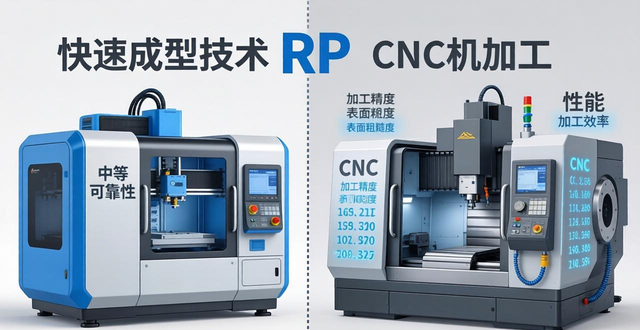
The reliability of the RP is in the middle of the range.
+ x2 H1 d0 F& r* q- j
For most technologies, product reliability increases as the product continues to mature, but the fact that RP technology is only 15 years old suggests that there are different levels of reliability, and because of the technology's short time frame and lack of resources, some RP manufacturers have not had sufficient time to improve device components to increase reliability.
The reliability of the CNC, which is in the middle of the range, is a little bit strange to understand, to say the least.
As a technology with a history of more than 30 years of research and development, CNC is a reliable and dependable technology, as technological improvements have been made over the years to eliminate equipment components that can reduce product reliability.
lead time
1 a$ S6 L2 U’ ?5 i+ c) ^4
” v
The cycle time required for RP is short to medium ( j5 }1
; F# q+ F1 K7 x
RP reduces not only the actual manufacturing cycle time, but also the overall process time because it requires fewer employees, fewer steps, and is less sensitive to design complexity; overall, RP technology is efficient in terms of time and manpower. If RP receives the data at 4.30pm, the product can be produced the next morning. In the case of CNC, if there are not two shifts of production time, absolutely can not produce the product, but it is not to say that RP technology is the fastest for any parts processing and manufacturing.
‘ L! Z: g5 f* O/ q0 O3 `- Q2
; a
The cycle time required for CNC is medium
There are quite a few things involved in machining, covering manpower, tool run trajectories, fixing of devices, machining times, materials, etc. The result is that numerous jobs take a lot more time than RP, however, if the design is simple and easy to understand, the CNC is able to shorten the cycle time, and if the rotary axis is fast, its feed rate will be altered as well.
What you have provided doesn't seem to be a complete sentence with clear semantics yah, please provide the correct sentence so that I can rewrite it as required.
This doesn't seem to be a complete and understandable normal sentence yet, please provide a more appropriate and complete sentence for rewriting yah.
U2 S, y$ g6 L7 M
These belong to some of these personal opinions, some of the data from the network, but I think it is actually quite objective, if there is a different view can be put forward, together to explore some. I'm looking forward to your comments.
0 J( c1 S’ {9 w9 ~3 {* r’ B
# i8 Y% o’ w#
What you have provided does not appear to be a complete sentence, please provide the specific sentence so I can rewrite it.
 Chinese
  Japanese
  English
  German
  Finnish
Leave a Reply
You must be logged in to post a comment.