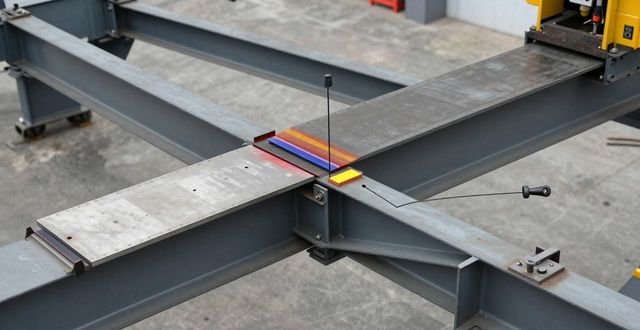


Bridge crane main beam deflection detection and correction method
I. Detection of deflection of main girder of bridge (gantry) crane
In the bridge (gantry) crane safety inspection, the main girder arch test is a very important content. It is clearly stipulated in 82 (technical conditions of general-purpose bridge cranes) that the arch F of the main girder in the middle of the span is equal to L (0.9 - 1.4) divided by 1000, and the maximum arch should be controlled in the middle of the span within the range of L/10. Currently, the traditional wire pulling method and the current hook suspension method, as well as the magnet suspension method, are commonly used. Each of these methods is described below.
1、Pulling steel wire method
The wire-pulling method provides for the presence of three persons to carry out the testing operation, who must go to the main beam of the crane to start the operation, the operation requires the use of © 0.5mm fine steel wire, one end of the wire is fixed to one end of the position of the main beam, the wire should be through the cover plate on the height of the block, the other end of the wire should be connected to the other end of the main beam with the 15kg spring scales placed. The point for measurement is then selected, the vertical distance between the wire and the upper surface of the main beam is measured, and the arch value is then calculated based on the results of the measurement. This method has a large degree of limitation, and is also associated with the dangers encountered by inspectors when working at height. This detection method can only be used in part of the box-shaped double girder overhead travelling crane main girder arch detection, but for the single girder bridge (gantry) crane and the box-shaped double girder overhead travelling crane main girder arch with a skirt plate, there is no way to carry out the detection operation, the detection can not be done.
2、Hanging hook hanging ruler method
Hook hanging ruler method, is the 300mm steel plate ruler hanging upside down on the hook, open the trolley (electric hoist), so that it runs along the I-beam track, with the help of the level set up on the ground, in turn, measure the elevation value of each point of the main beam, and then calculate the value of the arch of its arch, the error of this measurement method is large, and sometimes perhaps the opposite result, the factors affecting the accuracy of the measurement are:
Trolley travelling wheels, there are differences in its radius, there are errors in the shape of the track tread, and there are also three legs of the trolley, all of which will be directly reflected in the elevation value, resulting in the measured elevation value is not the real state, and the final calculation of the arch value will be inaccurate.
3. Magnet suspension method
There exists a method called magnet suspension method, which is to use a thin steel wire with a diameter of © 0.5mm, one end of the wire is fixed on the magnet, and the other end of the wire is fixed on a weight with a mass of 0.5kg, and a steel plate ruler with a length of 300mm is installed on the thin steel wire to be able to adjust the position, and the magnet is adsorbed on the lower surface of the main girder or I-beam rail with the help of a special insulating rod. Or the lower surface of the I-beam track, and then select the two ends of the main beam and the beam in the three measurement points, through the level set up on the ground to read the values presented on the scale suspended by the magnet, and then calculate the arch value of the main beam span it. The formula is as follows:
The mid-span elevation is subtracted by one-half, and the sum of the higher-end span elevation and the lower-end span elevation is shown in parentheses; the result is the mid-span arch value of the main girder.
When the steel plate ruler is fixed on the steel wire in a positive way, if the measured result shows a positive value, then this situation is judged to be the upper arch, if the result is negative, then it belongs to the lower deflection, with the help of such a method can be a variety of different types of crane girder arch detection, and the method has the characteristics of simplicity, and the results are very accurate, but also can save time and effort.
Second, bridge (gantry) crane main beam deformation correction method
The main girder of an overhead travelling crane will elastically deflect under its own weight and the loads applied to it, thus adding resistance to the load carriage. In order to compensate for this deflection of the main girder, the design requires that the main girder be made as a girder with an arch. So the arch becomes the main crane girder design and manufacturing during the main problem, must ensure that the specified arch value, neither too large, nor too small.
Only, bridge (gantry) crane main girder, in the manufacturing period, there will be different degrees of permanent deformation, in the use of the process, the same will produce different degrees of permanent deformation. In the main girder manufacturing period, given the main girder under the arch warping value of the reserved amount of lack of reasonableness, as well as the impact of the temperature, as well as the implementation of the welding process in the implementation of the error and many other factors, in the main girder welded, it's the arch, warping, horizontal side bending and the verticality of the web plate, that is, the main girder twisted deformation and so on, do not necessarily meet all the requirements, and therefore the need to carry out corrective work; If an overhead travelling crane's two main girders are not the same height at the same cross-section, the same must be corrected; while the crane is put into use in the process, because the main beam is not rigid enough to keep full load for a long time, or the crane works in a poor environment and many other factors, will also lead to permanent deformation of the main beam, when the value of the arch and the warping value is reduced to a certain degree, it is inevitable that repairs are necessary. Correction, according to the national standard -85 (lifting machinery safety regulations) in 1, 4, 10 provisions: for general bridge type crane, when the trolley is in the middle of the span position, and in the rated load condition, the main beam span under the deflection value of the horizontal line, up to the span of 1/700, if it can't be repaired, it should be scrapped. Therefore, in the bridge (gantry) crane manufacturing and use of the process, the main girder correction of this behaviour is absolutely indispensable, and is quite critical work. What kind of way to correct, this will be directly on the crane main beam deformation correction results, correction costs, the main beam in the external quality and crane system safety use and other aspects of the impact. Therefore, reasonable and correct correction method, extremely important, can not be ignored.
Currently, the main beam deformation correction methods include: flame correction method, pre-stressing method, repeated welding method, cutting method, and local cutting pad method. The specific choice of method depends on the situation, not a generalisation. Only by mastering the characteristics of each method, the scope of application, attention and other knowledge, you can correctly and reasonably select the correction programme, and then obtain a more ideal correction results.
1、Flame correction method
The principle of the flame correction method is like this, is in the metal structure on top of the local heating, resulting in some parts of the metal structure suffered plastic compression, to be cooled down, by virtue of the residual local contraction stress to achieve the effect of correcting the deformation.
Heating zones for arch buckling correction of main girders are shown in Fig. 1

In the case of under-arching, the lower triangular area of the heating plate and the rectangular area of the lower cover plate, and in the case of under-warping, the upper triangular area of the cantilever web and the rectangular area of the upper cover plate are heated. The size of the baking points, the number of baking points and the location of the baking points must be determined according to the actual conditions of the deformation. However, the following points must be noted:
The most suitable temperature for heating is in the range of 700 to 800 degrees Celsius; the temperature should not be too high or too low.
Since the yield limit of the metal (mild steel) tends to zero when heated to this temperature, the metal is in the hot carbon steel “state” and the correction is most effective.
Repeated heating is not possible when the metal is in the same position. Once repeated heating is carried out, the effect is not only not good, but also damaging to the metallic organisation of the metal.
The heating point should be placed at the bulkhead. This reduces the waviness of the web.
The heating point should avoid the dangerous section. After heating and straightening, the stress in the area of the baking point will increase, so the load stress in the dangerous section will also increase, thus making it easy to make the deformation effective.
( E ) After deformation of the main beam, the main beam should be strengthened. This is due to the fact that the stresses in the main girder are quite high after the correction. After many years of use, the metal material will gradually fatigue. This leads to a lack of rigidity. If no reinforcement is carried out, the effect of the straightening will not be maintained. On the contrary, the deformation will become more serious. Therefore, it is necessary to reinforce the material after straightening. Generally speaking, the method of reinforcement is as follows. Within the span of the main girder, channels are used on both sides of the lower cover plate. At the same time, an additional layer of lower cover plates is added at the web position. This increases the cross-section of the main girder.
The advantages of the flame correction method are:
Therefore, the flame correction method is widely used. However, this method of correction has the following shortcomings.
During flame straightening, in order to achieve a compression moulding effect, the part of the main beam used for straightening must be lifted upwards a little, so that the baking zone is subjected to compressive stresses, otherwise there will be no effect, and this will make the construction more difficult.
Even though the flame is heated at the bulkhead, it can cause the web and the cover to become more wavy.
? The main beam must be reinforced after flame correction, otherwise, more severe deformation will occur.
Based on the above discussion, under normal circumstances, we do not advocate the use of flame straightening method except for localised correction of hard bends. However, for large steel sections, such as I-beam, channel steel, such as straightening and do the reverse deformation, the use of flame straightening method is the most ideal, neither large presses, and do not need too spacious site, according to the degree of bending of the steel section, the appropriate selection of a few baking points, baked into a triangle on the surface, baked into a rectangle on the plane, baking the size of the point, the number of deformation based on the degree of decision, can be adjusted, both labour-saving and fast. Save energy and fast.
2、Prestressing method
Prestressing method to correct the main beam deflection, the principle is, in the main beam at both ends of the cover plate with the help of fixed support, through the pre-stressing tensioning to carry out a number of steel bars or steel wire rope operation, so that the main beam to withstand a bending moment, the moment under the upper part of the main beam to withstand tensile stress, the lower part to withstand compressive stress, under the action of the bending moment for the main beam to restore its upward for the upward state of the installation structure can be seen in Fig. 2. when the main beam encountered loads When the main beam encounters the load, its working pressure is just opposite to the direction of the steel prestressing force, so that the steel prestressing force can offset part of the working compressive stress, which improves the load capacity of the main beam.
Figure 2
The prestressing method is an effective method for the correction of main girder deflection. It has the following advantages.
After correction, the value of the upper arch becomes accurate and stable, and it can be adjusted at any time according to the changes that occur during the application.
? After straightening, the strength and stiffness of the main beam can be enhanced;
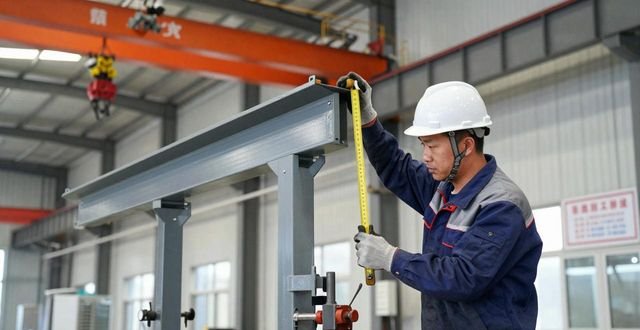
? The corrective construction process is simple, easy to implement, short cycle time and low cost.
However, it also has the following shortcomings:
? Only for bridge (gantry) crane box-shaped main girder arch degree under the deflection of the correction;
Horizontal bending and localised deformation of the main girder, warping correction of the gantry crane jib, etc. are not possible with this method.
? The shape of the correction is not aesthetically pleasing.
The prestressing method is most suitable when the crane has the following conditions:
? Cranes that have been used for many years;
? Insufficient rigidity of the main beam and poor load carrying capacity;
? Cranes are operated at full load for long periods of time;
? Poor working conditions, etc.
3. Repeated welding method
Repeated welding method is based on the principle of a specific way, the main weld by virtue of the high current, the use of repeated application of this means, resulting in the production of theWelding distortionThis is used to correct the original deformation and thus to correct the deformation. For example, when it is necessary to increase the arch of a main girder, two fillet welds are repeatedly applied to the lower cover plate and web of the main girder. In view of the cooling shrinkage of the welds, the resulting stresses increase the upper arch. If it is necessary to reduce the horizontal side bending, the horizontal side bending can be reduced by repeated welding at the two fillet welds between the convex web and the upper and lower cover plates. The welding current and the length of the repeated welds are determined according to the degree of correction to prevent overcorrection and to avoid back-correction.
It has been proved in practice for many years that this correction method is the best, with the characteristics of accurate and effective, smooth deformation, and does not lead to defects in appearance. This method is suitable for the correction of arch buckling value, the correction of horizontal side bending and the correction of large height difference between two main girders of the same cross-section of the bridge crane, etc., and it has multiple advantages such as practicality, economy, simplicity, good quality and speed. However, it is not applicable when there is a hard bend in one part of the main girder, or when the rigidity of the main girder is insufficient and large deformation occurs after long-term use.
4. Cutting method
Based on the principle of forming the upper arch by the shrinkage stress of the weld in the earlier main girder manufacturing, the arch warpage of the main girder can be improved by welding deformation. However, in order to generate the required welding deformation, a higher welding current is usually required, but this may cause the upper cover plate to burn through or shrinkage holes and other welding defects, in addition to the use of welding thermal deformation is more difficult to control the amount of deformation and the direction of deformation, which is likely to lead to the main girder and other technical parameters are too poor.
In some cases, it is possible to cut the top plate of the main girder with the help of the influence of the weight of the main girder on the arch warping. After cutting, the bending modulus of the cross-section of the main girder at the cutting location decreases, resulting in a weakening of the bending capacity of the main girder. Under the action of the main beam's own weight, its mechanical deformation occurs, the arch value in the span decreases, and the cantilever end buckling value increases. If this scheme is adopted, it is relatively easy to control the whole correction process and the size of the deformation. However, it should be noted that the main and secondary webs around the cutting position may lead to excessive web wave due to the rotational deformation of the main girder along the axis perpendicular to the web direction, which must be prevented.
Such a method has been proven to be feasible, easy to operate and easy to control. When the main girder undergoes permanent deformation, it can usually maintain its original technical data well, and will not cause large changes in technical parameters after the release of internal stresses or thermal deformation due to aging. Therefore, the cutting method is a good way to correct the newly-built main girder when the main girder arch warpage exceeds a large range, and this method can also be used to correct the deficiencies of cantilever excessively high (qualified within the span), excessively high within the span (qualified within the cantilever), or some other defects in the arch warpage, as long as the main girder is supported by the overhang, selecting a different support position and choosing a different cutting part, the intended target can be achieved. In the case of a relatively large amount of correction, it must be noted that, must pay attention to take measures in terms of technology, in order to prevent deformation of the web.
In addition to the four methods mentioned above, other such as local heating method and so on, will not be described in detail here. In a word, in short, all in all, all kinds of correction methods of choice, must be by the need to correct the specific circumstances of the equipment, to carry out a comprehensive and serious analysis, can decide to use which one of the programme, or a combination of several programmes used, so as to the shortest possible period of time, with the help of the lowest cost, and then obtain the best results.



 Chinese
  Japanese
  English
  German
  Finnish
暂无评论内容