
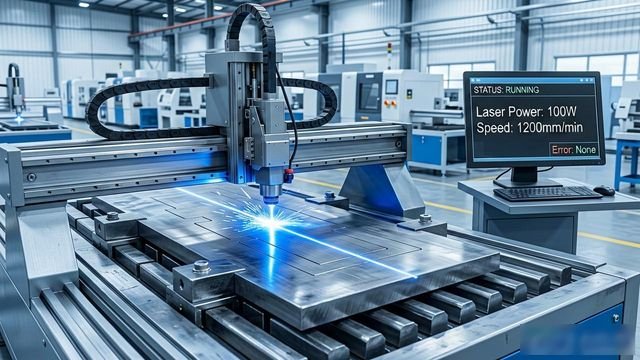
Traditional processing methods in sheet metal workshops involve shearing, punching and bending. The punching process requires a large number of dies; in sheet metal workshops, punching is characterised by minimal or no cutting, making it extremely important. Consequently, once a product has been processed, it generally requires dozens of sets of dies. and some products may even require hundreds of sets. In terms of time, the dies themselves require a certain design and manufacturing lead time, whilst the product also requires a specific prototyping period; this results in significant delays. From an economic perspective, the use of a large number of dies leads to a corresponding increase in product costs, resulting in a waste of resources. Consequently, within the highly competitive market environment, there is an urgent need for a new machining method to replace conventional approaches.
For all these reasons, laser processing technology has emerged in sheet metal workshops, The most significant feature of this technology is that it enables processing without the need for dies. The use of laser cutting for blanking eliminates the need for a large number of dies, thereby reducing production time and lowering product costs, which gives it a competitive edge in the market. It is particularly well-suited to the production of small-batch, high-variety products, as well as subsequent large-scale production runs.
Characteristics and Advantages of Laser Processing Technology
Lasers used in sheet metal workshops are characterised by their high brightness and extremely precise directionality; the laser beam is monochromatic and parallel, making it a coherent light source with a very high energy density. When the laser beam is focused, it can generate high temperatures in the material it strikes. Under temperatures reaching tens of thousands of degrees, regardless of the material’s hardness, melting and vaporisation occur instantaneously. At the same time, a shock wave is generated, enabling the material to be removed through melting. Essentially, during the laser material processing process, a localised area is heated to the point of melting, thereby forming vaporised material.
Laser processing technology in sheet metal workshops can be used to machine parts that are difficult to produce using traditional methods. For example, when it comes to large steel components requiring numerous holes of varying sizes, which is beyond the capabilities of traditional machining methods. However, laser processing technology is able to meet these requirements. Even when machining identical parts, laser processing offers the advantages of high precision and short processing times, thereby giving the products a strong competitive edge in the market.

Laser processing in the sheet metal workshop offers considerable flexibility in a two-dimensional plane, utilisinglaser cuttingDuring operation, the workpiece remains stationary whilst the cutting head moves; this prevents dead spots in the machining process, thereby improving material utilisation. It also eliminates the need for micro-connections in the equipment, resulting in a more streamlined laser processing system. Laser processing equipment is controlled holistically via a computerised control system, enabling processing to commence without the need to control individual parts, set up dies or design processing routes separately. Consequently, the preparation time for laser processing operations can be significantly reduced. The high processing speed of laser processing equipment shortens processing times and improves production efficiency.
Sheet metal workshop utilising laser processing technology
When the sheet metal workshop processes components, the procedure is as follows: first, preliminary development trials are carried out; this is followed by trial production; and finally, mass production commences. During the trial production phase, it is essential to maintain close communication with the customer. Only after receiving feedback on the processing results will mass production of the product commence.
The sheet metal workshop must maintain timely communication and consultation with customers to finalise various matters, including technical specifications for product requirements, contracts covering technical confidentiality, the management of product patents, design proposals and drawings, the handling of relevant technologies, and specific product delivery deadlines. Furthermore, contracts must be drawn up accordingly to clarify technical responsibilities and the respective rights of each party. Throughout the manufacturing process, the sheet metal workshop must maintain confidentiality regarding the customer’s technical information to ensure that their products are not subject to infringement or damage.
Upon receiving a commission for batch prototyping or production, the technical staff responsible for this task must carry out the relevant manufacturing activities in accordance with the standards specified in the contract. To ensure that the technical staff in the sheet metal workshop possess the requisite professional qualities, they must adopt an efficient and prompt approach to their work, thereby achieving the objective of delivering a satisfactory outcome for the customer.
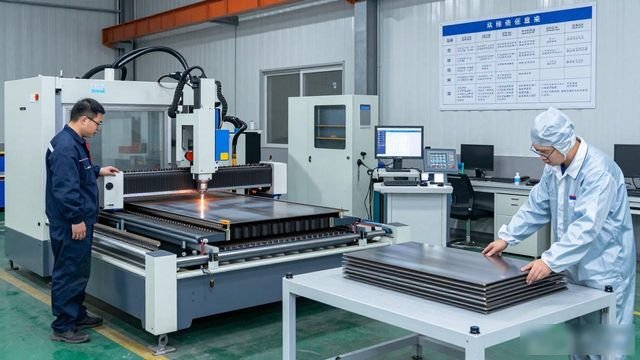
Technicians in the sheet metal workshop must be familiar with the characteristics of laser processing equipment, must be aware of the condition of the laser processing equipment, carry out proper maintenance to keep the equipment in optimal working order, and, when performing laser processing, conduct visual inspections in a timely manner, covering both macro and micro observations. They must also examine the cross-sectional shape of the laser-cut material and record the relevant information. Within the laser processing centre, there are areas housing the laser generator, the laser cutting zone, the computer control area, the raw material loading zone, the finished product unloading zone, and the material transfer device work area. Of these, the raw material loading area and the finished product unloading area require technical personnel to operate them, whilst the other areas—such as the laser generator area, the laser cutting area, the computer control area, and the material transfer device work area—can be automated through computerised control.
Sheet metal workshops use CO₂ or YAG lasers for laser cutting, performing both two-dimensional and three-dimensional cutting operations. This method is characterised by high cutting precision, with laser source power ranging from 5W to 90kW across a range of products; for sheet metal laser cutting, lasers with power outputs of 100W to 1500W are primarily used. When the laser source output power is less than 1500W, the laser source operates in single-mode oscillation, capable of cutting widths as narrow as 0.2 mm, with clean and smooth results. When the laser source output power exceeds 1500 W, the laser operates in multimode oscillation, capable of cutting widths up to 1 mm, though this may result in a small amount of residue.
When cutting thick plates, an auxiliary gas must be used; such gases include air, oxygen and nitrogen. Nitrogen prevents oxidation of the cut surface during the cutting process, whilst oxygen is suitable for high-speed cutting of thicker plates. In sheet metal workshops, laser cutting can utilise CAD or CAM technology to provide processing information and parameters for workpiece models and lasers, enabling rapid and high-precision production and meeting the requirements for automated cutting. Laser cutting places particular emphasis on tooling changeovers, which helps to shorten production lead times and reduce production costs.
In sheet metal workshops, laser processing technology—as a new process—is a product of modern scientific development. Techniques such as laser cutting, laser welding, laser drilling and laser forming are used in the production and processing of sheet metal components, and technicians are required to be proficient in their operation. With the continuous advancement of laser material processing technology, production and processing in sheet metal workshops will undoubtedly achieve a high degree of stability, reliability, efficiency and automation.
 Chinese
  Japanese
  English
  German
  Finnish
Leave a Reply
You must be logged in to post a comment.