

Today, advances in artificial intelligence technology are reshaping the scope of possibilities within the robotics industry—from flexible production lines in factories, to handling equipment in warehousing and logistics, to humanoid robots gradually emerging from the laboratory, “increasingly intelligent, increasingly robust and increasingly collaborative” has become the common trend guiding the next generation of robots, and at the very forefront of this progression, Harmonic reducerAs components referred to as the “core parts” of robotic joints, they are currently facing unprecedented pressure driven by demand—not only must they meet the rapid increase in shipment volumes, but they must also achieve breakthroughs simultaneously in terms of dimensions, torque and precision.
Statistics show that there are approximately 2 million robots in China, which is about 4.5 times the number in Japan, the country in second place. Furthermore, the International Federation of Robotics (IFR) reports that of all robots installed globally in 2024, 295,000 units—accounting for approximately 54%—were deployed in China. Whilst the industry as a whole has entered a cycle of expanded production, the number of companies truly capable of achieving stable mass production in the large-size, high-torque segments remains limited. As one of the leading companies in China’s harmonic reducer sector, Laifu Harmonic has long been dedicated to the field of precision transmission. Relying on its proprietary tooth profile designs and manufacturing processes, the company continues to refine its capabilities in mass production and product stability. Faced with a new wave of demand driven by AI and humanoid robots, Laifu Harmonic is further expanding its product portfolio towards “high-load” applications.
Type 58 Harmonic Reducer: Designed for High-Load Applications
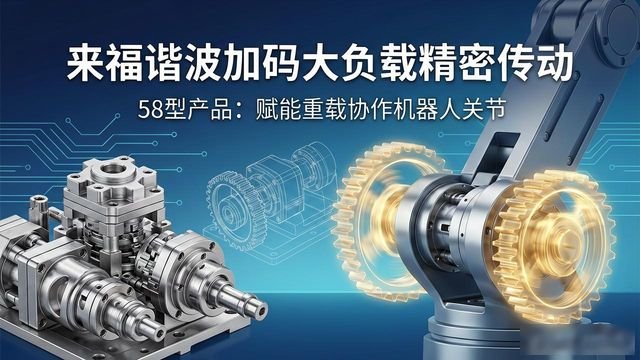
In line with this strategy, Laifu Harmonic is currently establishing a series of products tailored to the high-payload collaborative robot sector, covering size ranges such as 45, 50 and 58, with a focus on applications involving high-payload collaborative robots and industrial robots. Among these, the Type 58 harmonic reducer is Laifu’s flagship product, specifically developed for large collaborative robots and heavy-duty industrial robots, representing a comprehensive upgrade in key performance parameters.
Let’s first take a look at a set of detailed specifications: the Model 58 has an outer diameter of 240 mm, with gear ratios of 100, 120 and 160, and a rated torque ranging from 900 Nm to, with peak torque exceeding this figure and a transmission accuracy of less than 1 arc minute. These specifications demonstrate that this Laifu Harmonic product is capable of balancing torque output and motion accuracy under heavy loads, making it suitable for the high-load and high-stability requirements of large collaborative robots.

In other words, the Type 58 has struck a new balance between the harmonic reducer’s ability to “withstand forces” and its “precision of operation”. This means that robots equipped with this unit can perform more complex and flexible tasks as collaborative robots in scenarios—such as automotive manufacturing, heavy-duty assembly and logistics handling—where traditional industrial robots were previously the norm.
From “capable of production” to “stable mass production”
In fact, the challenges associated with large-sized harmonic reducers extend far beyond the mere issue of “scaling up”. For a long time, the industry has been grappling with a range of issues, including the considerable difficulty of tolerance matching, the unclear mechanisms underlying the deformation of the flexible ring, poor manufacturing consistency, and difficulties in inspection and traceability. Furthermore, any deviation at any stage is highly likely to manifest as transmission errors, noise, wear or a reduction in service life during the operation of the complete unit.
The solution proposed by Laifu Harmonic to address these pain points is more akin to what might be described as a complex system engineering approach. Thanks to the company’s innovative design concept—a new tooth profile developed entirely in-house—the load-bearing capacity of the entire unit has been significantly improved by approximately 60%, whilst wear has been reduced by 40%. The precision of this bidirectional angular transmission mechanism has been successfully controlled to within 40 arc seconds, whilst service life has been substantially extended to over 10,000 hours; furthermore, stiffness degradation over the entire service life is less than 20%. In developing this key component, the company utilised technology based on 3D curved-surface meshing to achieve high-precision contour finishing, as well as dynamic meshing to establish a precise simulation method. This resulted in a 50% improvement in the overall R&D efficiency of the new product, whilst costs have fallen steadily by 30%.
Lai Fu Harmonic places emphasis on consistency and controllability in the manufacturing process. For the high-efficiency, precision machining of flexible gears, the company has established a gear hobbing model based on multi-tooth intermittent cutting, thereby addressing the issues of tooth surface topography prediction and the optimisation of process parameters. For the high-efficiency, precision machining of rigid gears, Laifu Harmonic has established a mapping relationship between machining errors and the transmission errors of the complete unit, conducting multi-dimensional comparisons to achieve precise control of transmission errors. At the same time, the shot peening surface hardening process has further extended product service life by 30%, and the remaining service life prediction method, based on historical performance data, has achieved an accuracy rate of 85%.
This technology does not exist in isolation; for robotics companies, high-load joints require not merely individual components with high performance specifications, but rather transmission solutions that can be reliably supplied, verified and traced. For harmonic reducer manufacturers, the more complex the robotic application scenarios become, the greater the impetus for continuous iteration in tooth profile design, material processing, machining precision and service life modelling. The launch of the Laifu Harmonic 58 model is a prime example of this “mutually reinforcing” dynamic.
Mutual Empowerment with the Robotics Industry
The relationship between harmonic reducers and robots has never been a one-way supply relationship; the evolution of robot design has, in turn, driven breakthroughs in core components towards larger sizes and higher power densities; whilst the expansion of the performance boundaries of reducers, in turn, unlocks greater design freedom for robots, making it possible to combine characteristics such as “heavy-duty + collaborative” and “dexterity + strength”—which were previously difficult to reconcile.
A concrete example of this “two-way empowerment” is precisely the fact that Laifu Harmonic’s Model 58 product has already been brought to market. At present, large AI models are accelerating their penetration into embodied intelligence, whilst the humanoid robotics industry chain is taking shape at a remarkable pace. In this context, whoever can be the first to achieve a solid level of performance in the large-size and high-torque segments—and to make these capable of mass production—will have the greatest opportunity to secure a place in the next phase.
Laifu Harmonic, having evolved from a company dedicated solely to a single category of components to one capable of deep engagement across the entire robotics industry—thereby upgrading its capabilities to meet the complex demands of that sector—is driving the evolution of Chinese robotics, one joint at a time.
 Chinese
  Japanese
  English
  German
  Finnish
Leave a Reply
You must be logged in to post a comment.