
Grinding, is a machining method that falls within the category of finish machining (it should be noted here that mechanical machining encompasses a variety of processes, including rough machining, finish machining and heat treatment); it is characterised by a small amount of material removal and high precision. It is widely used in the mechanical manufacturing industry, for components made of carbon tool steel and carburised and quenched steel that have undergone heat treatment, a large number of cracks exhibiting a relatively regular arrangement often appear on surfaces that are essentially perpendicular to the grinding direction during the grinding process; this is known asGrinding cracks, Not only do such cracks inevitably affect the appearance of the component, but, more importantly, they also directly compromise the quality of the component.
Grinding is a machining process that shapes the surface of a workpiece using high-speed rotating grinding wheels or other abrasive tools. It is used to machine the internal and external cylindrical surfaces, conical surfaces and flat surfaces of various workpieces, as well as special and complex profiled surfaces such as threads, gears and splines. Given the high hardness of the abrasive grains and the self-sharpening properties of the grinding tools, grinding can be used to machine a wide range of materials, including hardened steel, high-strength alloy steel, cemented carbide, glass, ceramics and marble. The linear speed of grinding is defined as the linear speed of the grinding wheel, which typically ranges from 30 to 35 metres per second; when this speed exceeds 45 metres per second, the process is referred to as high-speed grinding. Grinding is used for semi-finishing and finishing operations, with accuracies capable of reaching IT 8 to 5 or even higher. The surface roughness of general grinding is typically Ra 1.25 to 0.16 micrometres, whilst that of precision grinding is Ra 0.16 to 0.04 micrometres. ultra-precision grinding yields a surface roughness of Ra 0.04 to 0.01 micrometres, whilst mirror grinding can achieve a surface roughness of less than Ra 0.01 micrometres. The specific power consumption of grinding—also known as specific energy consumption, which is the energy consumed to remove a unit volume of workpiece material—is greater than that of conventional cutting processes, whilst the metal removal rate is lower than that of conventional cutting. Consequently, prior to grinding, workpieces are typically machined using other cutting methods to remove the majority of the machining allowance, leaving only a grinding allowance of 0.1 to 1 millimetre or less. With the development of high-efficiency grinding techniques such as slow-feed grinding and high-speed grinding, it is now possible to grind parts directly from the blank. Grinding is also used for rough machining, such as removing the risers and gates from castings, flash from forgings, and the outer skin from steel ingots.
Cylindrical grinding
Grinding Machines

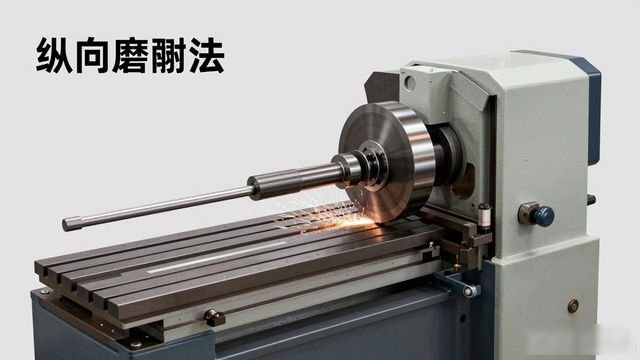
This operation is carried out on a cylindrical grinding machine and is used to grind the outer cylindrical surfaces, outer conical surfaces and shoulder end faces of shaft-type workpieces. During grinding, the workpiece rotates at low speed. If the workpiece simultaneously undergoes longitudinal reciprocating movement, and after each single or double stroke of this longitudinal movement, the grinding wheel is fed transversely relative to the workpiece, this is known as the longitudinal grinding method (Figure 1). If the width of the grinding wheel exceeds the length of the surface being ground, the workpiece does not move longitudinally during the grinding process; instead, the grinding wheel is continuously fed transversely relative to the workpiece. This is known as plunge grinding. Plunge grinding is generally more efficient than longitudinal grinding. If the grinding wheel is dressed to form a profiled surface, the plunge grinding method can be used to machine profiled external surfaces.
Internal cylindrical grinding
It is specifically designed for grinding cylindrical bores (Fig. 2), tapered bores and bore end faces on internal cylindrical grinders, universal external cylindrical grinders and coordinate grinders. The longitudinal grinding method is generally employed. When grinding the inner surface to a specific profile, the plunge grinding method may be used. When grinding internal bores on a coordinate grinding machine, the workpiece is clamped to the worktable; in addition to rotating at high speed, the grinding wheel performs a planetary motion around the centre line of the bore being ground. During internal cylindrical grinding, given the small diameter of the grinding wheel, the grinding speed is often less than 30 metres per second.
Surface grinding
It is primarily used on surface grinders for grinding flat surfaces, grooves and the like. There are two methods of surface grinding: One involves using the outer cylindrical surface of the grinding wheel for grinding; this is known as peripheral grinding, as illustrated in Figure 3. Generally, a horizontal-spindle surface grinder is used for this purpose; if a shaped grinding wheel is employed, it is also possible to machine various shaped surfaces; The other involves grinding using the end face of the grinding wheel; this is known as end-face grinding and is usually carried out on a vertical-spindle surface grinder.
Sharpening and grinding tools
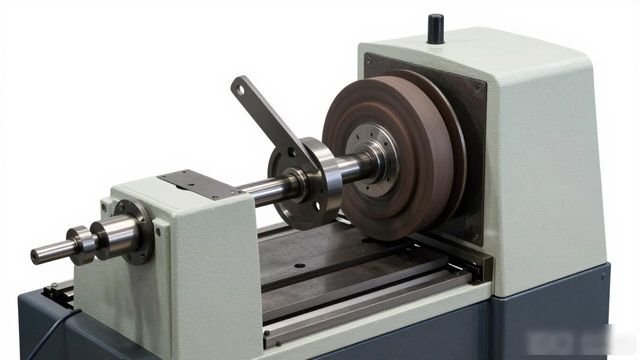
This is typically carried out on a centreless grinding machine, with the aim of grinding the outer circumference of the workpiece. During grinding, the workpiece is not centred or supported by centres; instead, it is positioned between the grinding wheel and the guide wheel, supported by a support plate beneath it, and rotated by the guide wheel. When the axes of the guide wheel and the grinding wheel are set at an angle of 1° to 6° to each other, the workpiece is able to perform an automatic axial feed movement whilst rotating; this is known as through-feed grinding (Fig. 4). Through-grinding can only be used for grinding external cylindrical surfaces. When employing plunge centreless grinding, the axes of the guide wheel and the grinding wheel must be adjusted to be parallel to one another, so that the workpiece is supported on the support plate without axial movement, whilst the grinding wheel continuously performs a transverse feed relative to the guide wheel. The surface that can be machined is achieved through plunge centreless grinding; centreless grinding can also be used for internal cylindrical grinding. During machining, the workpiece’s outer circumference is supported and centred by rollers or support blocks, and an eccentric electromagnetic chuck is used to drive the workpiece rotation, The grinding wheel extends into the bore to perform the grinding operation. In this scenario, where the outer diameter serves as the positioning reference, it ensures that the inner and outer diameters are concentric. Centreless internal grinding is frequently used to grind the inner raceways of bearing rings on specialised bearing ring grinding machines, isn’t it?
Processing characteristics
When grinding is compared with other cutting processes such as turning, milling and planing, it exhibits the following characteristics:
 Chinese
  Japanese
  English
  German
  Finnish
Leave a Reply
You must be logged in to post a comment.