

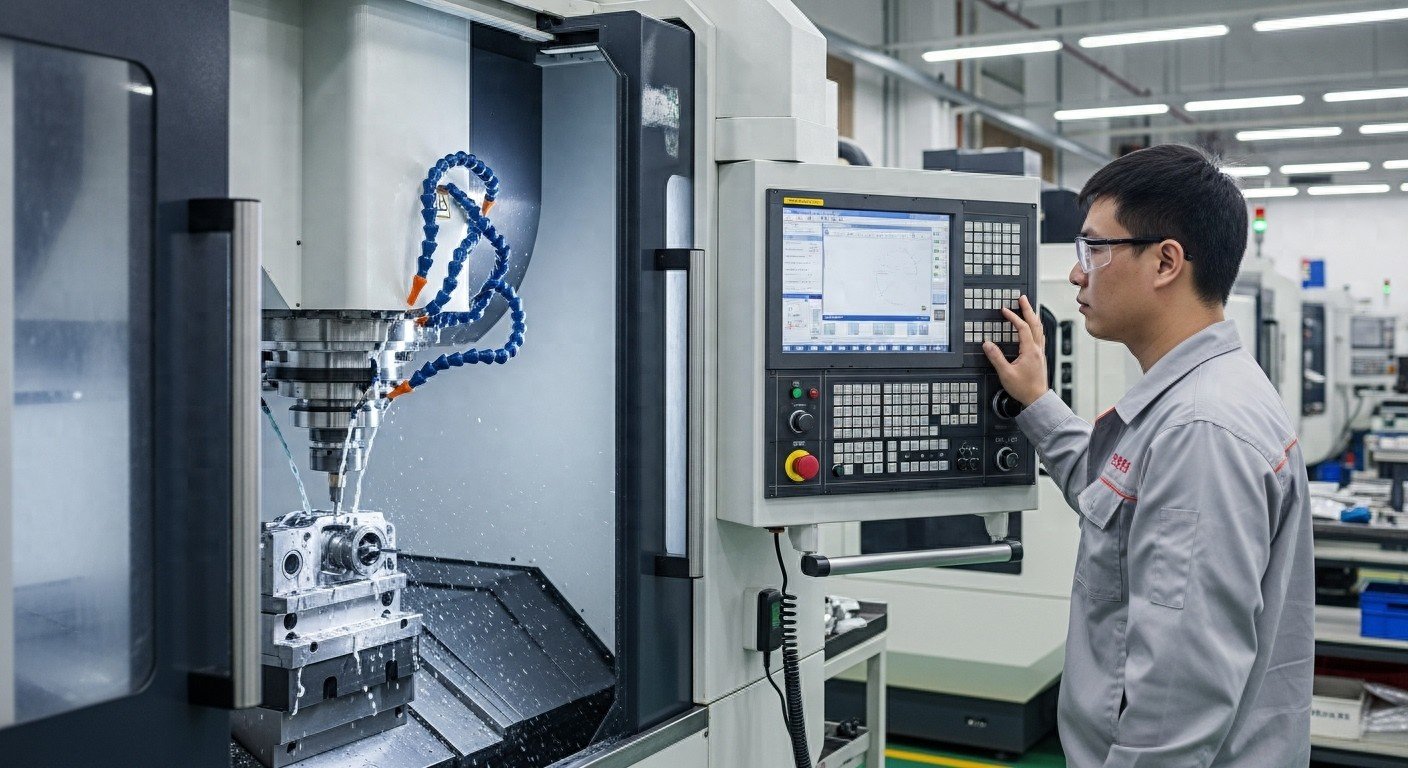
CNC is an acronym for ‘Computer Numerical Control Machine Tool’, commonly referred to as a CNC machine tool. It is a type of automated machine tool that operates under programme control. There is also the so-calledCNC Programming, refers specifically to the process of programming CNC machine tools.
CNC machining covers an extremely wide range of topics and involves many different aspects; this specific term is frequently used, particularly within the mechanical engineering sector. What exactly does the field of CNC machining encompass? What points require attention when carrying out CNC programming? Questions such as these fall within the scope of this field and are well worth in-depth consideration and exploration. We shall now proceed to provide a detailed introduction to these topics.
1. CNC programmingPoints to Note
(1) When the workpiece is at a higher level, roughing should be carried out using tools of different lengths in stages; once roughing with a large tool has been completed, a smaller tool must then be used to remove any remaining material.
(2) Use a flat-bottomed cutter to machine flat surfaces, minimising the use of ball-nose cutters wherever possible in order to reduce machining time; where a chamfer is required and the chamfer angle is an integer, use a chamfering cutter for the operation.
(3) Set tolerances appropriately to strike a balance between machining accuracy and computer calculation time, increase the number of machining operations, and reduce the time spent on idle cutting.
(4) For workpieces with high hardness, up-milling should be used; for workpieces with low hardness, down-milling should be used. Up-milling is employed during rough machining, whilst down-milling is used during finish machining.
(5) Tool materials with good toughness but relatively low hardness are suitable for rough machining, whilst those with poor toughness but relatively high hardness are suitable for finish machining.
2. CNC Machining Processes
(1) Workpiece clamping methods and selection of fixtures
When machining parts on CNC machine tools, the clamping method requires the appropriate selection of positioning references and clamping arrangements. When selecting precise references, one must generally adhere to the two principles of “unified references” and “coincident references”. In addition to these two principles, the following factors must also be taken into account:
a. Every effort should be made to machine all surfaces in a single clamping operation; therefore, a positioning method must be selected that allows all surfaces to be machined.
b. It should be possible to machine all surfaces of the workpiece in a single set-up.
c. When determining the positioning of the workpiece on the worktable, it is necessary to take into account the machining requirements at each station, the length of the cutting tools, and the impact of the tools’ rigidity on machining quality.
d. When selecting fixtures to be used during controlled machining, those assembled from standard components should be chosen. Furthermore, they must be adjustable fixtures. The aim of this is to reduce set-up times.
(2)order of processingthe arrangements
When determining the machining sequence, certain basic principles must be adhered to, including “machining surfaces before drilling” and “rough machining before finish machining”, amongst others. In addition to these basic principles, we should also follow the guidelines set out below, namely:
a. Carry out machining operations in accordance with the tool grouping method to prevent the same tool from being used repeatedly, thereby reducing the number of tool changes and the time taken.
b. For hole patterns with extremely high concentricity requirements, once positioning has been completed, all machining operations for that particular hole pattern should be carried out in one go before proceeding to machine hole patterns at other coordinate positions. This approach eliminates errors arising from repeated positioning, thereby improving the concentricity of the hole pattern.
c. Once the tool entry and tool change points have been selected and confirmed, they should not be altered.
(3) Planning the tool feed path
In this context, the feed path refers to the trajectory of the cutting tool relative to the workpiece in CNC machining. When planning feed paths, certain principles must be followed, specifically: ensuring that the workpiece achieves good machining accuracy; ensuring that the workpiece achieves good surface quality; simplifying numerical calculations; and minimising the length of the feed path.



 Chinese
  Japanese
  English
  German
  Finnish
No comments