

The Advantages of Cold Spraying Technology
1. Suitability for a wide range of materials: It can be used for spraying a wide variety of materials, including metals, plastics, ceramics and more, and is highly versatile.
2. In terms of the properties required for durability and protection, the resulting coating generally possesses exceptionally high corrosion resistance and wear resistance; it protects the substrate, thereby extending its service life.
3. Cold spraying causes virtually no environmental pollution, and any powder overspray can be recovered and reused.
4. Cold-sprayed coatings have low residual stresses, which are compressive in nature, making them suitable for the production of thicker coatings.
5. The chemical composition of the coating remains consistent with that of the base material, and its microstructure is also identical to that of the base material; oxidation is virtually non-existent, loss of alloy composition due to burning is virtually non-existent, and phenomena such as grain growth do not occur. It is suitable for spraying heat-sensitive materials, as well as reactive metals and polymeric materials, and is applicable to the preparation of both amorphous and nanocrystalline coatings.
Factors Affecting the Quality of Cold-Spray Coatings
The factors that can influence the properties of cold-spray deposited coatings can be divided into three categories: firstly, process parameters, such as gas conditions, nozzle design and spraying kinetics; secondly, powder characteristics; and thirdly, spraying parameters.
(1) Research into cold spraying process parameters is primarily based on fluid dynamics, exploring their impact on deposition efficiency and the final quality of the deposited layer. The formation of deposits depends primarily on particle impact conditions, specifically covering the particle impact velocity and the particle impact temperature, as well as the surface temperature of the substrate (or pre-existing substrate); consequently, most current research focuses on the relationship between cold spray process parameters and these three key parameters.
(2) With regard to powder characteristics, in cold spraying processes, the physical properties of the powder material have a certain influence on the quality of the deposited layer; factors such as particle size, morphology and oxygen content all play a role. The particle size range commonly used in cold spraying is approximately 5–45 μm; the particle size distribution of the powder material affects both particle velocity and critical velocity. The critical velocity generally decreases as the particle size increases; larger particles are more difficult to accelerate and have a higher heat capacity. Therefore, to improve deposition efficiency, the use of finer powders may be considered. Given these complex influencing factors, the final particle size depends on a variety of factors, such as spraying conditions, nozzle specifications and spraying distance. Secondly, powder particle morphology is another key factor; under low-energy spraying conditions, dendritic and other irregular shapes can lead to reduced porosity, whilst under high-energy spraying conditions, spherical powders yield better results. Finally, the oxygen content of the metal powder also has a certain influence on deposition efficiency; powders with low oxygen content are easier to deposit, and the thin oxide film on the particle surface facilitates the formation of strong bonds. The particle size and morphology of the powder determine the specific surface area per unit volume; the larger the surface area, the faster the rate of oxidation, which in turn adversely affects the quality of the coating. It is therefore essential to ensure the powder is stored in an airtight container to prevent oxidation.
(3) With regard to spraying parameters, in the past, critical velocity has been used to assess the spraying performance of various materials. However, amongst the numerous characteristics of cold spraying, performance does not depend solely on the critical velocity but is also related to the particle impact velocity; therefore, when considering spraying performance, it is more appropriate to base discussions on velocity ratios or energy parameters rather than relying solely on the critical velocity. It should be noted that, as the temperature of the spraying gas rises, materials such as those with low melting points and nickel-based alloys may begin to adhere to the throat of the nozzle, leading to nozzle blockage. This, in turn, reduces spraying effectiveness and adversely affects deposition efficiency. In such circumstances, the problem of nozzle clogging can be resolved by selecting a suitable nozzle material and employing water-cooling methods. In the control of the cold spraying process, and during the optimisation of microstructure and properties, the driving force for plastic deformation can be increased by raising the particle velocity. For example, measures such as increasing the pressure of the propellant gas, reducing the particle size of the powder, or replacing nitrogen with helium can be employed. However, these methods increase production costs, and a reduction in particle size can impair the flowability of the powder. Furthermore, consideration may be given to raising the particle temperature to reduce the resistance to plastic deformation. Examples include preheating the powder particles and increasing the temperature of the propellant gas. Finally, factors such as the nozzle velocity and angle, spraying distance, powder feed rate and gas pressure also influence the quality of the cold spray coating.
Typical Cold-Spray Materials, Coating Properties and Applications
Typical cold spray materials

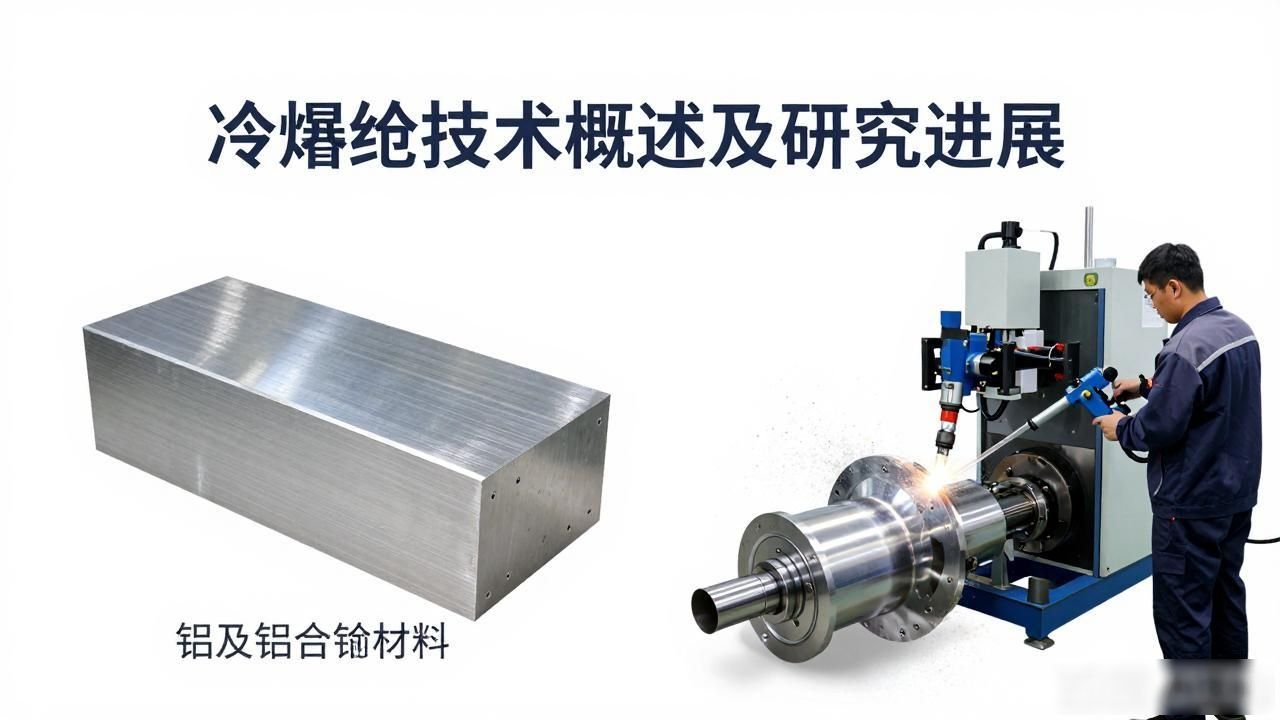
(1) Aluminium and aluminium alloy coatings: aluminium and its alloys are characterised by low density, high ductility, good corrosion resistance, and excellent thermal and electrical conductivity, and are widely used in both industry and everyday life. Cold-sprayed aluminium and aluminium alloy coatings can be used to repair industrial components made of aluminium alloys, and have attracted widespread attention from both academia and industry. Although aluminium and its alloys have low strength and melting points, they exhibit good plasticity, high deformability and low critical velocities during cold spraying, making them theoretically easy materials to spray. However, due to aluminium’s low density, the motion of particles during flight is easily affected by bow shock waves near the substrate. The surface of aluminium powder is highly prone to oxidation; overcoming the effects of the oxide layer and preparing high-density deposits remains a challenge. This is not unique to pure aluminium; cold-sprayed aluminium alloys also exhibit excellent properties. Aluminium-silicon alloys exhibit high strength, low thermal expansion and excellent anti-friction properties. Research has shown that during the cold spraying of aluminium-silicon alloys, due to the thermal effects of high-temperature gases, the coating contains not only the α-Al phase but also a reinforcing phase consisting of fine silicon particles, thereby resulting in enhanced strength. Al-Sn binary alloys possess excellent anti-adhesion properties and a low modulus of elasticity; they are commonly used as materials for sliding bearings in the automotive industry and have been in long-standing use. These characteristics have provided a wider range of options for the design and manufacture of numerous automotive components, thereby driving technological progress and innovation in the automotive sector. Cold-sprayed Al–Sn binary alloy coatings are characterised by low porosity, high deposition rates and excellent mechanical properties. Furthermore, the addition of various alloying elements—such as Mg, Fe, Ag and Ni—to Al–Cu alloys can form different intermetallic compounds, thereby further enhancing mechanical strength; high-strength Al–Cu alloys are widely used in the aerospace and automotive sectors.
Illustration of a cold spray coating
Source: H, Kreyer H, Gartner F, et al. ‘Cold-A’. *Journal*, 2016, Vol. 116: pp. 382–407.
(2) Copper and its alloys, which possess excellent thermal conductivity, electrical conductivity, ductility, corrosion resistance and wear resistance, are widely used in numerous fields such as power, electronics, energy and machinery, and are among the materials most readily applicable in cold spraying processes. The physical properties and performance characteristics of cold-sprayed copper coatings are all outstanding; this indicates that they are exceptionally dense, with virtually no porosity, and that their electrical conductivity in the sprayed state approaches 100 per cent of that of the base material. The bond strength of copper on 316L substrates exceeds that on other substrates; however, the higher the yield strength of the substrate, the higher the particle velocity required to achieve an effective bond. Consequently, as particle velocity increases, it is possible to produce copper coatings with high adhesion strength on a variety of substrate materials.
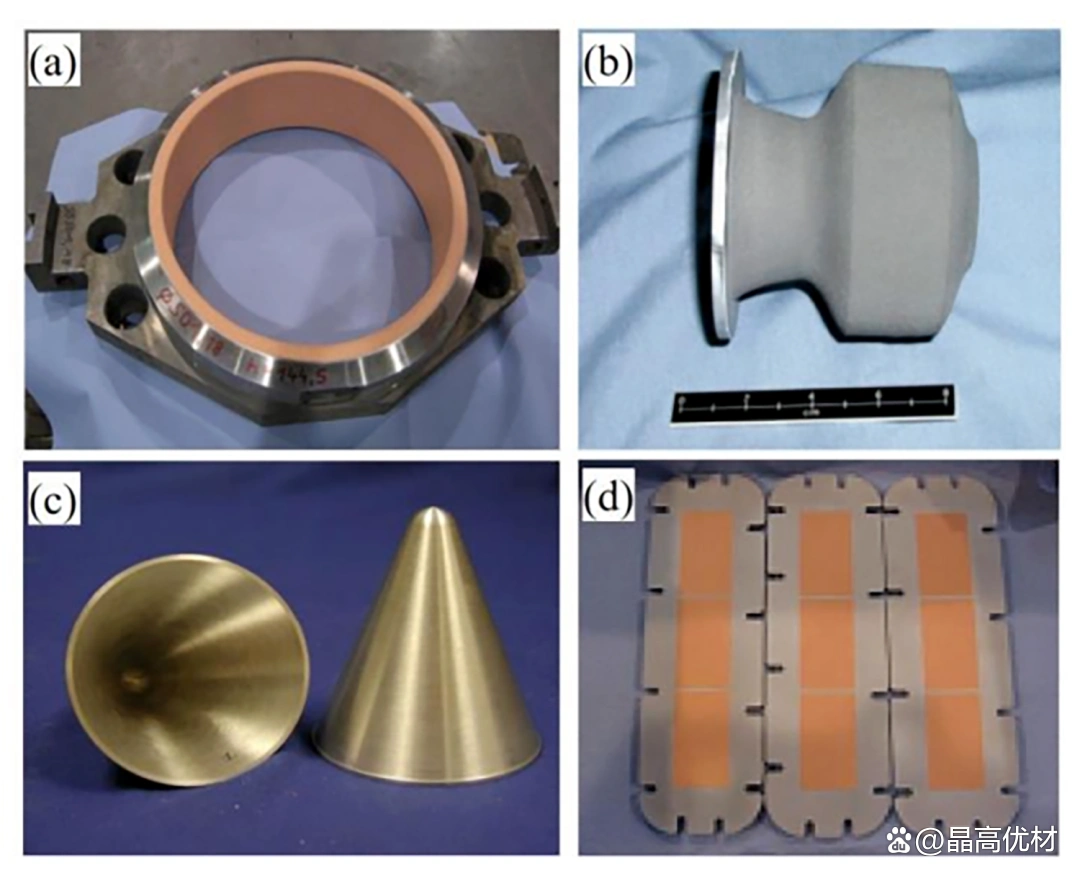
Cold-sprayed components with complex structures and thin coatings
(a) A thick copper coating has accumulated inside the pressure ring of the food processor; (b) it is distributed in an axisymmetric pattern.
(c) Conical structure (d) Copper coating on power electronics heat sinks
The reason is that the aluminium is in a cold, solid state, in which: one.
(3) Titanium and titanium alloy coatings: as titanium and titanium alloys are characterised by their low density, high strength and good corrosion resistance, and good biocompatibility, they are widely used in the aviation sector, the aerospace sector, the oil and gas sector, the chemical industry, the medical sector, and the automotive sector, amongst others. In cold spraying, the critical velocity required for the deposition of titanium and titanium alloys is relatively high; consequently, to obtain dense titanium and titanium alloy coatings, it is necessary to use high-pressure cold spraying equipment and higher process parameters, such as nitrogen as the carrier gas, a gas temperature of between 800 and 1100 °C, and a gas pressure of 4 to 5 MPa. Furthermore, the use of helium as the carrier gas can accelerate titanium and titanium alloy particles to higher velocities, thereby inducing more intense plastic deformation and stronger bonding strength in the particles; consequently, the use of helium results in extremely dense titanium and titanium alloy coatings. According to relevant research, compared with spraying Ti alone, the use of a mixed feedstock (Ti+) helps to form a relatively dense composite coating (with a porosity of approximately 1.51 TP3T). This observation suggests that the creation of a hard/soft impact interface during the cold spraying process is beneficial and can lead to superior coating performance. By customising process parameters, titanium and titanium alloy coatings with different porosity levels can be obtained; porous coatings can be used in biomedical applications, whilst dense coatings can be utilised in the repair and remanufacturing of aerospace components.
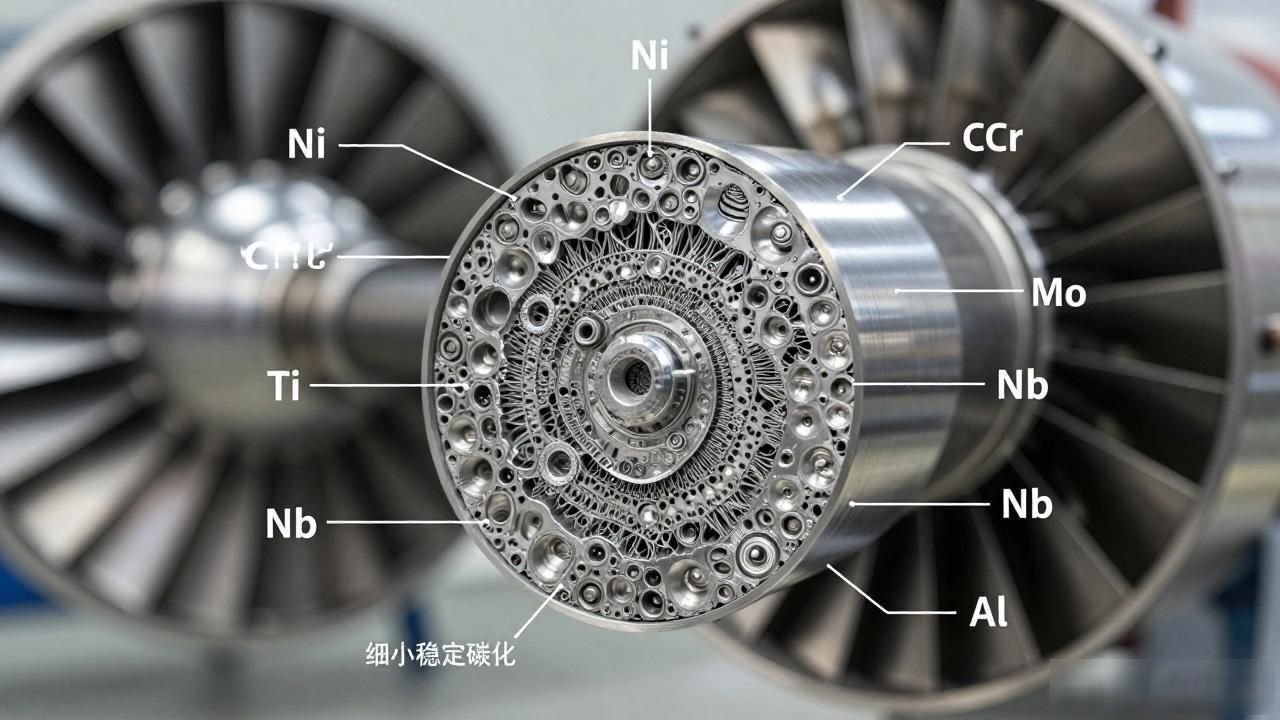
(4) 718, a nickel-based superalloy containing the alloying elements Ni, Cr, Mo, Nb, Ti and Al, forms a nickel-based high-temperature alloy coating through the formation of γ’ and γ” strengthening phases, as well as fine and stable carbides, 718 exhibits high strength only at elevated temperatures, whilst also possessing good resistance to oxidation and gas corrosion; it is therefore widely used in aerospace components operating at relatively high temperatures. Compared with pure nickel, which is easier to spray, 718 has a higher yield strength, poorer ductility and a higher strain hardening rate, making it difficult to apply via cold spraying. Similar to titanium alloys, the critical velocity required for cold spray deposition of 718 is also very high.
As can be seen from the range of materials listed above, cold spraying technology now covers a wide spectrum of metals, alloys, ceramics, polymers and advanced functional materials (including composites, nanomaterials and cermets). Among these, the preparation of advanced functional materials represents a new trend in cold spraying. In recent years, cold spraying has also been successfully applied to the preparation of high-strength metallic glass materials. Metals and alloys possess excellent processability; although they have been the subject of extensive research over the past decade or so, given that cold spraying is set to become a key method for additive manufacturing and repair in the future, the scale of application of metallic materials or metal-matrix composites will continue to expand step by step.
02
Main Applications of Cold Spraying
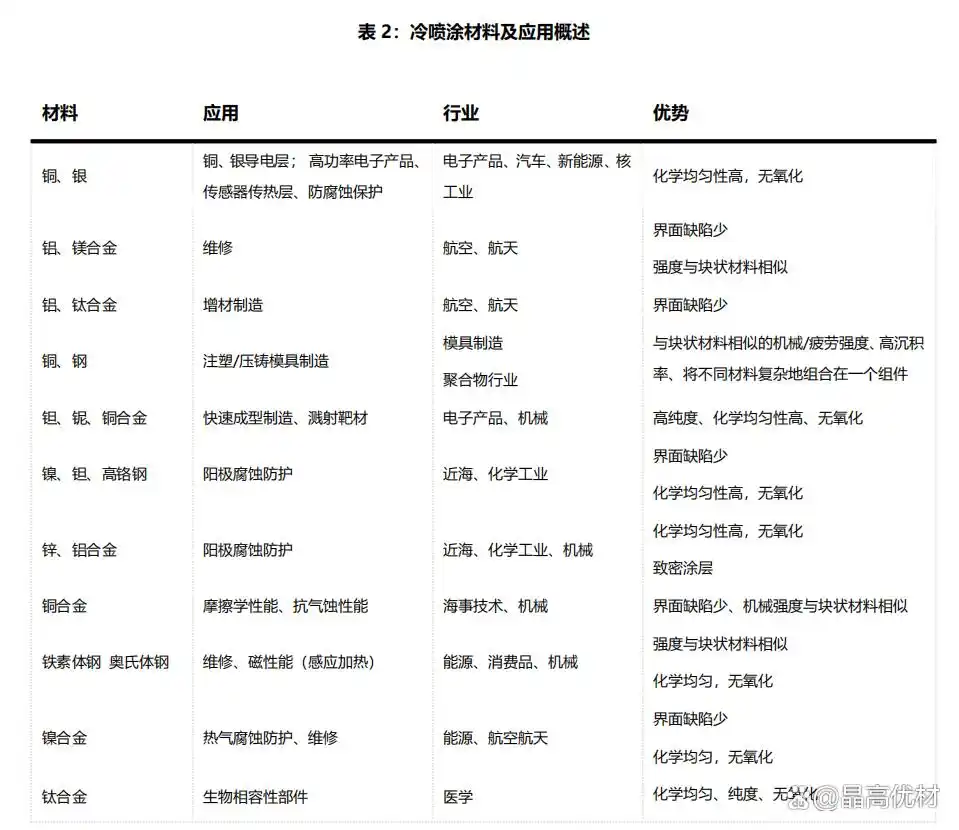
(1) In the electronics sector, the industry utilises cold spray technology to rapidly apply a silver coating onto the backing of target materials. Cold spray direct-forming of target materials offers high production efficiency, as well as characteristics such as high relative density and good adhesion to the backing; the internal grain structure of the targets is uniform, fine-grained and free from defects, and the deposition efficiency is relatively high, Currently, large-scale metal sputtering targets produced by direct cold spraying are widely used in the electronics and information technology sectors, including integrated circuits, liquid crystal displays, data storage, glass coating, laser storage media and electrical components.
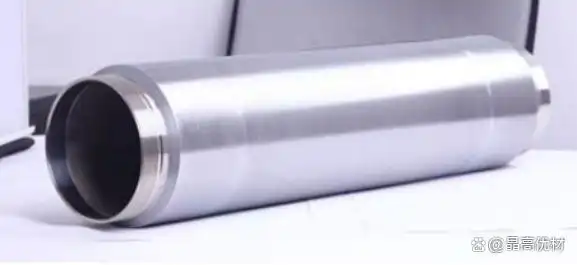
Rotating silver targets for cold spraying
(2) In the aerospace sector, cold spray technology can be used to treat aircraft engines, manufacture aircraft landing gear and produce aircraft wings and other aircraft components, creating a protective coating on their surfaces. This coating is highly dense, offers good electrical and thermal conductivity, and exhibits strong adhesion. It effectively reduces the aircraft’s energy consumption whilst also enhancing the corrosion resistance of the manufactured components.
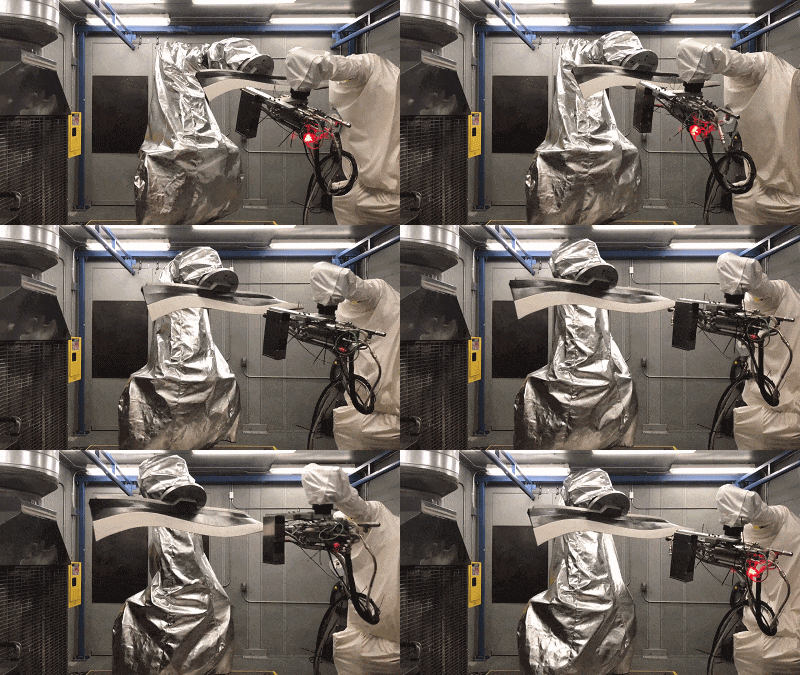
Cold spraying for the manufacture of large aerospace components
 Chinese
  Japanese
  English
  German
  Finnish
Leave a Reply
You must be logged in to post a comment.