
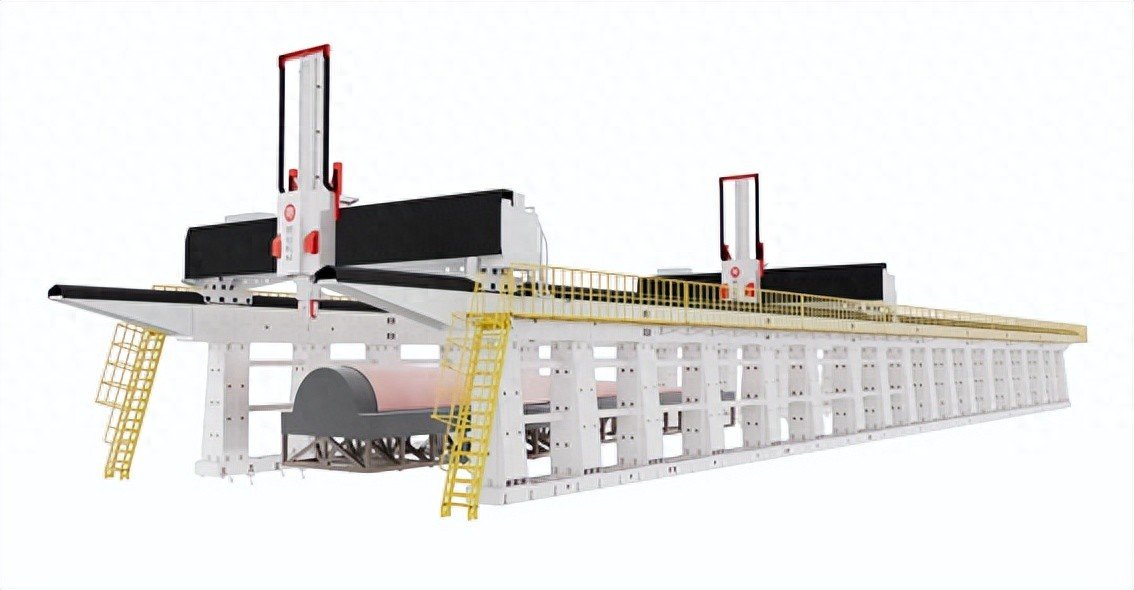
InmachiningThose working in the industry deal with “axes” on a daily basis, but what exactly are the differences between three-axis, four-axis and five-axis systems? Why is the link between five-axis machining and sectors such as aerospace, mould-making and new energy vehicles becoming ever closer and increasingly inseparable?

First, let’s get to the bottom of what an ”axis” actually is
The term ”axis” in machine tools refers to the direction of relative motion between the cutting tool and the workpiece.
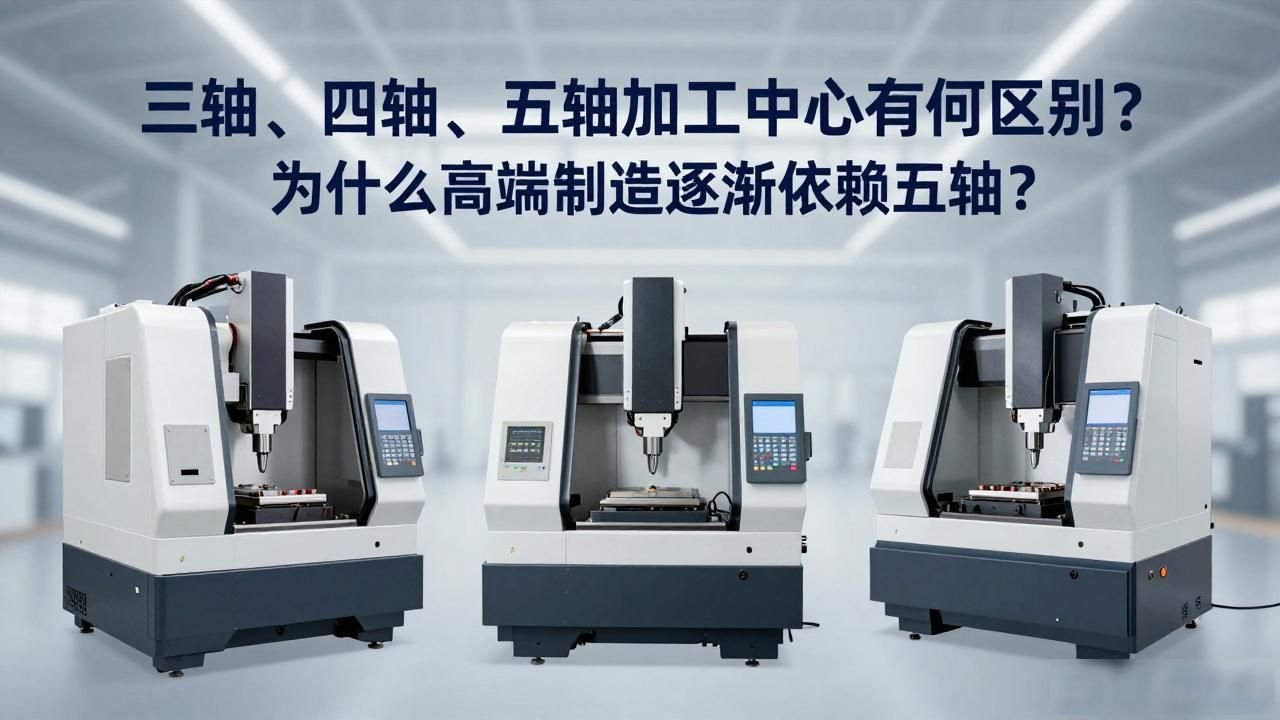
The most basic type is the three-axis machining centre, which has three axes—X (left-right), Y (forward-backward) and Z (up-down)—that move in a linear fashion. Machining is carried out by the cutting tool always cutting vertically downwards, the workpiece is clamped to the worktable and remains stationary. It is capable of machining flat surfaces, steps, bores and shallow cavities, and is entirely sufficient for parts with simple geometries. It represents the largest share of the current market and remains the standard equipment for the majority of machining enterprises.
A four-axis machining centre adds a rotational axis to the basic three-axis configuration; this rotational axis is generally referred to as the A-axis or C-axis. allowing the workpiece to rotate in a specific direction. This enables the machining of cylindrical surfaces, side features and helical grooves in a single set-up. However, most four-axis machines actually operate in a “3+1” mode, whereby the rotary axis is rotated to a specific angle and then locked in place, after which three-axis machining proceeds; the four axes do not operate in synchronisation simultaneously.
5-axis machining centreTwo rotary axes have been added to the three linear axes; the five axes can operate in synchronisation, meaning that the cutting tool is no longer restricted to “cutting vertically downwards”, but can adjust its angle at any time according to the shape of the workpiece and approach it from any direction in space.
The key difference: it’s not just a matter of ”having a few more axes”
Many people believe that a five-axis system simply has two more axes than a three-axis system; in fact, the fundamental difference lies in the spatial degrees of freedom between the cutting tool and the workpiece.
The number of clamping operations required: take a part with a hexahedral shape; in three-axis machining, only the top surface of the part can be machined. If the side surfaces are to be machined, the part must be turned over and re-clamped; this requires at least five operations. With four-axis machining, the rotary axis allows four faces to be machined; however, machining the top and bottom faces remains problematic. With five-axis machining, all five faces can be machined in a single clamping operation. Each additional clamping operation introduces an extra reference error; for more complex parts, the greater the number of clamping operations, the more difficult it often becomes to effectively control the final accuracy.
One particular capability relates to the machining of curved surfaces. Components such as aeroengine blades feature surfaces with extremely variable curvature, as do precision mould cavities. the same applies to artificial joints. During three-axis machining, the cutting tool can only enter vertically; when encountering complex surfaces, either the cutting angle is sub-optimal or the tool simply cannot reach the area. Five-axis machining, however, allows the cutting tool to traverse the surface at an angle, maintaining an optimal cutting posture at all times.
When machining deep cavities, three-axis machining inevitably requires the use of very long cutting tools to reach deep into the cavity; this can result in significant vibration and poor surface finish. In contrast, with five-axis machining, by adjusting the angle, shorter cutting tools can be used to machine deep areas, offering superior rigidity and stability.
for what reason?high-end manufacturingIncreasing reliance on five-axis machining
Just take a look at this set of figures and it will all become clear:
As we approach 2025, China’s five-axis coordinationCNC machine toolsThe market size reached 13.04 billion yuan, representing a year-on-year increase of 13.4 per cent compared with the previous year, and is projected to reach 14.79 billion yuan by 2026. Within this, the aerospace sector accounted for 38.6 per cent of five-axis applications, making it the largest single market; energy equipment accounted for 22.3 per cent; automotive powertrains accounted for 14.5 per cent; and precision moulds accounted for 12.1 per cent.
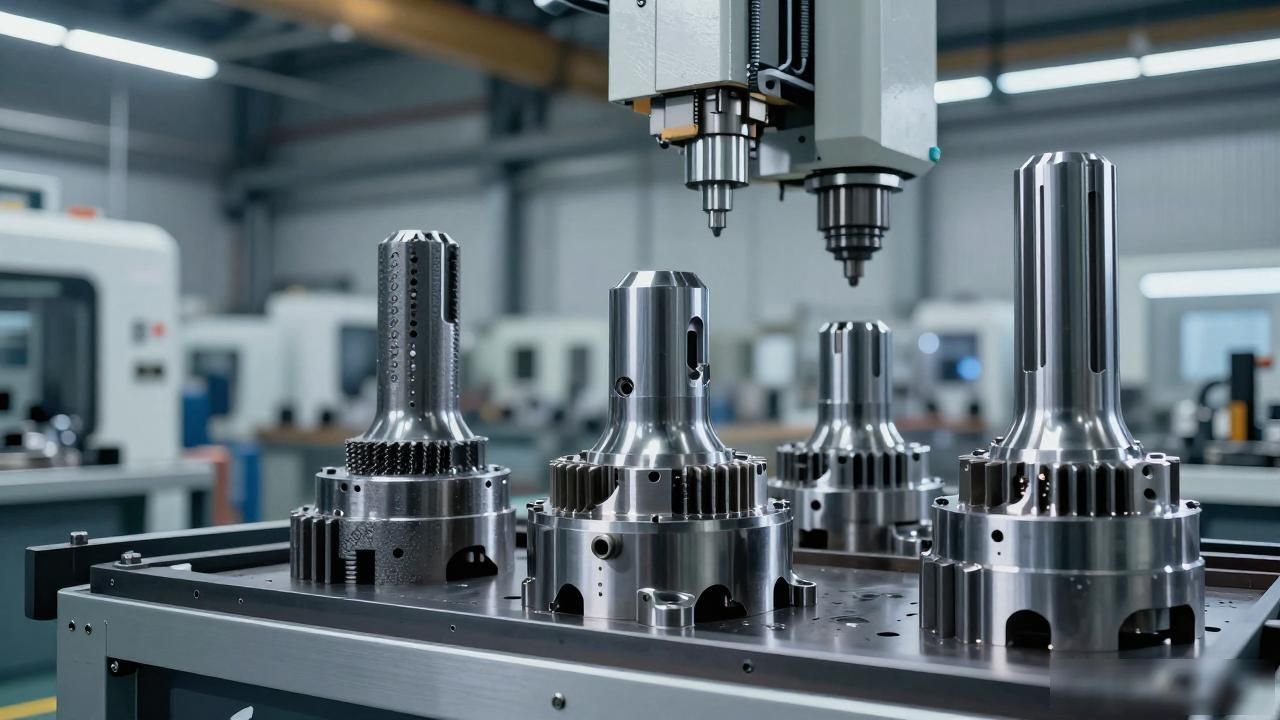
These fields share a common characteristic: the parts involved are extremely complex and the precision requirements are extremely stringent; traditional manufacturing processes are unable to meet these demands, or, even if production were possible, the process would be extremely slow.
The integral blade discs of aircraft engines feature complex blade geometries and materials that are difficult to machine, making it impossible to complete the machining process using a three-axis machine. The main pump casings in nuclear power plants feature deep-cavity, thin-walled structures, which place extremely high demands on dimensional consistency. When carrying out subsequent finishing operations on integrated die-cast components for new energy vehicles, the presence of multiple hole positions and irregular geometries places high demands on the dynamic accuracy and thermal stability of five-axis machining centres.
There is a practical consideration: the prices of domestically manufactured five-axis machines are currently falling rapidly. For equipment of the same specifications, domestic models are priced at around 60–70 per cent of the cost of German or Japanese products, and delivery times are more than half as short as those for German or Japanese products. In 2025, Kede CNC’s shipments of five-axis machines reached 328 units, representing a 29.1% increase compared to previous figures. Whereas purchasing a five-axis machine used to cost tens of millions and involve a six-month lead time, these barriers to entry have now been significantly lowered.
Are three axes no longer useful?
Of course, that is not the case. For parts with simple structures that are suitable for mass production, three-axis machines remain the option offering the best value for money. The programming process is relatively straightforward, the operational threshold is low, and maintenance costs are minimal. For the majority of products manufactured by small and medium-sized enterprises, three-axis machining is more than capable of handling them effectively.
The choice of how many axes to use is not determined by which is more advanced, but rather by the requirements of your specific parts: for flat parts or single holes, three axes are sufficient to meet the requirements; for cylindrical parts or holes on the side, using four axes will result in greater efficiency; For parts with multi-angled slopes, complex and irregular shapes, or deep features such as cavities with very thin walls, a five-axis machine is the practical solution.
The trend that truly merits attention is that, as the cost of domestically manufactured five-axis machines falls and the pool of skilled personnel expands, five-axis machining is shifting from being “exclusively confined to the aerospace and defence sectors” towards a wider range of civilian manufacturing applications. For companies whose products are undergoing a process of increasing complexity, gaining an early understanding of the capabilities of five-axis machining may be more crucial than simply waiting for equipment prices to fall.
 Chinese
  Japanese
  English
  German
  Finnish
Leave a Reply
You must be logged in to post a comment.