
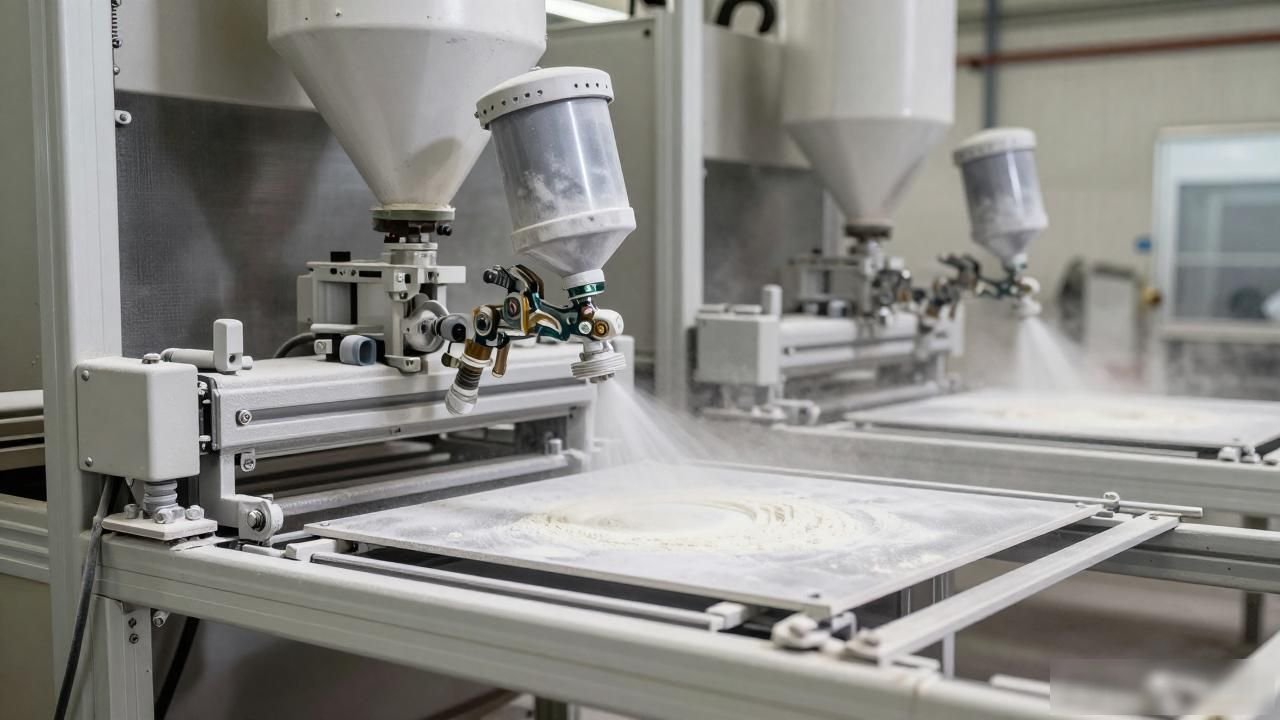
An automated powder coating factory for metal parts is a production facility specialising in the use of automated powder coating equipment to apply surface coatings to metal and certain plastic components. Powder coating, also known as electrostatic powder coating, a process in which powder coatings are applied to the surface of workpieces via electrostatic attraction and then cured by heating to form a coating film. Such manufacturing facilities typically consist of a pre-treatment system, an automated powder coating booth, a curing oven, a conveyor chain and a control system, and are widely used in numerous sectors including consumer electronics, automotive components, and home lighting.
The first stage in the process at an automated powder-coating factory for metal fittings is pre-treatment; the quality of this pre-treatment has a direct impact on the adhesion between the coating and the substrate. Common steps include degreasing, rust removal, rinsing, and phosphating or passivation. Degreasing is carried out to remove oil and grease from the surface of the workpiece, rust removal is intended to eliminate scale and rust; the rinsing stage generally employs multi-stage counter-current rinsing to minimise residues; phosphating forms a conversion coating on the metal surface to enhance coating adhesion and corrosion resistance, automated productionThe production line uses a conveyor chain to immerse the workpieces sequentially into each tank, whilst carefully controlling the temperature and duration to ensure consistent and reliable treatment results.

Once the workpiece has undergone pre-treatment, it proceeds to the automated powder coating stage. Within the powder coating chamber, there is an automated spray gun and a powder supply system; the powder coating is atomised by compressed air and becomes electrically charged, Workpieces that are earthed or carry an opposite charge will attract the powder, thereby forming a uniform powder coating. Automatic powder coating plants are generally equipped with reciprocating machines or robots to drive the spray guns, which automatically adjust the spray path and powder output according to the workpiece’s shape and size. For complex workpieces, multiple spray guns are designed to operate in coordination to minimise blind spots and ensure complete coverage. During the spraying process, any powder that does not adhere to the workpiece is collected by a recovery system and recycled, resulting in a relatively high material utilisation rate.
Workpieces that have undergone powder coating are immediately transferred to the curing oven. The curing stage is crucial for enabling the powder coating to melt, level out and undergo a cross-linking reaction, thereby forming a tough coating film. The oven temperature is generally maintained within the range of 180°C to 220°C, with the holding time determined by the thickness of the workpiece and the coating formulation. Automated production lines utilise temperature control systems to maintain uniform oven temperatures and employ methods such as infrared or hot-air circulation for heating. Workpieces that have undergone curing must pass through a cooling section to reduce their temperature before they can be unloaded or assembled. Throughout the entire process, the speed of the conveyor chain must be precisely matched to the length of the oven zone to ensure consistent curing results for each batch of workpieces.
The key element in that hardware automatic powder-coating factory isquality controlThese include coating thickness, adhesion, appearance and colour, impact resistance and salt spray resistance, amongst others. Modern factories are equipped with in-line coating thickness gauges and colour difference metres to carry out spot checks on batch production. In addition, the industry places great emphasis on environmental management. The automated powder coating process is inherently a low-solvent-emission process, Powder coatings do not contain organic solvents, and emissions of volatile organic compounds are relatively low. However, wastewater from pre-treatment and exhaust gases from the powder coating process still require specialised treatment to ensure that both exhaust gases and wastewater meet discharge standards, thereby complying with green manufacturing requirements.
Products manufactured by hardware factories using automated powder coating exhibit excellent corrosion resistance, good scratch resistance and good resistance to ageing; as such, they are widely used in applications requiring long-term protection, such as outdoor equipment, the casings of domestic appliances and even automotive components. Compared to the traditional and widely used liquid spraying method, the coatings formed by powder coating are thicker and more uniform, and the process lends itself well to automated production. With the continuous development of manufacturing processes, automated powder coating lines are now being integrated with digital management systems, thereby further enhancing production efficiency and batch consistency. For component manufacturers requiring surface treatment, understanding the basic principles and processes of automated powder coating will help them make more informed choices regarding the most suitable processing methods.
 Chinese
  Japanese
  English
  German
  Finnish
Leave a Reply
You must be logged in to post a comment.