
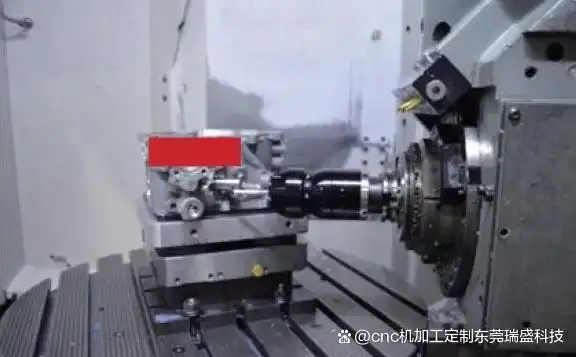
Parts machined using CNC equipment are referred to as CNC-machined parts. CNC machining generally refers to a method of precision machining controlled by computerised digital systems; this method has now become a widely used form of machining.
The type of machine known as a CNC machine tool—that is, a computerised numerical control machine tool—is a piece of equipment used for CNC machining. It is referred to by slightly different names in different regions; for example, in the Yangtze River Delta region it is often called a ‘machining centre’, whilst in the Pearl River Delta region it is commonly known as a ‘computerised lathe’.
A typical CNC machine tool:
CNC lathes operate by rotating the material held in a chuck, and then moving the tool along two axes into the workpiece to cut cylindrical parts.
CNC milling machines are commonly used to manufacture flat parts; however, they are also capable of creating complex shapes for the production of more intricate machines with greater degrees of freedom; During machining, the workpiece remains stationary, whilst the spindle rotates in tandem with the cutting tool to drive the operation; the tool then moves or rotates along three axes—or in some cases, four or five axes—to cut into the material; In certain specific circumstances, the spindle remains stationary whilst the workpiece is fed into it.
CNC drilling machines: these machines are similar to CNC milling machines; however, they are specifically designed to cut along a single axis, meaning that the drill bit moves downwards towards the workpiece solely along the Z-axis and never cuts along the X- or Y-axes.
There is a type of machine known as a CNC grinding machine; these machines move the grinding wheel towards the workpiece to produce a high-quality surface finish. Their purpose is to remove minute amounts of material from hardened metal, and they are therefore used for finishing operations.
Thanks to its high precision, CNC machining is widely used across various industries. However, when compared to other manufacturing methods such as injection moulding, die-casting and stamping, CNC machining services may appear to be more expensive. The main factors affecting the cost of CNC-machined parts include the following:

1. Machining equipment
The cost of equipment encompasses the initial purchase price, costs incurred during operation, and maintenance costs, amongst others. There may also be additional costs, such as the cost of cutting tools and the costs associated with operating the CNC system; all these costs will affect the cost per machined part. Consequently, the higher the cost of purchasing a machine, the higher the cost of operating it, and the higher the cost of maintaining it, the more expensive the parts produced by that machine will become.
Milling machines are often more expensive than lathes, as they have more complex moving parts; they are more difficult to set up, operate and maintain, and are capable of performing more complex machining operations. Therefore, unless absolutely necessary, parts should be designed to be suitable for machining on a lathe.
There are various types of milling machines, with differing levels of complexity and capability. The greater the number of axes a milling machine has, the higher its price. Most modern CNC machine tools are equipped with three or five axes. Although 5-axis machines are capable of producing extremely complex geometries with greater precision and speed (and therefore require less machining time), they are generally more expensive than 3-axis machines.
2. Design costs
The costs incurred during the preparatory work prior to actual machining are known as design costs. These primarily comprise the costs associated with CAD—that is, the process of structural and engineering drawing design—as well as those related to CAE, namely the optimisation and analysis process, and CAM, which refers to the manufacturing programming process. In this context, whether the costs incurred for CAD and CAE are allocated to the cost of the parts is not fixed; it depends on the terms of the collaboration between the two parties. Furthermore, design costs are fixed; consequently, the higher the production volume, the lower the design cost allocated to each individual part.
3. Cost of materials
The cost of materials used in the manufacture of parts is a crucial component of the overall cost of those parts; raw material costs, material consumption and material processing time together make up the material cost.
With regard to raw material costs: market prices vary between different raw materials, and prices also differ across different market regions. When selecting raw materials for components, one should choose materials appropriate to the component’s intended use and function, rather than opting for high-priced materials that far exceed the performance requirements. For example, whilst both are types of stainless steel, 316 stainless steel is considerably more expensive than 304 stainless steel.
With regard to material usage, when designing the structure of a component, consideration should be given to minimising material usage as far as possible, inManufacturing processAt the same time, consideration should be given to minimising material usage as far as possible; if necessary, a modular approach may be adopted, whereby two relatively simple components are assembled subsequently to form a single complex component, which would otherwise require a greater amount of material and more machining time.
The time required to machine a material; the cost of a component is directly proportional to the time required to machine it; The machining time of a material is linked to its machinability; materials with lower machinability require more time to machine and, at the same time, consume more resources during the process, such as coolant, electricity and cutting tools. (For example, relatively soft materials such as aluminium alloys are easier to cut, which means their machining time is shorter; whereas harder materials, such as stainless steel, require more expensive tools for machining, and these tools are more prone to damage and wear during the process; in such cases, the machining cost of the part will be higher.)
4. Production volume
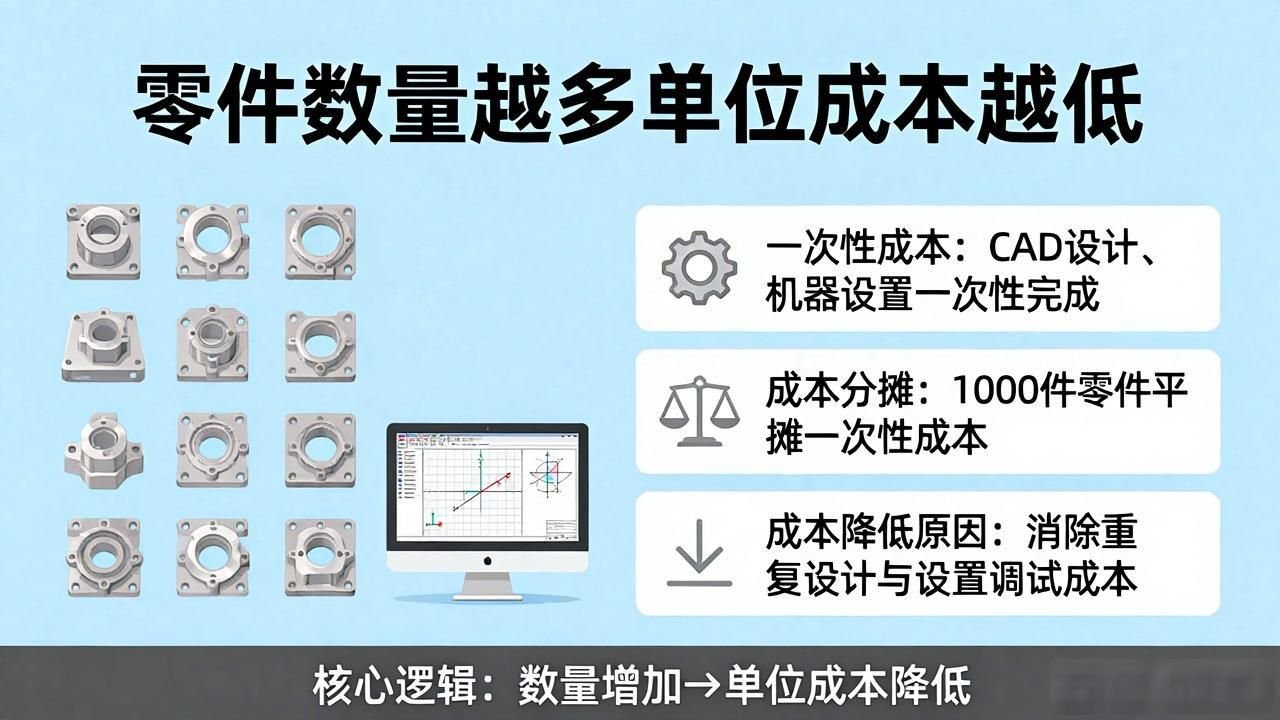
As the quantity of identical parts increases, the unit cost decreases significantly. This proportional reduction in cost is primarily due to the elimination of repetitive design costs and machine set-up and commissioning costs. The CAD design, CAM preparation and machine set-up required for all parts to be manufactured are carried out on a one-off basis. During production, the cost of a single part comprises the design and machine set-up costs; if 1,000 parts are produced, these design and machine set-up costs are spread across the entire batch of 1,000 parts.
5. Special requirements
Prior to machining, it is essential to specify both the tolerance requirements and the surface roughness requirements for CNC-machined parts. Stricter tolerance requirements increase the difficulty of machining, which in turn raises the scrap rate and consequently drives up costs; Where surface roughness requirements are particularly high, CNC milling may prove unfeasible, necessitating the use of a grinding machine or alternative methods; this adds to the number of processing steps, thereby increasing costs.
Once CNC-machined parts have been completed, they may require certain post-processing steps, such as heat treatment or surface treatment, with the aim of enhancing the parts’ functionality, performance and aesthetic appeal; however, these post-processing requirements will, to a certain extent, increase the cost of the parts.
With regard to surface treatment, another significant cost driver is the need to apply different surface treatments to different areas of a component; for example, localised electroplating, localised anodising, or applying an anodised finish to a two-tone prototype, where one area is anodised whilst another is electroplated. Consequently, in order to achieveCost reductionWhere it is not strictly necessary to proceed in that manner, every effort should be made to ensure that the surface treatment applied to every part of the component is carried out to the same standard and in the same manner, so as to maintain uniformity, consistency and uniformity throughout.
The more complex the structure of a component, the higher the manufacturing cost will be. Highly complex parts may require more advanced machinery; they also demand more machining time, involve multiple set-ups and re-set-ups, and necessitate greater resources and more thorough and meticulous inspection. All these factors will have an impact on the cost of the parts.
In CNC machining, the characteristics and design of certain parts inevitably lead to higher costs.
1) Avoid thin-walled designs
Workpieces with excessively thin walls require more machining time, as they are extremely fragile. Given that they are prone to vibration or deformation, it is difficult to maintain precise tolerances; more seriously, this can lead to fracture. These thin-walled workpieces are more expensive due to the slow machining process, the need for specialised machining techniques and the high scrap rate.
Thick-walled components tend to be more stable when machined and are also slightly cheaper to produce. In order to keep production costs consistently low, thin-walled designs should be avoided; the wall thickness of metal components should be greater than 0.8 mm, whilst that of plastic components should be greater than 1.5 mm.
2) Avoid designing features that cannot be machined using CNC
Not all features can be machined using CNC. A typical example is a 90° internal angle: as all current CNC milling cutters are cylindrical in shape, when cutting the edges of a cavity, a rounded corner is produced rather than a right angle or any other sharp corner.
If it is essential to maintain a right angle, a common method of achieving this is to use EDM (electrical discharge machining), which is a more expensive manufacturing process than CNC machining. If fillets cannot be used solely for assembly reasons, it is recommended to use internal fillets.
3) It is recommended that a larger internal corner radius be designed
Although using a tool with a relatively small diameter can reduce the corner radius, this necessitates multiple passes at a lower speed, as smaller cutters cannot remove material as rapidly in a single pass as larger ones can. Consequently, smaller fillet radii also lead to increased machining time and costs; it is therefore recommended that the fillet radius R be at least one-third of the cavity depth D.
At the same time, to prevent tool wear, it is essential to design an inner edge that does not exert excessive pressure on the tool. To achieve this, a good rule of thumb is that the corner radius should be slightly larger than the tool radius used for machining the cavity; in other words, the corner radius should be 1.3 times the milling cutter radius or greater. For example, if the milling cutter radius is 5 mm, it is recommended to add a radius of 6.5 mm at the internal corner. This additional radius reduces the stress on the cutting tool and increases the cutting speed.
4) Limit the depth of the cavity
Machining deep cavities has a significant impact on the cost of CNC parts, as it requires the removal of a large amount of material and is a time-consuming process. Excessive cavity depth can lead to issues such as tool overhang, as well as tool deflection, resulting in difficulties with chip evacuation and even a series of problems such as tool breakage.
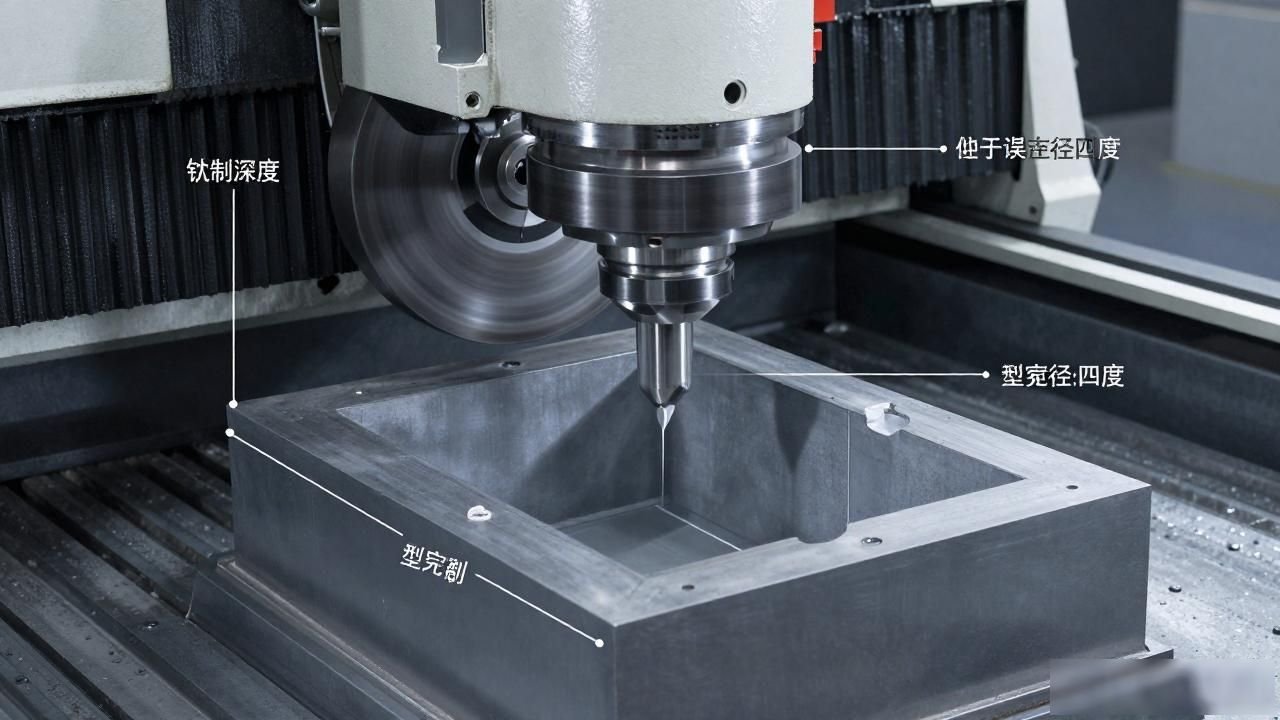
When the milling depth exceeds twice the diameter of the milling cutter, the feed rate must be reduced; this inevitably increases machining time and raises the cost of the workpiece. For every additional doubling of the milling depth, the feed rate is halved, and the machining time more than doubles. Typically, the milling depth does not exceed four times the diameter of the cutting tool. During the design phase, the maximum depth should be four times the width of the cavity; for example, the depth of a 15-millimetre-wide cavity should not exceed 60 millimetres.
If a deep pocket cannot be avoided, the method for machining it is to gradually lower the end mill and mill layer by layer, However, this is also particularly time-consuming. Furthermore, when machining deep pockets, the cutter must be angled to the correct cutting depth, and a gentle entry requires sufficient clearance.
5) Minimise the use of curved structural features
When designing CNC-machined parts, simplicity should be the guiding principle, and the use of complex curved surface features should be minimised. This is because achieving complex surfaces with the required surface finish necessitates the use of small cutting tools; these small cuts take considerably longer than standard cuts, thereby significantly increasing costs. Therefore, to help minimise costs and machining time, the use of curved surfaces should be reduced as much as possible or avoided altogether. For example, when chamfering outer edges, a bevel should be used rather than a fillet, unless absolutely necessary.
6) Limit the thread length
As is well known, the load-bearing portion of a threaded connection is found within the first few threads; therefore, it is sometimes entirely unnecessary to have a very long thread length. Long threaded holes may require special tools to work with, and they also consume more machining time, which in turn increases costs. The recommended thread length should not exceed three times the bore diameter. In the case of blind threaded holes, it is recommended to leave an unthreaded section at the bottom of the hole measuring at least half the diameter of the hole.
7) Design standard-sized holes
Use standard drill bits capable of performing high-precision CNC hole machining quickly; for economic reasons, standard hole diameters should be used wherever possible. For non-standard hole sizes, it is essential to use end mills for machining, although this may result in higher costs.
Furthermore, as a general rule, the larger the hole, the deeper it can be drilled; however, it is recommended that the drilling depth should not exceed ten times the diameter of the drill bit.
8) Keep the number of times the CNC machine is set up to a minimum
Flipping or repositioning parts can lead to an increase in manufacturing costs, as this usually has to be done manually. Furthermore, in the case of complex geometries, custom fixtures may be required, which in turn drives up costs. Where particularly complex geometries are involved, a multi-axis CNC system may be necessary, which would further increase the price.
Consequently, in order to minimise the number of times the part needs to be turned over and repositioned, all features requiring machining should, wherever possible, be designed on a single plane; if this cannot be avoided, consideration should be given to dividing the part into features that can be machined on a CNC machine in a single set-up, and then bolting or welding them together.
9) Avoid unnecessary text and engraving
Adding text features to the surface of CNC-machined parts is a practice that should be avoided; after all, incorporating text into the design via CNC machining will only increase machining time and drive up costs.
However, if the text and typeface are specified in the design brief, the following rules should be followed:
Adding text to the surface of CNC-machined parts, whether by screen printing or spray painting, offers relatively good value for money.
It is feasible to carry out laser engraving on curved surfaces, given that the amount of material removed in such cases is minimal.
If your design software does not offer custom engraving fonts, we recommend using a 20-point sans-serif font. The reason for this recommendation is that this typeface lacks any superfluous lines at the ends of each letter’s strokes—that is, serifs. These additional strokes would increase the cost of production. Furthermore, we recommend using size 20, as sizes smaller than this are considered fine details, which are more difficult to machine and incur higher costs.
 Chinese
  Japanese
  English
  German
  Finnish
Leave a Reply
You must be logged in to post a comment.