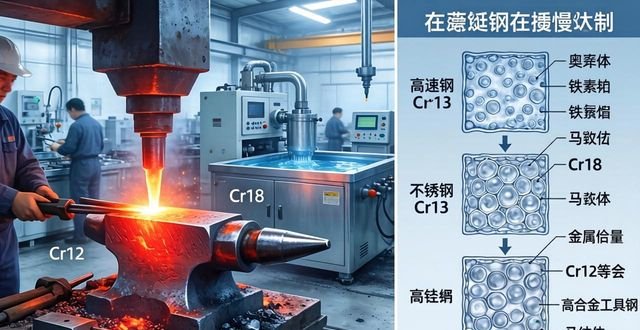


1. Cooling method
There are three methods of post-forging cooling, depending on how fast or slow the cooling rate is.
(1) Cooling is carried out in the air, and the rate of cooling is relatively fast. The forgings are placed one by one or in piles directly on the workshop floor for cooling. However, it should never be placed in the wet place or metal plate, and also never placed in the place where there is overhanging wind, otherwise the cooling of the forging will be uneven or localised rapid cooling and thus causing cracks.
(2) in the pit (box) within the implementation of cooling, cooling rate is relatively slow. The forging will be placed in the pit or iron box for closed cooling, or the forging is buried in the sand, lime or slag in the pit to cool. Generally speaking, the temperature of the forging into the sand should not be less than 500 ℃, and the thickness of the sand piled up around it should not be less than 80 mm. the cooling speed of the forging in the pit can be adjusted with the help of different insulation materials and the thickness of the insulation medium.
(3) cooling in the furnace, the slowest cooling rate, the forging straight into the furnace, control the furnace temperature in accordance with certain cooling specifications Xu cooling, this applies to high-alloy steel and special steel forgings. Generally speaking, the forging into the furnace when the temperature can not be lower than 600 to 650 ℃, loading the furnace temperature at the time should be similar to the temperature of the forging into the furnace. Commonly used cooling norms exist isothermal cooling and undulating isothermal cooling.
2. Cooling speed
Forging cooling specifications, the key point is the cooling rate, based on the chemical composition of the steel, as well as organisational characteristics, as well as section size and many other factors, to determine the appropriate cooling rate.
-Generally speaking, the purer the chemical composition of the steel, the faster the permissible cooling rate will be. For small and medium-sized carbon steel and low alloy steel forgings, after forging are taken to the kind of cooling speed faster air-cooled way, while the alloy composition is taken as furnace cooling.
For example, carbon tool steel, alloy tool steel and bearing steel, such as high carbon content of the steel, if forging slowly after cooling, in the grain boundary will precipitate a network of carbides, the use of the performance of the part has a serious impact. Should be forged after the first rapid cooling to 700 ℃, where the use of air-cooled, blast or spray, and then placed in the pit or furnace forgings slowly cooled.
There is no phase transformation of steel, such as austenitic ferrite steel, there is no organisational stress in the cooling process of the forging, can be used to rapid cooling, and in order to obtain a single-phase organisation after forging, the same need for rapid cooling, so the forging of such steels are generally used in the air-cooling method.

For the air-cooled self-hardening steel, such as high-speed actinium, stainless steel 4Cr13, Cr18, high-alloy tool steel, Cr12, etc., because of the air-cooled martensite phase transition will occur, which will cause a large organisational stress, which is extremely easy to produce cooling cracks. Therefore, such steel forging must be slow cooling.
For steels that are sensitive to white spots (such as chromium-nickel steels), furnace cooling should be carried out in accordance with certain cooling specifications in order to prevent the formation of white spots during the cooling process.
Then for the kind of large cross-section size of the forging, in view of its temperature stress in the cooling process is relatively large, so after forging should be slow cooling. On the contrary, for those small cross-section size of the forging, after forging is able to carry out rapid cooling.
For more information, you can directly contact Wuxi Hanchao online customer service, which also focuses on the study of hot forging mould failure, specializing in the sale of hot forging moulds used for hot forging moulds with cost-effective hot forging die steel (such as: GR steel, HD steel, HM1, HM3, CG2, B3,,, QRO 90, etc.), to provide hot forging mould failure analysis, selection advice, and the other mould steel (non-magnetic mould steel, cold work mould steel, hot work mould steel, plastic mould steel, etc.).




 Chinese
  Japanese
  English
  German
  Finnish
暂无评论内容