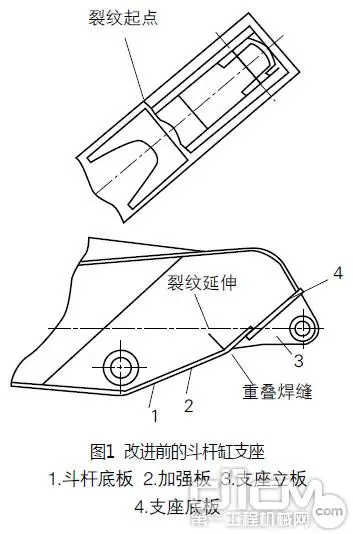


1. Cracking phenomenon
A certain model of excavator, after leaving the factory, about three thousand hours of work, the phenomenon of cracking at the upper end of the bucket rod, the cracked part is in the overlapping weld where the top reinforcement plate of the bucket rod and the bucket rod cylinder piston rod support plate are connected. The crack caused the bottom plate of the bucket bar to break, and the crack extended laterally along the bottom plate of the bucket bar. Heavily loaded excavator bucket rod bottom plate almost fracture, individual excavator crack has been extended to the bucket rod web, as shown in Figure 1.

2. Analysis of causes
(1) steel toughness due to repeated welding and reduce the original design of the model excavator bucket rod cylinder piston rod support, the bottom of the bottom plate and no reinforcement plate, in the use of the process, the vertical plate and the bottom of the plate welded to the bottom plate bending deformation, in order to increase the rigidity of the bottom plate, to prevent the bottom of the plate deformation in the later products in the supplementary welding of the reinforcing plate, the supplementary welding of the reinforcing plate, the overlap of the weld between the vertical plate and the reinforcing plate, resulting in the bucket rod base plate After welding the reinforcement plate, there is overlapping weld between the vertical plate and the reinforcement plate, which leads to the reduction of plasticity and toughness of the bottom plate of the bucket bar, and makes the bottom plate crack when it is stressed.
(2) Stress concentration
When the excavator is in the digging operation state, the position of the bucket cylinder piston rod support is subjected to the maximum force, and the base plate at the bucket cylinder piston rod support will be subjected to tensile and compressive alternating stresses. However, the support plate extends to the reinforcement plate of this place belongs to the weak place, the support plate extends towards the base plate of the length is relatively short, which results in the support plate and the base plate connected to the place where there is a concentration of stress, which makes the support plate to pull the base plate cracked.
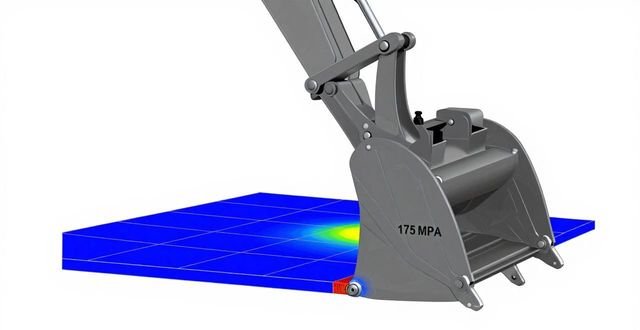
We carried out finite element stress analysis work for the bucket cylinder piston rod support, and then found that when the excavator is in the maximum digging force state, the tensile stress at the position of the vertical plate extended to the reinforcing plate at this time has reached 175M P a, coupled with the weld welding process of the stress generated, the stress concentration of this phenomenon is becoming more obvious.
(3) Prolonged use of crushing hammers
Excavator users to carry out surveys, know that those who appear bucket cylinder piston rod support cracking excavator, all equipped with a crushing hammer. Because of these excavators for a long time to use the crushing hammer to carry out operations, resulting in the cylinder bearing a large alternating stress, which makes its bottom plate cracking phenomenon.
3. Improvement programmes
We want to solve the problem of cracking at the piston rod support of the bucket cylinder, and to solve it completely, in the case of the original support hinge point position remains unchanged, for the bucket cylinder support structure, in accordance with the following scheme, to do the improvement.
(1) Increased structural strength
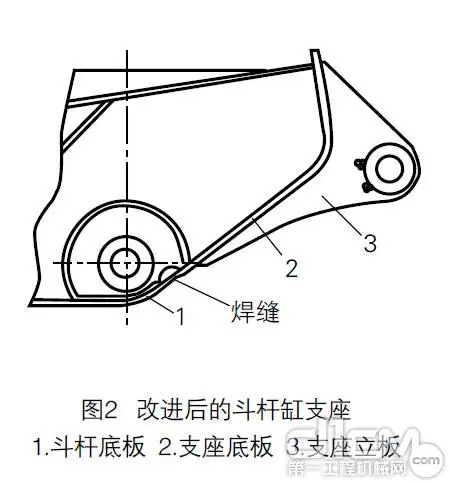
Two measures are taken to increase the structural strength, one is to thicken and lengthen the support base plate 2, and the other is to widen the support plate 3, as shown in Fig. 2. After thickening the support base plate 2, it can improve the strength and stiffness of the upper end of the bucket bar, thus reducing the possibility of deformation and cracking of the upper end of the bucket bar. After lengthening the support base plate 2, it avoids the butt joint with the bucket rod base plate 1 in the high stress area, thus reducing the stress of the weld. By widening the support plate 3, allowing it to extend downwards by an additional 300mm, and gradually reducing the cross-sectional area of the support plate 3, such a structure with a slow transition can reduce stress concentrations.
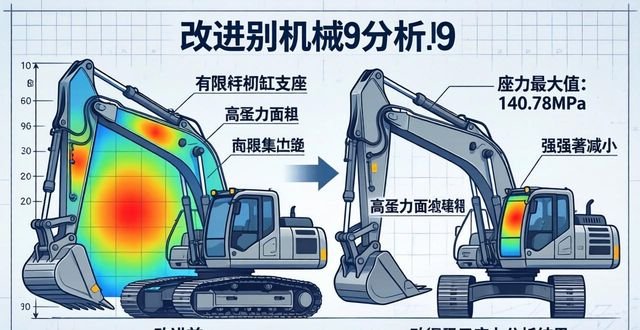
We carried out finite element stress analysis for the improved bucket cylinder support, and found that the maximum value of stress decreased from the value before improvement to 140.78 MPa at this moment, and the area of the high stress zone was greatly reduced.
(2) ImprovementsWelding process
The welding method of the support plate 3 is changed to a multi-layer welding form, in order to reduce the heat generation of the weld position during welding, and the transition part of the weld is polished smooth after welding, in order to reduce the stress concentration point, after the welding process is improved, it is found that the number of weld seams is reduced, and the welding deformation and the welding stress are also reduced to some extent.
4. Improving effectiveness
The excavator bucket cylinder piston rod support to be improved, enhanced its structural strength, at the same time, cut down the welding workload, so that the production process can be simplified, but also improve the efficiency of the bucket rod production, based on a small batch trial production, put into the market to be used, that type of excavator no longer appeared in the bucket rod upper end of the phenomenon of cracking, which indicates that this structural improvement has been a success.


 Chinese
  Japanese
  English
  German
  Finnish
暂无评论内容