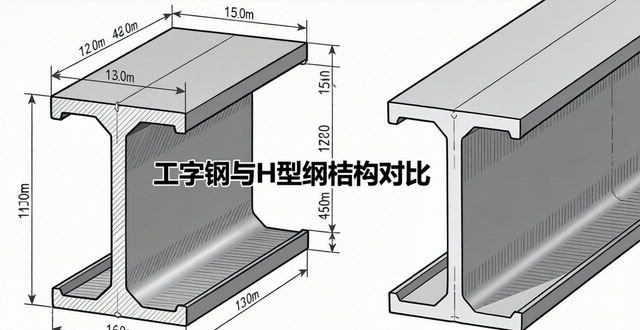


011. Differences between I-beams and H-beams
1.1 Differences in structural characteristics
In the actual use of the head, I-beam and H-beam differences often make construction practitioners confused, although the two steel in the appearance of some similarities exist, but they are in the performance and application of a very significant difference, first of all to make it clear that the I-beam and H-beam is not just in the name of the difference, they are in the structure of the actual existence of significant differences, the next we will go in depth to discuss these two steel in the building and selection of points. Next, we will go in-depth to explore the two steel in the construction of the application and selection points.
I-beam steel, its cross-section shows the shape of the “I”, its upper and lower flange internal surface inclination is 1 to 6, which leads to the flange outside the thinner and thicker inside, which makes the I-beam steel in the two main planes of the cross-section of the characteristics of the existence of obvious differences, it is not easy to give full play to the advantages of its strength. Although the market out of the thickening of the I-beam, but the structural characteristics of the I-beam has decided that its torsional performance is lacking.
Compared with other steel materials, H-beam is widely used in steel buildings, its inner surfaces of the flanges are parallel, there is no inclination, and its cross-section characteristics are significantly better than those of the traditional I-beams, channels and angles.H-beam is a new type of steel that is cost-effective and efficient by virtue of its optimised distribution of cross-section area and a reasonable strength-to-weight ratio. Its cross-section shape is similar to the English letter “H”, so it has this name.
Moreover, the two inner edges of the H-beam are straight, which simplifies welding and splicing operations and improves the mechanical properties per unit weight, thus saving a large amount of material and construction time. However, I-beams show good performance in terms of straightness and tensile strength, but their torsional capacity is limited by their cross-section size. In comparison, H-beams show excellent performance in these areas, with each having its own strengths.
1.2 Performance andAreas of application

H-beams differ from I-beams in a number of significant ways, which not only affect their performance but also determine their suitability for different applications. Firstly, as far as structural properties are concerned, the inner surfaces of the flanges of H-beams are parallel and have no inclination, whereas I-beams are “I” shaped, with the inner surfaces of the upper and lower flanges inclined, resulting in a significant difference in the cross-section properties in the two main planes. This structural difference further affects the mechanical properties of the two steels.
Moving on, in the field of application, H-beam, with its optimised cross-sectional area distribution and reasonable strength-to-weight ratio, has become an economical and efficient type of new steel, and is widely used in steel structure construction. As for I-beam, although it shows good performance in straight pressure and tensile strength, its torsional capacity is constrained by the cross-section size, and the scope of application is relatively narrow.
In summary, H-beam and I-beam have obvious differences in terms of structural characteristics and application areas. It is these differences that make H-beam show good performance in some aspects, especially in the field of steel structure construction, its advantages appear more prominent.
022. Recommendations for specific applications and options
2.1 Limitations on the application of I-beams
For I-beams, because of their high height and narrow width, their scope of application is mainly for bending members in the plane of the web, not for axial compression or as load-bearing columns. I-beams, whether ordinary or light, are characterised by a high height and narrow width, which results in a significant difference in the moment of inertia between the two main planes. Therefore, this type of steel is mainly suitable for members subjected to bending in the plane of their webs, or combined into lattice-type force members. However, for axial compression members or members with bending perpendicular to the plane of the web, I-beams are less suitable and their range of application is therefore limited.
2.2 Advantages and applications of H-beams
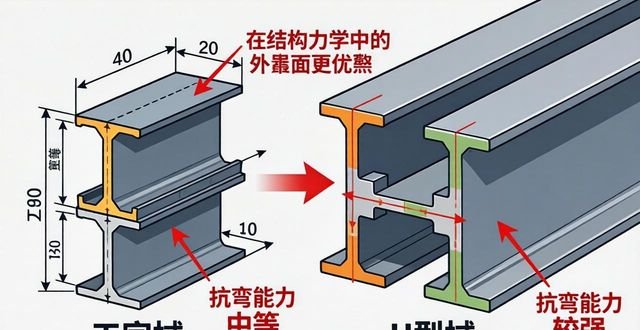
As rewritten below: H-beam, with its wide wings and strong bending resistance, is more suitable for use as load-bearing columns, and is also able to give more design flexibility. It is a kind of high efficiency and economic cut section, the section shape has been optimised to give more effective performance of the steel and improve the load carrying capacity. Compared with ordinary I-beam steel, H-beam has wider flanges and parallel inner and outer surfaces, which makes it easier to connect with high strength bolts and other components. In addition, H-beam has a reasonable size composition, and a full range of models to provide designers with more flexibility.
2.3 Rolling process and specifications
H-beam using complex rolling process, in the standard is divided into different flange categories, in order to meet the diversified needs of the building, in the rolling process here, H-beam and I-beam steel also has a significant difference, H-beam flange is the thickness of the rolled cross-section or a combination of 3 plates welded cross-section, however, I-beam using rolled cross-section, and in the production process in the inner edge of the flange has a 1. 10 slope, given that H-beam flange is wider and no slope (or very small slope), the rolling process to add a set of vertical rolls to synchronise the roll rolling process: 10 slope, in view of the wider H-beam flange, and no slope (or slope is very small), its rolling process to set up an additional set of vertical rolls to carry out synchronised roll rolling, so its rolling process and equipment is more complex than ordinary mills.
In addition, China's hot-rolled H-beam national standard, that is, GB/-1998, H-beam is divided into three categories: narrow flange, wide flange, and steel piles, in order to meet the needs of different applications. Narrow flange H-beams are suitable for beams or compression bending members, while wide flange H-beams and H-piles are suitable for axial compression members or compression bending members. For the same weight, H-beams have an advantage over I-beams in terms of w, ix, iy and other performance indicators.




 Chinese
  Japanese
  English
  German
  Finnish
暂无评论内容