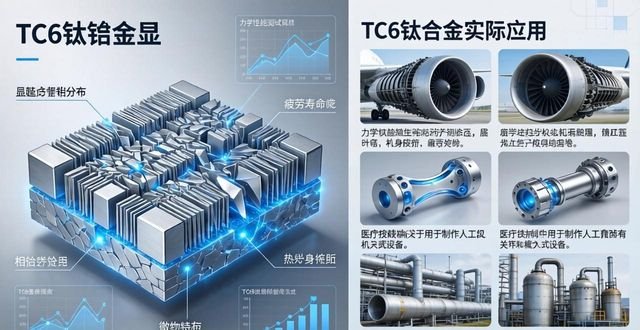



TC6 titanium alloy is a two-phase titanium alloy with a complex microstructure. Since its introduction, it has demonstrated immense application potential in numerous high-end manufacturing sectors, including aerospace, medical devices and chemical processing equipment. This alloy is renowned for its notable advantages, such as low density, high strength and corrosion resistance; at the same time, due to its unique material properties and the challenges posed by its processing, it has become a focal point of research for materials scientists and engineers. However, TC6 titanium alloy is expensive and difficult to forge and form, characteristics which, to a certain extent, limit its wider application. The microstructure of the TC6 titanium alloy will be examined in depth in this paper, as will its performance characteristics and processing challenges. Furthermore, current research and application progress regarding these challenges will also be explored in detail.
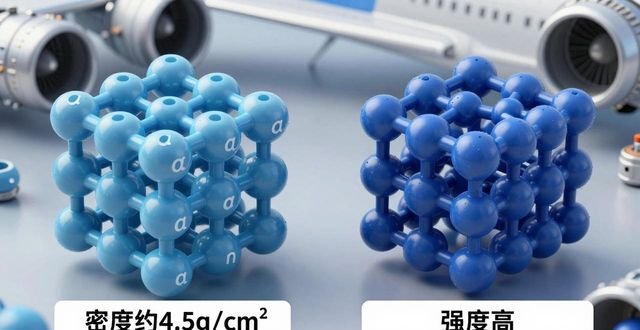
TC6 titanium alloy is an α+β two-phase titanium alloy; its microstructure consists of the α phase, which has a face-centred hexagonal structure, and the β phase, which has a body-centred cubic structure. This unique phase structure confers excellent overall mechanical properties on TC6 titanium alloy. The α phase primarily serves to provide high strength and good toughness, whilst the β phase helps to improve the alloy’s ductility and machinability. However, it is precisely this complex phase structure that makes TC6 titanium alloy prone to issues such as microstructural inhomogeneity and complex phase transformations during machining, thereby increasing the difficulty of machining. Performance characteristics: Firstly, low density. The density of TC6 titanium alloy is approximately 4.5 g/cm³, which is significantly lower than that of many traditional metallic materials, such as steel and nickel-based alloys. This characteristic gives TC6 titanium alloy a distinct advantage in the aerospace sector, as it reduces the weight of aircraft and improves fuel efficiency. Secondly, it possesses high strength. TC6 titanium alloy has very high tensile and yield strengths and is able to maintain good mechanical properties even in high-temperature environments. This makes it an ideal material for manufacturing critical components such as high-pressure vessels and engine blades. 3. It exhibits excellent corrosion resistance in a variety of corrosive media, including seawater, acidic solutions and alkaline solutions. This characteristic gives it broad application prospects in fields such as marine engineering and chemical processing equipment. ### Processing Challenges 1. **The material is perceived as expensive** **:** The cost of TC6 titanium alloy as a raw material is relatively high, primarily due to its highly complex alloy composition and the complexity of the manufacturing process. Furthermore, as titanium alloys are relatively difficult to machine, the scrap rate during processing is relatively high, which further increases material costs. 2. It is difficult to forge the material to achieve the desired shape, TC6 titanium alloy has poor thermal plasticity and is prone to phase transformations during heating, resulting in an uneven microstructure. This makes it difficult to control the material’s flow behaviour and dimensional accuracy during the forging process, leading to defects such as cracks and folds; consequently, the forging of TC6 titanium alloy presents a technical challenge. ### Progress has been made in research and application; in response to the processing challenges of TC6 titanium alloy, scholars and engineers both domestically and internationally have undertaken extensive research, achieving a series of significant advances. 1. By precisely controlling heat treatment parameters such as heating temperature, holding time and cooling rate, it is possible to optimise the microstructure of TC6 titanium alloy, thereby enhancing the material’s ductility and machinability; this is known as heat treatment process optimisation. For example, the use of a dual-annealing process can significantly reduce the β-phase content in the microstructure and enhance the stability of the α-phase, thereby improving the material’s mechanical and machining properties. To overcome the challenges encountered during the forging and forming of TC6 titanium alloy, researchers have pioneered a variety of advanced forging techniques, such as isothermal forging, superplastic forging and precision forging; these constitute advanced forging technologies. By precisely controlling the temperature and pressure during the forging process, these techniques enable effective management of material flow and dimensional accuracy, thereby significantly improving the quality of forged TC6 titanium alloy components. An effective method for producing high-performance titanium alloys is powder metallurgy; through processes such as the pre-treatment, compaction and sintering, it is possible to produce titanium alloy components with excellent mechanical and machinability properties. Furthermore, powder metallurgy enables near-net-shape manufacturing of complex-shaped parts, thereby further reducing material and processing costs. 4. With the rapid development of computer technology, numerical simulation and modelling techniques have been widely applied in the field of titanium alloy machining. By constructing accurate numerical models, it is possible to predict key parameters such as deformation behaviour, temperature distribution and stress states during the machining process of TC6 titanium alloy, thereby providing scientific evidence for optimising machining processes. To enhance the corrosion resistance and wear resistance of TC6 titanium alloy, researchers have also conducted extensive research into various surface treatment technologies. For example, surface modification techniques such as shot peening, nitriding and ion implantation can significantly improve the surface hardness and corrosion resistance of TC6 titanium alloy, thereby extending its service life. ### Application Prospects Although TC6 titanium alloy is relatively difficult to machine, its excellent performance characteristics mean it has broad application prospects in numerous fields. In the aerospace sector, TC6 titanium alloy can be used to manufacture critical components such as aircraft engine blades, high-pressure vessels and landing gear; in the field of medical devices, TC6 titanium alloy is widely used in orthopaedic and dental implants due to its excellent biocompatibility and corrosion resistance; in the chemical engineering sector, TC6 titanium alloy is utilised to manufacture corrosion-resistant reactors, piping and valves, amongst other critical equipment. ### Conclusion: In summary, TC6 titanium alloy, as a two-phase titanium alloy with a complex microstructure, has attracted considerable attention due to its notable advantages, including low density, high strength and corrosion resistance. However, its widespread use is constrained by the high material costs and the difficulty in forging and forming the material. By optimising heat treatment processes, developing advanced forging techniques, utilising powder metallurgy, employing numerical modelling and simulation, and implementing surface treatment technologies, it is possible to significantly enhance the machinability and overall performance of TC6 titanium alloy, thereby providing strong support for its application in a wider range of fields. In the future, with the continued development of materials science and processing technologies, the prospects for the application of TC6 titanium alloy will become increasingly broad.



 Chinese
  Japanese
  English
  German
  Finnish
No comments