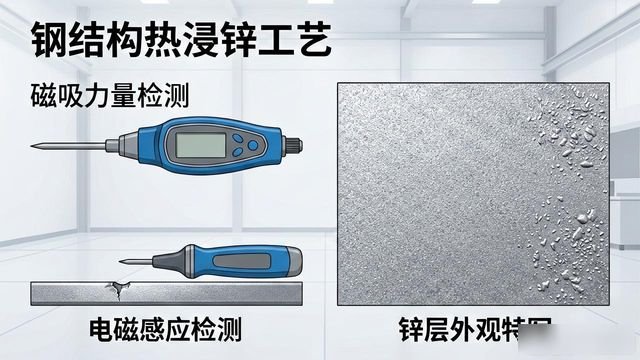


The hot-dip galvanising process, as applied to steel components, can be found at the following website.
1. Technical Requirements
For the corrosion protection of space frame components, including walkways, staircases and roof purlins, the steel must be sandblasted to remove rust prior to acid washing; the rust removal grade must meet the Sa2.5 standard, and the acid washing must meet the Be standard, steelworkHot-dip galvanising shall be used for corrosion protection; the technical specifications, test methods and thickness of the galvanised coating must comply with the provisions of GB/-2002 and shall not be less than 60 µm. The corrosion resistance of the space frame components and roof purlins must meet the quality requirement of 15 years of maintenance-free service. 2. There is also a description of the hot-dip galvanising process.
Hot-dip galvanising, as an effective method of metal corrosion protection, has been widely adopted in metal structural installations across various industries. Hot-dip galvanising involves immersing rust-removed steel components in molten zinc at a temperature of approximately 600°C, causing a layer of zinc to adhere to the surface of the steel components. For this project, the galvanised coating on the steel components must be no less than 60 micrometres in thickness. Hot-dip galvanising is carried out under high-temperature conditions. For tubular components, both ends must be kept open. If both ends are sealed, the expansion of air inside the tube may cause the end caps to burst, which could lead to safety incidents. If one end is sealed, the flow of molten zinc will be impeded, making it prone to accumulate inside the tube. Furthermore, hot-dip galvanisingprocess.
4. Hot-dip galvanisedquality controlMeasurement of zinc coating thickness

The thickness of a zinc coating can be measured using either destructive or non-destructive methods; however, in the vast majority of cases, non-destructive testing is sufficient. Magnetic non-destructive testing instruments fall into two categories: one measures the magnetic attraction between steel and a permanent magnet, whilst the other utilises the principle of electromagnetic induction. Non-destructive testing of hot-dip galvanised components can be carried out at any stage to determine the remaining zinc coating thickness. Appearance of the zinc coating.
The appearance of the zinc coating varies considerably; such variations are often due to the inherent properties of the steel substrate. However, the suitability of the zinc coating should be assessed on the basis of its rust-preventive properties and its performance over the long term. Dark grey zinc coating.
During the steel production process, silicon is occasionally added as a degassing agent; however, silicon also accelerates the reaction between the steel and the molten zinc bath. When hot-dip galvanised workpieces are lifted from the zinc bath whilst still at high temperature, this reaction continues, causing the pure zinc layer on the surface to transform, either completely or in patches, into a zinc-iron alloy layer. Compared to a pure zinc layer, this zinc-iron alloy layer appears darker in colour; however, if left exposed to the atmosphere for a period of time, this dark grey hue becomes less pronounced. The zinc-iron alloy layer on reactive steel is thicker than that on standard low-silicon steel, meaning it has a longer service life. The rust-preventive properties of the zinc-iron alloy layer are no less effective than those of a pure zinc layer; in some acidic industrial environments, it is even more suitable than a pure zinc layer. The zinc-iron alloy layer offers superior wear resistance; however, if a thick zinc coating is handled carelessly during lifting operations, there is a relatively high risk of it flaking off, so it is essential to handle it with care to prevent iron rust stains.
An intact hot-dip galvanised coating, which provides long-term rust protection, may occasionally become stained with rust or discoloured. This can lead to the mistaken conclusion that the zinc coating is substandard, or that it is visually unacceptable. This may be caused by one or more of the following reasons: Firstly, the hot-dip galvanised workpiece comes into contact with unprotected or inadequately protected steel, such as when a hot-dip galvanised workpiece is connected to an unprotected, electroplated or painted iron nut; secondly, the surface of the hot-dip galvanised workpiece becomes contaminated with iron filings generated by other processes.
3. Where steel components are unprotected or inadequately protected, rusty water seeps out (just as it does from damaged areas on painted workpieces) . As the acid solution penetrates pinholes or gaps in the welds, welding is carried out on hot-dip galvanised components; however, if no appropriate anti-corrosion protection is applied afterwards, to prevent iron rust stains, all parts of the structural component must be provided with effective anti-corrosion protection. Bolts and nuts must also undergo hot-dip galvanising. Weld seams should be as continuous as possible to prevent penetration by acid pickling solution, and must be free of weld slag. If welding on hot-dip galvanised components is unavoidable, the welded areas must be thoroughly cleaned and repaired. Rust stains and discolouration caused by external factors will not affect the service life of the zinc coating; however, contaminated areas may require cleaning to improve the appearance of the structural component. This can usually be achieved using a wire brush or cleaning powder to restore the surface of the zinc coating, which is generally somewhat rough.
International standards stipulate that hot-dip galvanised coatings must be smooth; however, they also specify that the definition of smoothness on steel structural components must not be assessed against products from automated production processes, such as hot-dip galvanised steel sheets, iron wire or water pipes. Uneven zinc coatings are often caused by variations in the steel’s composition and surface condition, which result in uneven growth of the zinc-iron alloy layer. Such uneven coatings are generally thicker than standard ones and consequently offer a longer service life; however, they may also give rise to dissatisfaction or affect the intended use of the workpiece. Lumps and streaks: what causes them? how exactly do they form, and what consequences do they entail? These questions warrant in-depth investigation. Why do lumps and streaks appear? What causes them? How do they affect the overall quality of the hot-dip galvanised coating and the final performance? How should these complex issues be accurately understood and properly addressed?
Swelling and streaks are caused by uneven zinc deposition on sharp or thin parts when the workpiece is lifted out of the zinc bath; however, this has no effect on the lifespan of the zinc coating. Pimples.
The pitting observed on hot-dip galvanised surfaces is caused by dross, which consists of suspended particles of zinc-iron alloy within the galvanising bath. This may be due to iron residues remaining on the surface of the workpiece when it is transferred to the bath following pre-treatment, or it may result from the removal of zinc dross from the bottom of the bath. Slag possesses the same rust-preventive properties as pure zinc; if it appears on the surface of the zinc coating as fine, dispersed particles, this is acceptable. White rust refers to stains caused by storage in damp conditions.
Moisture-induced storage stains are white oxides and dark grey patches that appear on the surface of hot-dip galvanised workpieces. These are caused by the workpieces being stored in close proximity to one another or transported whilst in a damp environment. Once white rust has formed, its base turns either dark grey or black. To prevent the formation of white rust, hot-dip galvanised workpieces should be stored in a dry, well-ventilated environment. Similarly, during transport, they should be kept in a dry, well-ventilated environment; for example, when stored outdoors, the surfaces should not be stacked on top of one another, as air circulation prevents the accumulation of condensation and moisture. Stacking in a tightly packed manner should be avoided, as capillary action will draw moisture into the gaps between overlapping parts. Workpieces should also not be stored in direct contact with the ground. If a bright surface finish is essential, a coat of varnish or similar finish may be applied to the surface to maintain its lustre. Severe rust stains must be removed; this is usually achieved using a wire brush or light sanding. The use of chemicals to remove white rust should be a last resort, and must be followed by thorough rinsing with plenty of clean water to remove any flux residues.
During the hot-dip galvanising process, flux is used; residual flux may adhere to the surface of the workpiece and, upon exposure to moisture, form white rust. Although this is merely a surface issue, these flux spots may compromise the lifespan of the zinc coating and should therefore be removed. Exposed areas.
As zinc provides sacrificial corrosion protection, minor localised defects measuring 5 mm in width can self-repair, although this may have a slight impact on the lifespan of the zinc coating. Areas where zinc has not been applied due to issues in the production process will be inspected by the galvanising plant, which will then carry out repairs or rework. However, some bare spots are caused by defects in the steel itself, such as creases, or non-metallic impurities pressed into the steel surface during rolling, which prevent zinc from adhering.



 Chinese
  Japanese
  English
  German
  Finnish
暂无评论内容