
In February 2026, a fibre-optic machine was installed in our company’s workshoplaser cuttingCutting machine: Since this cutting machine was put into operation, it has saved the company a great deal in processing costs, improved production efficiency, and played a significant role in shortening product lead times.
Laser cutting is a process in which a laser emits a beam of light; this beam is reflected and focused by a focusing lens onto the workpiece, causing it to melt or vaporise at high temperatures, whilst an auxiliary gas blows away the molten material to achieve the cut. Laser cutting, which replaces traditional mechanical cutting tools with an invisible beam, is widely used in the processing of both metallic and non-metallic materials. It can significantly reduce processing time, lower processing costs and improve processing quality.
Compared with other thermal cutting methods, laser cutting offers the following advantages:
1. Cutting qualityRight, that’s very accurate.
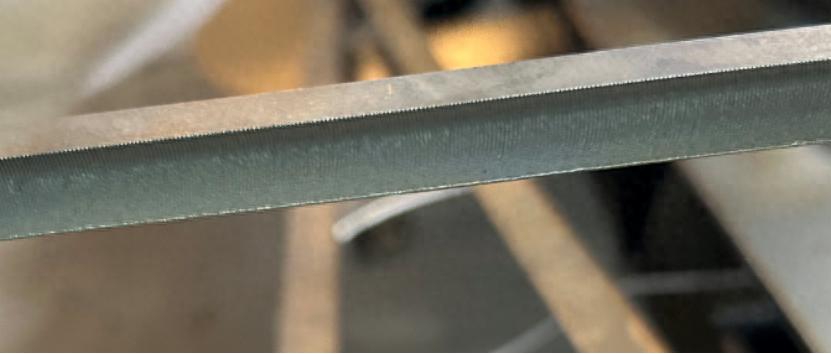
As the laser produces a small focused spot—with a diameter as small as 50 μm—and has a high energy density, there are no shear burrs; laser cutting therefore achieves superior cut quality, with a smooth and aesthetically pleasing cut surface. The surface roughness of the cut edge can range from Ra50 to Ra25; workpieces requiring pre-welding preparation that do not require a particularly high level of surface finish can be cut directly by the laser, thereby saving a processing step. Figures 1 and 2 show the surface morphology of sheet metal cut during laser blanking in the structural workshop. As laser cutting machines are equipped with CNC capabilities, they can precisely control the dimensional and positional accuracy of workpieces.
Table 1: Dimensional tolerances achievable with laser cutters

Figure 1
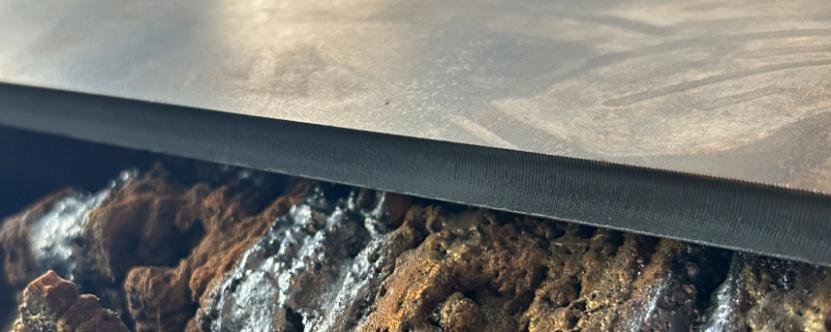
Figure 2
2. Minimal deformation during cutting
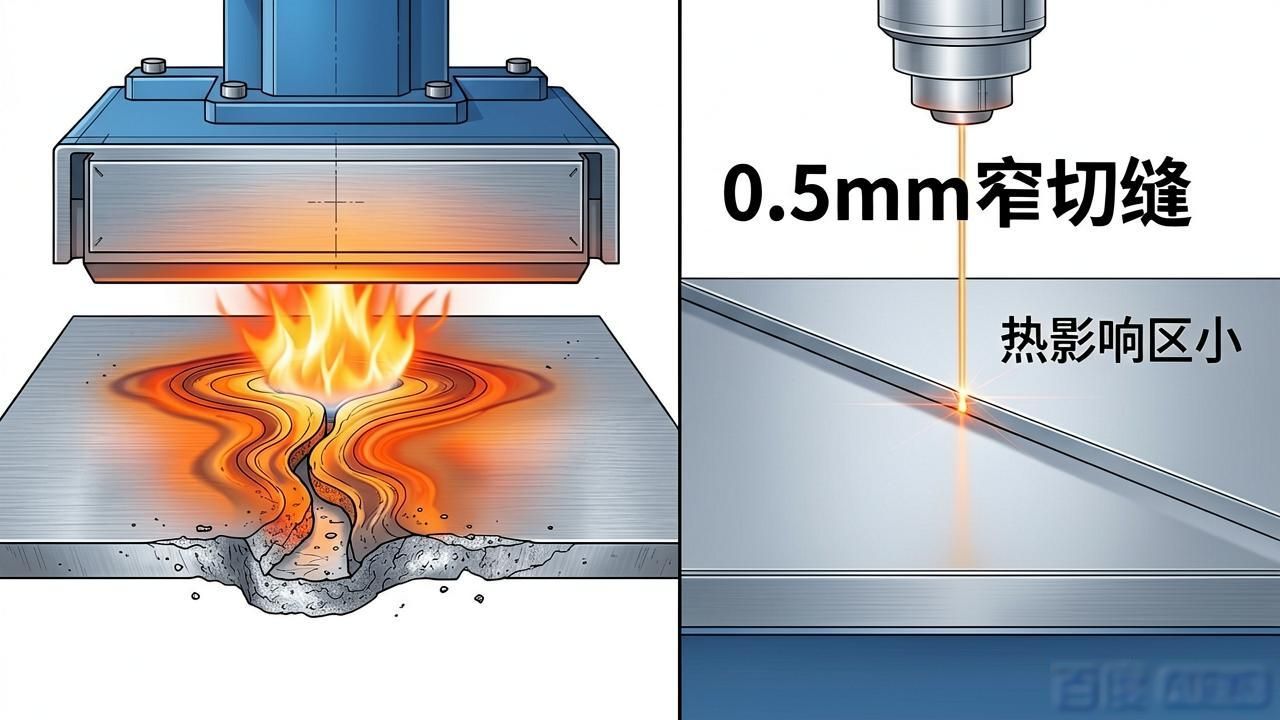
Conventional thermal cutting, which produces a large heat-affected zone, is prone to causing thermal deformation of the sheet metal when cutting thin sheets, as the excessively long cut seam subjects the material to thermal stress. Laser cutting is characterised by a very small focused spot and a narrow cut width of typically around 0.5 mm; consequently, the heat-affected zone is minimal, the cut is free from mechanical stress, and the properties of the material adjacent to the cut are virtually unaffected. This results in minimal deformation of the workpiece after cutting and high cutting precision, the cut seam exhibits excellent geometry, with a cross-sectional shape that is a relatively regular rectangle; the narrow cut seam facilitates efficient cutting.
3. Fast cutting speed
The cutting speed of a laser cutting machine increases as the laser power increases, and also as the gas pressure increases; however, it decreases as the thickness of the material being cut increases. When cutting carbon steel plates less than 2 mm thick, the speed can reach 10 m/min, whereas for carbon steel plates of around 6 mm, the cutting speed is approximately 2.5 m/min. Furthermore, it is considerably faster than plasma cutting under conditions involving plates of the same thickness. When the power and plate thickness are the same, cutting speeds vary depending on the material being cut. For example, when cutting 12 mm-thick bakelite, the speed can reach 4.5 m/min, whereas when cutting 12 mm-thick steel plate, the speed is only 0.8 m/min.
4. High cutting efficiency
As lasers possess transmission properties, laser cutting machines are typically equipped with multiple CNC worktables. The entire cutting process can be controlled numerically; during operation, simply by modifying the CNC programme, the machine can be used to cut parts of different shapes, enabling both two-dimensional and three-dimensional cutting. Given the high cutting speed, this significantly improves cutting efficiency. For example, before structural workshops were equipped with laser cutting machines, producing thin sheet metal parts with holes required multiple processing steps, such as shearing with a shearing machine and cutting with a plasma cutter; holes smaller than the sheet thickness often had to be machined in a separate machining workshop. Clearly, the loading, unloading and transport involved in this process wasted a great deal of unnecessary manpower, material resources and time. Nowadays, laser cutting can accomplish this in a single step, increasing efficiency by 200 to 300 per cent.
As we move forward with the times and technology advances, more advanced... will emerge.CNC cuttingEquipment; therefore, keeping pace with the times and carrying out equipment upgrades at the appropriate time is of great significance for enterprises in improving product quality and enhancing their competitiveness.
 Chinese
  Japanese
  English
  German
  Finnish
Leave a Reply
You must be logged in to post a comment.