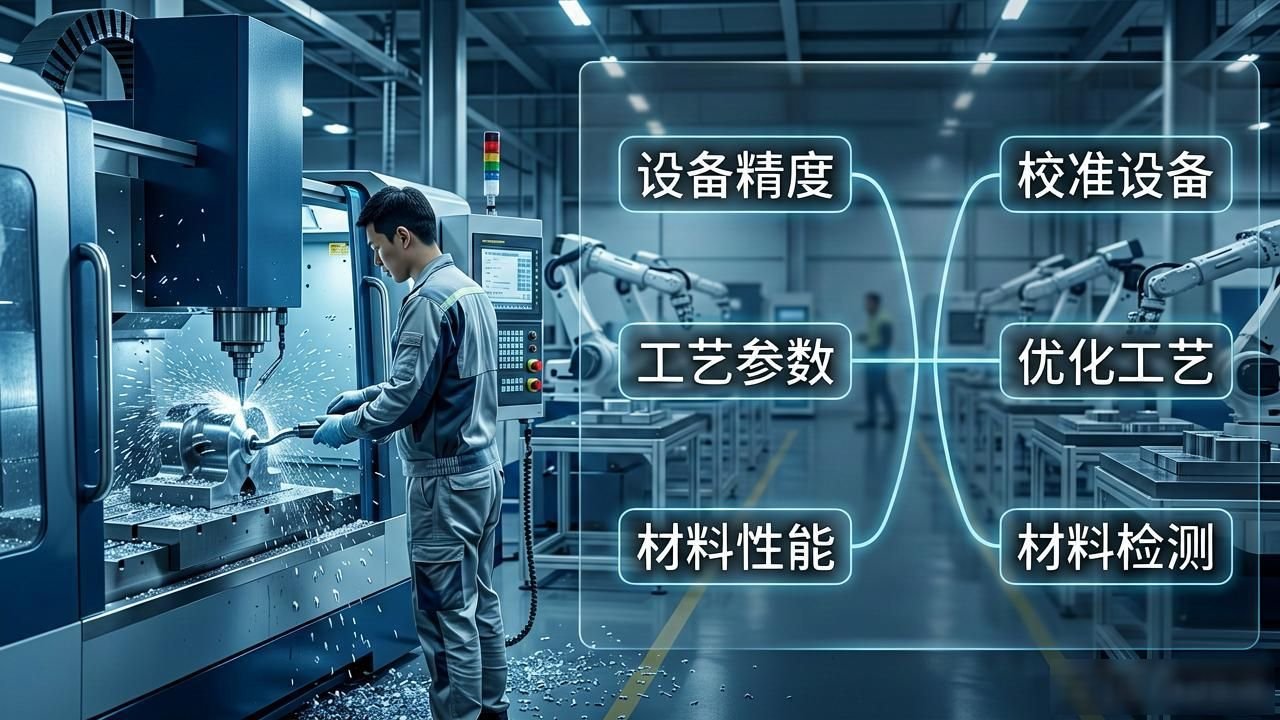



The focus is on mechanical componentsmachining accuracy的Influencing factorsand countermeasures. The key point is that the quality of mechanical components has a significant impact on the assessment of machining accuracy—a crucial indicator of mechanical quality. Therefore, it is essential to place greater emphasis on accuracy during component machining. The machining process of mechanical components is influenced by a variety of factors, and controlling their accuracy is a relatively challenging technical task. The paper begins by providing an introduction to the machining accuracy of mechanical components. Building on this foundation, it then conducts an in-depth exploration of the various influencing factors and proposes targeted solutions, with the aim of contributing to the improvement of machining accuracy for mechanical components. Keywords: mechanical components, machining accuracy, influencing factors, countermeasures. Introduction: In recent years, China’s economy has experienced rapid development, leading to a substantial increase in demand for various types of machinery in industrial production, with demand for small and micro-sized machinery being particularly pronounced. This has consequently placed higher demands on the machining of mechanical components. During the machining process of mechanical components, controlling precision is of paramount importance. This requires operators to base their work on the specific requirements of the machinery, employing bespoke solutions underpinned by precision. Different machining techniques must be applied to meet varying requirements, thereby ensuring that every mechanical component falls within the required precision range. It is important to note that the machining process is complex and intricate; indeed, even the smallest detail may, to a certain extent, have a significant impact on machining accuracy. 1. An introduction to the precision of mechanical component machining. During the machining of mechanical components, overall precision is primarily influenced by three factors: shape, position and dimensional accuracy. Throughout the machining process, these three constraints are interdependent and influence one another; positional tolerances must not be smaller than geometric tolerances, and dimensional tolerances determine the range of positional tolerances. The error values generated during the machining process generally serve as a good representation of machining accuracy. Before commencing the machining of a part, the machinists are usually provided with the designer’s strict dimensional requirements; however, the finished part will exhibit a certain deviation from the design. This is known as machining error, which is an objective reality. At the same time, the greater the error, the lower the machining accuracy. The process of machining a part usually involves various stages and steps, and each stage inevitably involves some degree of error. When combined, these errors have a significant impact on machining accuracy. For example, positioning errors are highly likely to occur during the clamping stage, caused by a mismatch between the part’s positioning reference and the design reference, whilst clamping errors result from excessive clamping force, amongst other factors. The errors generated at each stage accumulate as the machining process progresses, and by the final stage, they can severely affect the machining accuracy of the part. At the present stage, research into the machining accuracy of mechanical parts in China primarily employs two methods: the single-factor analysis method and the statistical analysis method. In single-factor analysis, the impact of errors arising at each stage on machining accuracy is examined, whilst the influence of errors from other stages is excluded. The statistical analysis method involves sampling; it analyses the precision of a subset of parts within a batch, endeavouring to thoroughly investigate the various types of error present. It is worth noting that this method is of greater practical value during mass production. When machining mechanical components, the machining methods employed at each stage will affect machining accuracy, thereby influencing component quality at its very root. Below, we will examine stress-induced deformation,Thermal deformationand the geometric accuracy of the process system, to analyse the factors influencing machining accuracy. When machining mechanical components, deformation of the process system frequently occurs; this is the result of various external forces, such as clamping forces and gravity. Under such circumstances, the position of the cutting tool relative to the workpiece changes, leading to the introduction of errors; this is one of the key factors affecting machining accuracy. Deformation of the process system not only affects machining accuracy to varying degrees but also results in a deterioration in the surface quality of the workpiece and a significant reduction in production efficiency. Generally speaking, the most common type of deformation in a machining system is elastic deformation; therefore, enhancing the system’s resistance to elastic deformation plays a vital role in improving machining accuracy. During the machining process, phenomena such as friction occur at various stages, leading to a rise in temperature; under the influence of thermal forces, the machining system is subject to thermal deformation. Once deformation occurs, it can very easily cause adverse consequences for the machining equipment’s cutting tools and workpieces, thereby reducing machining accuracy. An analysis of the heat sources responsible for thermal deformation reveals that there are primarily two types: internal and external heat sources. The former refers to the cutting tools of the machining equipment whilst in operation.




 Chinese
  Japanese
  English
  German
  Finnish
No comments