
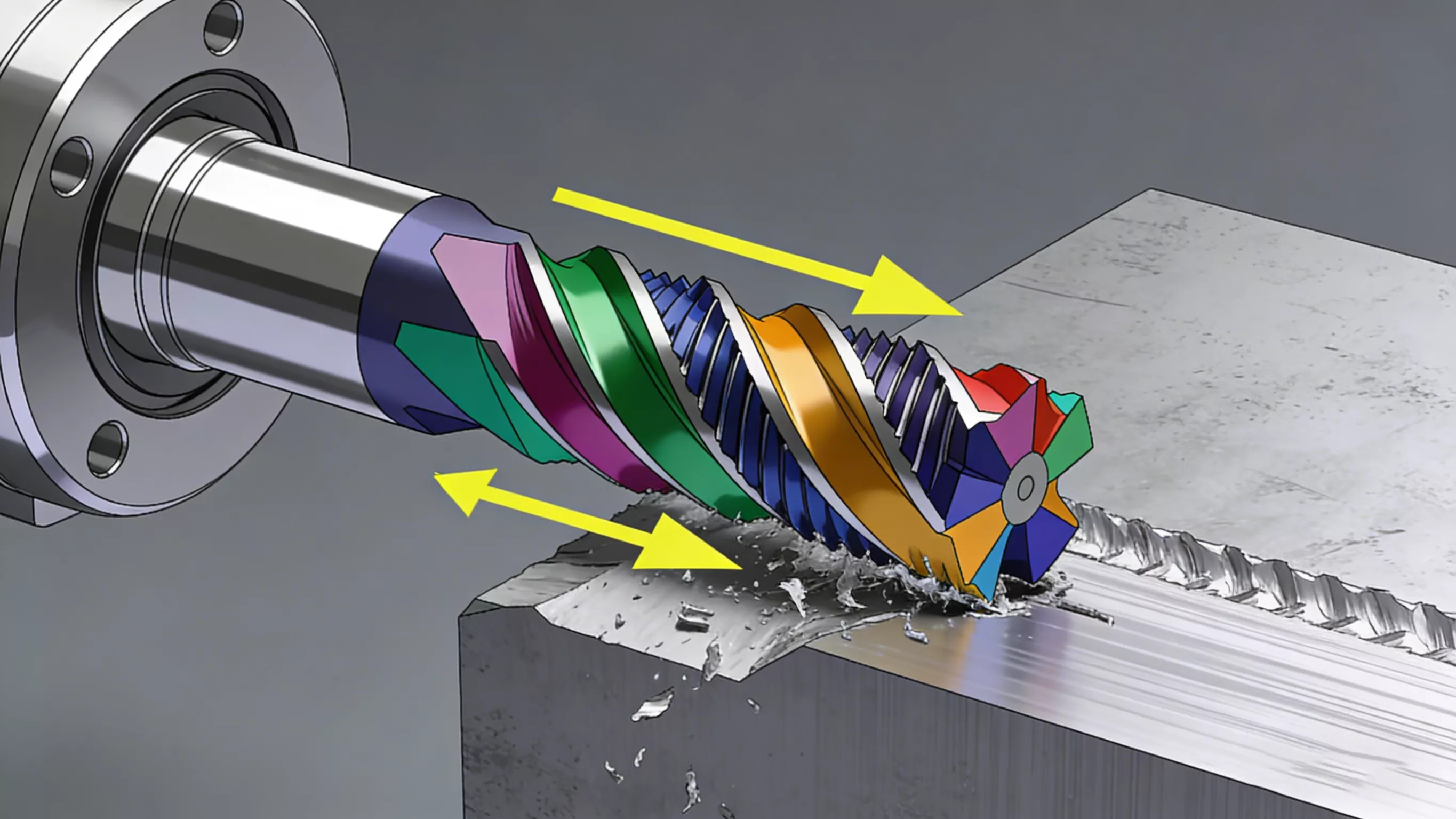
In the workshop of Jucheng Precision, “this surface should be milled flat, that slot should be milled out”, such words are one of the more frequent appearances in the workshop environment on the CNC milling machining instructions description. It is a cornerstone process in modern manufacturing, used to realise complex shapes, high-precision planar surfaces and three-dimensional features. Simply put, milling is the process of cutting a stationary or moving workpiece with a rotating tool, but behind this seemingly simple action lies a whole range of precision science involving motion control, tool geometry and material mechanics. This article will take you deeper into the world of CNC milling, from the principles to the practical level, guiding you to a comprehensive understanding of this ubiquitous manufacturing technology.
Core Principle: Essential Difference from Turning
Milling is a material removal process that is most characterised by a rotary main motion of the tool and a linear or curvilinear feed motion of the workpiece.

The essence of milling, Figure 1, is the relative motion between the tool, which is operated rotationally with several cutting edges, and the workpiece, as well as the shearing of the material.
In simple terms, milling is a “keep the tool in motion” operation, while turning is a “keep the workpiece in motion” operation. These two methods complement each other and together form the core of CNC machining.
Process Types: Four Common Milling Methods
Milling can be classified into several main types depending on the machining objectives and tool paths:
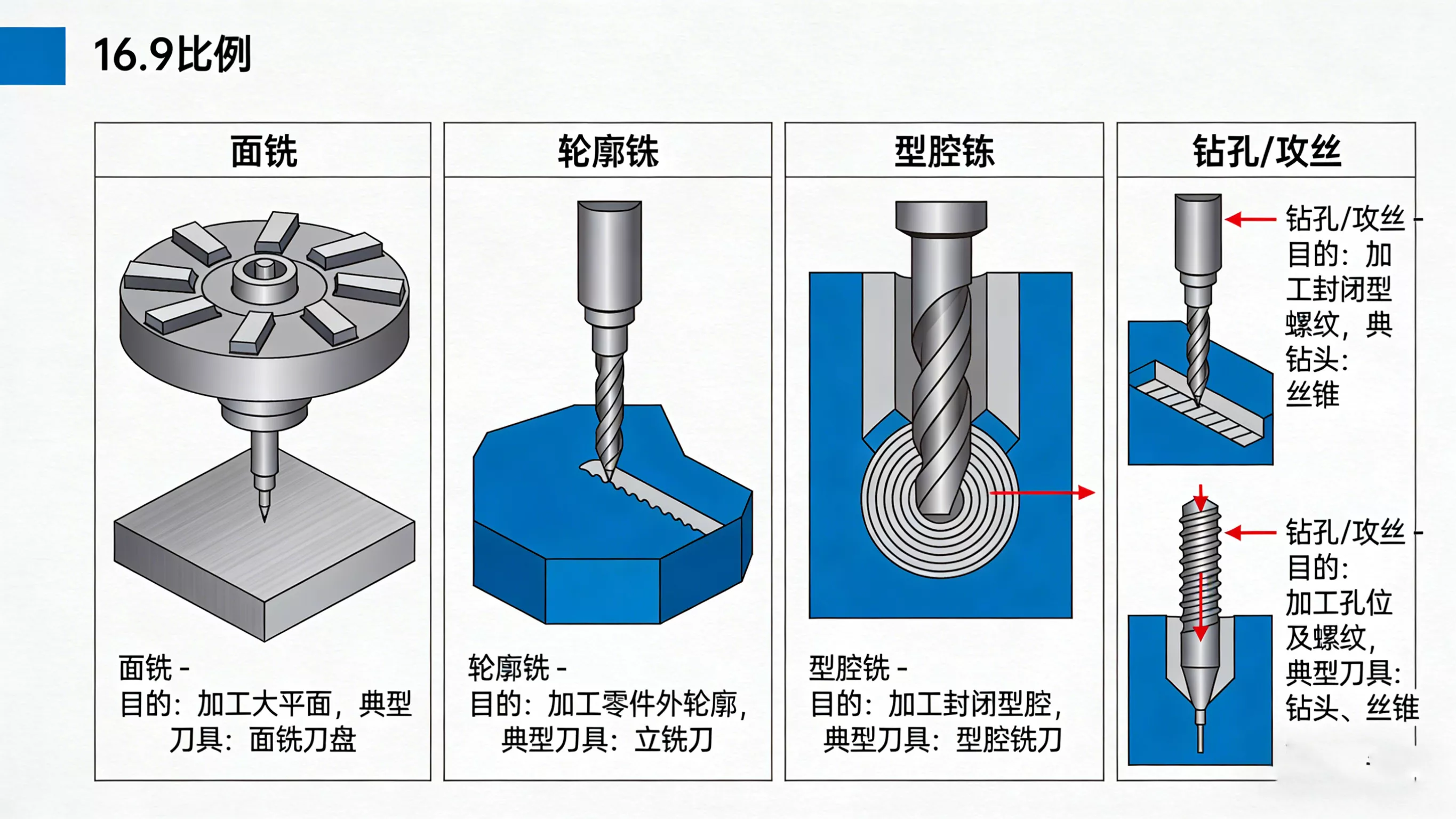
Figure 2: Different machining objectives require different milling strategies and tools.
1. Face milling
Purpose: To quickly obtain large, high-precision flat surfaces.
Typical tools: Face milling discs (with multiple indexable inserts).
Key Points: The diameter of the cutter disc usually needs to cover the width of the workpiece, using a linear or profiling path.
2. Contour milling
Purpose: To machine the external or internal contour shape of a part.
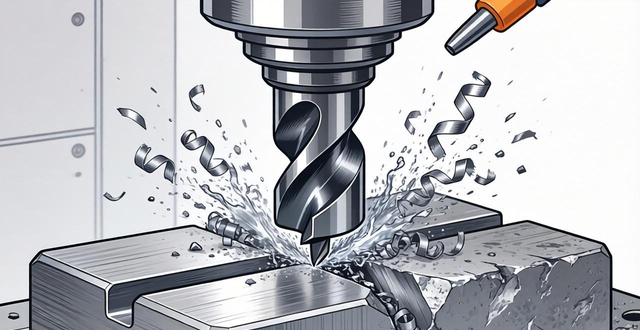
Typical tools: End mills (using side flute cutting).
There are points, first of all, rough milling, ah, to leave a margin, and then it is fine milling link, to reach the final size, but in this process, it must be considered tool radial compensation.
3. Cavity milling
Purpose: To remove material from a closed or open area to form a pit or cavity.
Typical tools: End mills (both end and side flutes are involved).
Emphasis is placed on the planning of efficient roughing toolpaths, such as spiral downcutting and reciprocating cutting, as well as on strategies for finishing sidewalls and bottoms.
4. Hole machining
The purpose is to carry out, among other things, drilling activities, reaming operations, boring operations, tapping behaviour and so on. These operations, although often regarded as separate processes, are nevertheless carried out on the milling machine by means of the spindle.
Typical tools: Drills, reamers, taps, boring tools.
One thing to pay attention to is accurate positioning, as well as the right speed and feed. For high-speed deep hole drilling, attention should be paid to the situation of chip removal and cooling.
Knowing the scenarios for each milling process is the basis for efficient programming. For a more in-depth discussion on machining strategies, please refer to our article on optimising CNC machining strategies.
Tools and parameters: the key to milling results
Successful milling depends on the “right tool” and the “right parameters”.
Core cutting parameters
The golden rule is that in roughing, the goal is metal removal rate, which can be achieved by choosing a larger depth of cut, a wider width of cut, and a moderate feed per tooth fz; in finishing, the focus is on surface quality, which can be achieved by choosing a smaller depth of cut, a smaller stepover, an appropriate feed per tooth fz, and a higher rotational speed.
Strategy selection: How to plan the milling process?
When faced with a part, sound milling process planning follows the following logic:
Part features are analysed to identify planes, contours, cavities and holes, and to evaluate dimensional requirements, tolerances and roughness.
Drawing up the machining sequence, generally in accordance with the “first rough and then fine” guidelines, in accordance with the “first face after the hole” requirements, follow the “first main and then secondary” provisions to carry out, the first priority will be the reference surface Machining out.
Select from a variety of clamping options to ensure that the workpiece is stable when subjected to cutting forces, and consider whether multiple clamping operations are required to machine all faces.
Assigning tools and parameter co-ordination: Assigning the right tool for each process and setting the initial parameters according to the material and the type of machining (roughing or finishing).
Generation of toolpaths and optimisation of the generated toolpaths inside the CAM software to optimise their coherence, avoiding empty strokes and reducing sudden changes of direction.
Milling process insights from Jucheng Precision
Case: High-precision aluminium alloy communication shell machining
The challenge is that the parts are thin-walled aluminium alloy housings with a large number of internal and external heat sink teeth and many mounting columns, which require strict dimensional accuracy, tight form and positional tolerances, and the need to control machining distortion.
Milling process programme:
Beyond single cuts: systematic milling capabilities
At Prudential Precision, we take this view and feel that milling excellence is not dependent on a single machine or tool, but is built into the system:
We are committed to placing every milling process into a system that is controlled, predictable and optimised to provide our customers with high quality milling solutions from simple parts to complex components.
In digital manufacturing, there is a particularly active “carving pen” thing, that is, CNC milling, which relies on that kind of incomparable flexibility and precision, to shape the physical appearance of today's industrial products. Whether it's the metal frame of a smartphone or the blade mould of an aero-engine, it's all about precision milling. To understand its principles, but also to master its methods, and even be able to systematically plan and go to the application, which is the key bridge between innovative design and manufacturing excellence. Here in Jucheng Precision, we have been in-depth study of this technical skills, with special professional milling ability, to help each precise idea completely realise the success of the ground.
-- Jucheng Precision CNC Milling Process Centre
 Chinese
  Japanese
  English
  German
  Finnish
Leave a Reply
You must be logged in to post a comment.