

go formachiningWhen the vibration characteristics, and vibration control technology for the vibration, there is a named machining vibration characteristics andvibration controlThe documentation for the technology is in docx format.
Abstract: In the category of machining, vibration can cause the quality of machined surfaces to develop in the direction of degradation, which in turn affects machining accuracy and efficiency. This paper introduces the two main types of vibration in machining, namely forced vibration and vibration itself, and analyses the causes of these two types of vibration. It also analyses the causes of these two types of vibration, and gives several measures to prevent vibration according to the actual situation. The field of scientific research is also briefly described.
Due to the external periodic interference force caused by forced vibration, so to eliminate forced vibration, we must first find out the source of vibration, and then take appropriate measures to control.
The excitation force of the vibration source is reduced or eliminated. For parts with a rotational speed of 600r/min or more, such as grinding wheels, chucks and motors, they must be balanced, especially those with a particularly high rotational speed, and precise balancing work must be carried out. The machining accuracy and installation accuracy of gears should be improved, so that the smoothness of the work can be improved, thus reducing the vibration caused by the periodic shock; the manufacturing and assembly accuracy of rolling bearings should be improved, so as to reduce the vibration caused by the defects of the bearings.
Adjust the frequency of the vibration source to avoid the frequency of the excitation force and the intrinsic frequency of the system are similar, to prevent resonance, to take to change the motor speed or spindle speed to avoid the resonance of the region, to improve the precision of the contact surface, to reduce the roughness of the bonding surface, to eliminate the gap, and to improve the contact rigidity to improve the stiffness and intrinsic frequency of the system.

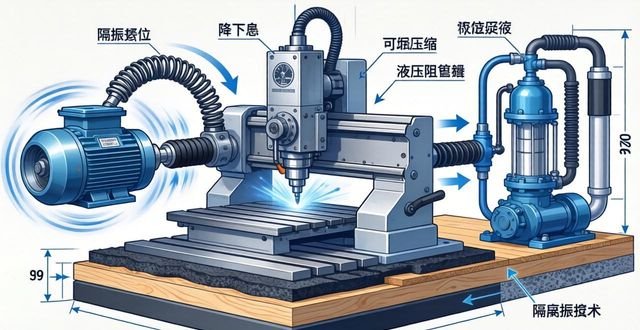
First of all, take vibration isolation measures, including, the machine's motor and the machine itself, to use flexible connectors to isolate the vibration of the motor, but also to separate the hydraulic part from the machine, and the use of hydraulic cushioning device to reduce the impact of the components when the change of direction, in addition to the use of thick rubber, wood, the foundation of the machine to prevent the vibration of the surrounding sources of transmission to the machine tool through the ground and the foundation, and so on.
3. 2 Ways to control self-excited vibration
(1) Appropriate selection of tool geometry parameters, experimental and theoretical studies show that in the tool geometry parameters, the most significant impact on the vibration is the main angle of deviation and the front angle, selecting a reasonable main angle of deviation can reduce vibration.
The second is to enhance the vibration resistance of the process system, the vibration resistance characteristics of the process system is one of the main factors affecting the vibration of the vibration of the main factors, to think of ways to enhance the contact stiffness of the process system.
(3) The use of vibration-damping devices, vibration-damping devices are often attached to the process system to absorb or consume the energy of the vibration occasion, so as to achieve the goal of vibration damping, which is also effective in suppressing forced vibration and vibration vibration, is to enhance the vibration resistance of the process system is an important path.
Active vibration control and active vibration isolation
Vibration passive control, is the traditional method used for vibration control, generally consists of springs and damping, because of the passive control device exists for the system eigenvalue is a fixed value and other shortcomings, so the passive control method has been more and more difficult to adapt to the high-precision, fast-response vibration control needs, with the rapid development of computer and control technology, as well as the theory of vibration and control theory of the intersection of the cross-penetration, vibration active control technology as an interdisciplinary branch of mechanics began to be applied in the field of engineering, active control technology with fast, stable and intelligent characteristics. With the rapid development of computer and control technology, as well as vibration theory and control theory cross-penetration, vibration active control technology as an interdisciplinary branch of mechanics began to be applied in the field of engineering, active control technology has the characteristics of fast, stable and intelligent.
Passive vibration isolation technology belongs to one of the branches of vibration control technology, its role is to set up between the controlled vibration and vibration body of the original, in order to weaken the vibration body of the vibration of the controlled vibration of the impact, however, it relies on vibration isolation is not the original active driver, but the spring and damping. Spring and damping performance is in the control system, can produce more active vibration isolation element realisation force change rule is much simpler control force, its adaptability and adjustability is far less than the active vibration isolation system, different springs and damping has different characteristics, the common point is set up in accordance with the requirements of the designer. Therefore, the active vibration isolation technology, belonging to the current research hot spot category, is the kind of vibration isolation technology with great development potential.
At present, the research on active vibration isolation technology at home and abroad mainly has the following aspects:
The driver is the main component of the vibration active control system, and its function is to transform the non-mechanical quantities such as non-electricity output from the controller into mechanical quantities such as displacement, force, and so on, so as to reach the drive of the control object. At present, the drive for active vibration isolation technology, mainly covers: pneumatic and hydraulic drive, electromagnetic drive, piezoelectric drive and super magnetostrictive drive.
In actively controlled vibration isolation systems, vibration sensors are important components, often using inertial sensors, the principle of the forced vibration characteristics of the spring-mass system to implement vibration measurement, the role of the vibration of the vibration isolation object is the amount of vibration (position).




 Chinese
  Japanese
  English
  German
  Finnish
暂无评论内容