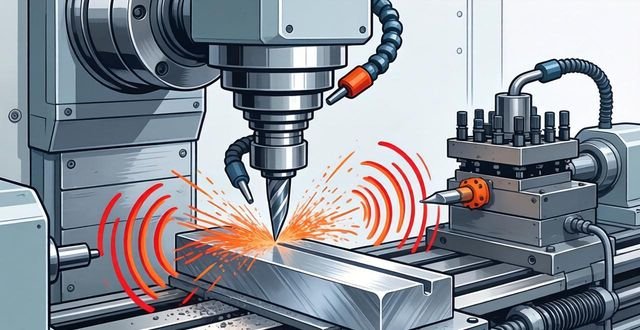


machiningVibration analysis and control measures in
Abstract: In the machining process, vibration phenomenon occurs most frequently, how to solve the problem of vibration in the machining process is always one of the topics studied by the machinery manufacturing industry. Along with the continuous development of science and technology, modern CNC machine tools have become the main tools in the process of machinery manufacturing, although it improves the efficiency of machinery manufacturing, but also causes many problems. The article mainly analyses the adverse effects of vibration on machining, then the types and causes of vibration to be elaborated, and finally on the elimination of vibration methods and ways to explore.
Keywords: machining; free vibration; forced vibration; self-excited vibration; vibration cancellation
I. Preface
In machining, vibration is an extremely harmful physical phenomenon that has a significant impact on surface quality and productivity. If vibration occurs during machining, there will be relative displacement between the tool and the workpiece, resulting in vibration marks on the machined surface, which can have a serious impact on the surface quality and performance of the part. Vibration also places additional dynamic loads on the tool, resulting in faster tool wear and sometimes even chipping. At the same time, vibration makes machine tools, fixtures and other parts of the connection become loose, which increases the gap, reduces the rigidity and accuracy, shortens the service life, and in serious cases may even lead to cutting processing can not continue. Noise generated in the vibration, but also on the operator's own health hazards, in order to reduce vibration, sometimes have to go to reduce the amount of cutting, which makes the machine tool for processing when the productivity is reduced. Therefore, the causes and characteristics of vibration in the machining process to carry out research and analysis, to seek effective ways to control vibration is very necessary, the type of mechanical vibration is divided into free vibration, forced vibration and self-excited vibration, three categories. Free vibration is under the action of the initial disturbance force destroys the balance of the system, relying only on the elastic restoring force to maintain the vibration. Because there is always damping in the system, free vibration will decay quickly, so the impact on machining is not very large. Forced vibration belongs to a kind of vibration, this kind of vibration is not attenuated, self-excited vibration also belongs to the category of vibration that is not attenuated, these two kinds of impact on machining, can not be ignored.
II. Types and causes of vibration
The causes of vibration are multidimensional and cover three main categories: free vibration, forced vibration and self-excited vibration.
1. Analysis of free vibration
If the system is in operation and the external forces disappear, the machine tool system itself produces a decaying motion, which is called free vibration. The reason for this is that the process system is subjected to some of the forces, such as external impact on the system, the machine tool drive system due to non-periodic shock caused by the impact of the workpiece processing, etc., which will lead to the system itself in a state of imbalance, relying on the system itself has the elasticity of the restoration force to restore, based on the vibration generated by the main is the free vibration. The frequency of free vibration is the same as the frequency of the system itself, but the system will form a damping force, so the free vibration will gradually subside.
2. Analysing forced vibrations
External cyclical interference force to produce forced vibration, but the main reason for its generation is that, during the cutting process, due to the existence of machine construction parts part of the poor accuracy of the situation, resulting in uneven machine operation, which in turn causes vibration. At the same time, the reverse side of the tool can also cause vibration, each type of tool has a unique edge height, so vibration will be generated during machining. Vibration can also occur during machining if the surface of the workpiece to be cut is not continuous and varies in hardness and softness for a number of reasons. On the outside of the machining system, there are also reasons that cause vibration when the lathe is in operation. Forced vibration has its own unique characteristics, mainly, the vibration caused by the emergence of the steady state is a harmonic vibration, so in the disturbing force is not eliminated when the vibration will not be attenuated, if the disturbing force is eliminated, the vibration will be terminated immediately; in view of the cause of the vibration, the frequency of the vibration is equal to the frequency of the disturbing force; when the damping force of the system becomes small, the amplitude of the forced vibration will be increased, and harmonic influence trajectory range is also the bigger, so the vibration will be reduced. Increasing the damping can effectively reduce the amplitude of the forced vibration; in the resonance region, a small frequency will lead to a large change in amplitude, while the phase angle will also change.
3. Analysis of self-excited vibrations

Machine tools in the machining, self-excited vibration is the case, the vibration itself so that part of the cutting force cycle changes, and the cutting force generated in turn act on the system, supplemented by the system due to the damping effect of the reduced capacity, so that the vibration of the system can be maintained and strengthened. In the machining process, the self-excited vibrations are mainly high-frequency strong vibrations, which can lead to a reduction in the quality of the surface of the machined workpiece, greatly affecting the productivity of the machine tool. In the grinding process, the vibration generated between the grinding wheels is also self-excited vibration. The main principle of operation is shown in Figure 1:
Self-excited vibration has the main characteristics, its vibration type belongs to the kind of non-attenuation, so the system's own intrinsic parameters, the frequency of self-excited vibration plays a decisive role, this aspect and the forced vibration is quite different; in each cycle of vibration, the vibration energy obtained by the system is compared to the energy consumed due to damping, and this value determines the size of the amplitude of the self-excited vibration; Self-excited vibration is generated by the vibration process Self-excited vibration is caused by the excitation and feedback generated by the vibration process itself, so if the process stops, the self-excited vibration will disappear.
III. Measures to eliminate vibration
Machine processing, forced vibration accounted for a large proportion of self-excited vibration also accounted for a large proportion of the proportion of free vibration is very small. Free vibration is quickly removed by the damping force, so the elimination of vibration is often based on the cause of the other two types of vibration to be eliminated.
1. Measures to eliminate self-excited vibration
(1) Selection of tool geometry parameters should be reasonable, experiments and theoretical studies show that the tool geometry parameters, the most significant impact on the vibration is the main deflection angle and front angle, because the wider the chip is more likely to vibrate, and the smaller the Kr, the wider the width of cut, so the more likely to vibrate, the larger the front angle, the smaller the cutting force, the smaller the amplitude.
(2) in the cutting time, the relevant parameters to give a scientific choice, mainly covering the cutting speed, related to the workpiece feed that amount, but also involves the back eating amount of matters, like Figure 2 content, when in the range of 20 to 60m/min range of cutting speed, the amplitude of the amplitude increases particularly rapidly, when the speed is higher than or lower than this range, the vibration will slowly weakened, the amplitude decreases. As shown in Figure 3, feed and amplitude basically form an inverse relationship between that, amplitude with the increase in feed and gradually reduce. Figure 4 shows that the back draft and amplitude present a positive relationship, the amplitude increases with the increase in back draft. In the cutting process should be based on the actual situation to choose reasonable parameters related to the cutting process.
(3) in the processing period to enhance the system's own vibration resistance, in the elimination of vibration, the machine tool system's own vibration resistance occupies a dominant position, this aspect should be paid attention to, can be improved with the help of the following methods, first of all, the rigidity of the machine tool to be improved, but also for the various components based on their own unique fixed frequency to be analysed, followed by a reasonable layout, at the same time can be put in the system to be increased resistance. Increase, these initiatives can increase the vibration resistance of the machine, for the tool should also improve its vibration resistance, for the workpiece to enhance its rigidity, mainly the bending rigidity of the workpiece to be improved.
(4) add vibration cancellation devices within the processing system, the vibration cancellation device is mainly to add the vibration absorber into the system, there are two types of vibration absorbers, namely, power vibration absorbers and shock absorbers, power vibration absorbers are added to the system on top of a few larger mass blocks, by virtue of the addition of the mass of the block to generate power, and then let the elastic element generated by the force and the excitation force to cancel each other out, shock absorbers are mainly Shock absorbers are mainly added to the vibration system with a rigidly connected shell, in the added shell there is a free-moving mass block, when the system vibrates, the free vibrating mass block impacts the shell, consuming energy to reduce vibration.
(5) the stiffness ratio of the vibration pattern to be adjusted, relying on the vibration pattern coupling principle, the vibration generated by the process system, will also be affected by the stiffness ratio of the vibration pattern, as well as the combination of the vibration pattern stiffness ratio of the impact of the relationship between them to carry out a reasonable adjustment of the work, will be able to effectively enhance the system's vibration resistance to self-excited vibration to play a role in suppressing the vibration.
2. Measures to reduce forced vibration.
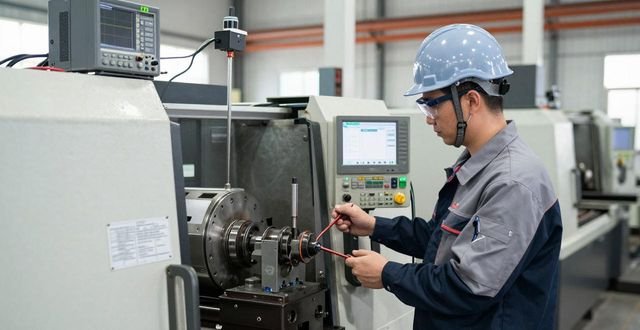
Based on the causes of forced vibration, we need to find the source of the vibration and then take measures to eliminate the vibration.
(1) First of all, the vibration source of the vibration force to be eliminated or weakened, when the speed of the parts is higher than 600r/min, it is necessary to balance, when the parts are in a high-speed rotating state, the parts of their own uneven distribution of sand particles, which indicates that the work caused by the surface wear is not uniform, which will lead to vibration of the spindle, so if a new replacement of the grinding wheel, it must be after two times. Therefore, if a new grinding wheel is replaced, it must undergo two balance tests, i.e., the test before correction and the test after trimming. Improving the smoothness of the gears also reduces the vibration caused by periodic impacts.
(2) Try to let the frequency of the excitation force is not close to the system's own inherent frequency, in order to prevent resonance, can change the motor speed, can also change the spindle speed. At the same time can also improve the contact surface and bonding surface accuracy, reduce the gap, so that the system's inherent frequency.
(3) can use vibration isolation means, in the machine tool motor and bed connection, the use of flexible connection methods, so that the motor vibration can be isolated, at the same time can be separated from the hydraulic part of the machine tool, or in the system to add hydraulic buffer device, so that can reduce the impact caused by the component reversal of direction, between the machine tool and the foundation by adding a thick rubber or timber, etc., to isolate the machine tool and the ground connection can prevent the vibration of all around the source of the ground through the transmission of the machine tool.
IV. Effective use of vibration in the machining process
Among the many ways to utilise vibration, vibratory cutting is the easiest to achieve, and its application is quite effective in improving the surface quality of parts. Vibratory cutting is the workpiece space and time conditions to be reasonable changes, resulting in the cutting principle of change, reduce the cutting force and cutting heat, improve the quality of cutting, but also improve the timeliness of processing. Vibratory cutting time is short, can complete the process of cutting in and out, in view of the short time, cutting the workpiece has not yet vibration, the tool has already left the workpiece.
The use of vibration can be achieved by varying the cutting speed so that it is regular, which improves the surface quality of the machined part. For example, when vibration is generated, cutting forces and cutting temperatures are reduced, which reduces deformation and cracks in heat-treated parts, resulting in precision machining. When vibration parameters are properly selected, tool life can also be significantly improved. Vibratory cutting tests show that in vibratory cutting, if the tool in accordance with the sinusoidal law, can be formed on the machining surface of the small cutter marks, so when the parts to carry out the work, in the surface of the oil film, can significantly enhance the parts of the activities of friction wear resistance. The residual force of vibratory cutting is very small, so the processing of the metamorphic layer is shallow, the impact on the surface of the gold organisation is small, and then the surface and the internal gold organisation of the material structure is almost the same, the corrosion resistance of the surface of the workpiece can be enhanced.
V. Conclusion
Vibration in machining is an extremely harmful physical phenomenon that has a significant impact on surface quality and productivity. If vibration occurs during machining, there will be relative displacement between the tool and the workpiece, resulting in vibration marks on the machined surface, which will seriously affect the surface quality and performance of the parts; vibration will make the tool to bear additional dynamic loads, thereby accelerating the wear of the tool, and sometimes even avalanche; at the same time, the vibration will make the machine tool, fixtures and other connecting parts become loose, thereby increasing the gap, reducing the stiffness and accuracy, shortening the service life, and in serious cases, even make the cutting process can no longer be carried out. At the same time, vibration will make machine tools, fixtures and other connecting parts become loose, thus increasing the gap, reducing the stiffness and accuracy, shortening the service life, and in serious cases, even make the cutting process can not continue to carry out; vibration in the process of noise will also be harmful to the health of the operator. In order to reduce vibration, sometimes have to go to reduce the amount of cutting, resulting in reduced productivity of machine tool processing. Therefore, the causes and characteristics of vibration in machining research and analysis, and then seek to control the vibration of the effective way, which is very necessary.
In machining, the causes and patterns of vibration can be analysed to reduce the presence of vibration, which can improve the quality of workpieces and the process capability of machines and tools. However, if you intend to eliminate vibration completely, it is necessary to conduct further research to take more advanced vibration reduction initiatives. If the vibrations generated during machining are used appropriately, the quality of the service can be improved and the quality of the part can be enhanced.



 Chinese
  Japanese
  English
  German
  Finnish
No comments