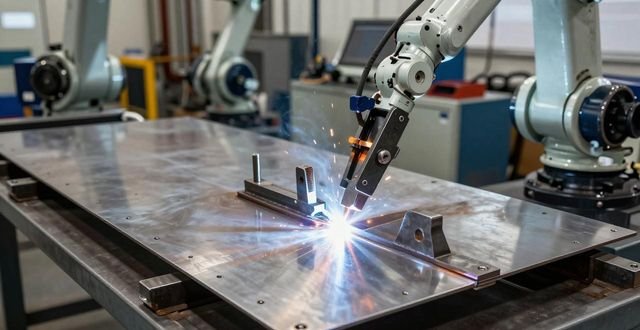


Methods of controlling welding distortion
1. Design measures
(1) Select reasonable weld size:
Once the size of the weld increases, the deformation will follow the increase, but too small a weld size will make the structure of the bearing capacity will be reduced, but also to make the cooling rate of the welded joints faster, the hardness of the heat-affected zone increases and is prone to cracking and other defects, so to meet the structural load-bearing capacity as well as to ensure the quality of the welding under the conditions of the board in accordance with the thickness of the process to select the smallest weld size that can be selected.
(2) Minimising the number of welds; and;
Appropriate selection of plate thickness, reduce the number of ribs, and then be able to reduce the weld as well as post-weld deformation of the corrected amount, such as thin plate structural components, you can use the compression structure to replace the ribbed plate structure, in order to reduce the number of weld seams, to avoid or reduce the deformation of the post-weld.
(3) Reasonable arrangement of weld positions:
Reducing bending distortion can be done in two ways, either by making the weld symmetrical to the neutral axis of the weldment's cross-section, or by making the weld close to the neutral axis.
(4) Allow for shrinkage:
After welding, longitudinal shrinkage and deformation will occur, but also transverse shrinkage and deformation, for this situation, you can use the amount of shrinkage of the weld estimation, in the design of the link in advance to plan the shrinkage allowance, in order to achieve its control.
(5) Allow for the location of the loading welding fixture:

This is the case when the structure is left in a position where a welding jig can be mounted, which can be utilised during welding, and where the purpose of utilising the jig is to control the technical deformation.
2、Anti-deformation method
(1) For plate thicknesses between 8 mm and 12 mm, butt welding is carried out using a one-sided V-bevel, and a counter-deformation of 1.5° is applied at the time of assembly, with almost less angular deformation occurring after the welding is completed.
(2) After welding of I-beam, angular deformation will be triggered by transverse shrinkage. If the upper and lower cover plates are pressed into anti-deformation, i.e. plastic deformation, before welding, and then assembled and then welded, the angular deformation of the upper and lower cover plates after welding can be eliminated. However, the size of the anti-deformation of the upper and lower cover plate is mainly related to the thickness and width of the plate, and at the same time, it is also related to the thickness of the web and heat input.
(3) The pipe joints of the boiler are concentrated in the upper part, and the pipe joints of the container are also concentrated in the upper part, which will cause bending deformation after welding, so it is necessary to borrow the forced anti-deformation clamping device, but also with the trace sequence of symmetrical and uniform heating, and adopt the alternating skip welding method, which adopts the elastic anti-deformation under the action of the external force, and with the welding sequence of the reasonable heating, the welding basically eliminates the bending deformation after welding.
(4) The two main girders of the bridge crane, whose structure is box-type, consists of left and right webs, as well as upper and lower cover plates, in order to enhance the rigidity of the beam, the beam is designed with large and small rib plates, and most of the fillet weld joints of these rib plates are concentrated in the upper part of the beam, which will lead to bending deformation of the lower radius after welding. However, the technical requirements of the bridge crane stipulate that the main beam should have a certain degree of arch after welding, in order to resolve the contradiction between post-welding deformation and technical requirements, often using prefabricated webs on the arch, that is, in the preparation of the material, let the two webs in advance to leave the arch.
3. Rigid fixation method
Before welding, the weldment is restrained with additional rigidity to force the weldment not to deform freely during welding.
(1) When welding flanges, fixing the two flanges back-to-back can effectively reduce angular deformation.
(2) When thin plates are butted together, use a pressurised iron around the HO to prevent wave deformation of the thin plates after welding.
After welding, when the addition of constraints to remove after the weldment will still be left on the top of the weldment a little bit of deformation, just than the original obviously much less, this method will lead to the weldment in the weldment to produce a relatively large welding stress, so for the weldment easy to crack the material should be used with caution.
4. Selection of a reasonable welding sequence
So let's think about the welding sequence, which can have a significant impact on the welded structure. If the welding sequence is inappropriate, it will affect the smooth running of the whole process. When faced with asymmetrical welded structures, special care should be taken to arrange the welding sequence appropriately.
(1) If an I-beam can be welded by two persons at the same time.
(2) in reply to the layout of the asymmetry of the situation, should first go to weld the number of welding seams on the side of the small, this is due to the welding of the first weld produced by the deformation of the magnitude of the larger, and then with the help of the other side of the number of welding seams caused by the deformation of the first welded seams to offset the deformation caused by the first welded seams, which can be very significant reduction in the overall structure of the deformation.
(3) for long weld welding, straight welding is the largest amount of deformation, it is this state is continuous welding for long time for the implementation of the weldment heating and the results, in the case of possible circumstances, should be continuous welding into intermittent welding, so as to reduce the weld with the base material because of the increase in the surface of the heat and thus produce plastic deformation.
5. Heat dissipation method
With the water spray cooling method, the heat of the welding area will be dispersed during welding, and the forced cooling method will be used to force the heat area to be greatly reduced, which in turn will achieve the purpose of reducing the deformation.
The use of heat dissipation, for example, reduces weld distortion; however, it is not suitable for weldments with relatively high hardenability.
6. Self-weight method
If there are more welds in the upper part of the I-beam than in the lower part, the I-beam will bend upwards after welding.
If the beam such as I beam to turn over and then set aside, the two piers placed in the two end points, so that the beam itself with the help of the self-gravity bending tendency, and gradually go to offset the bending deformation produced after welding, beam when placed for a certain length of time, will become straight, or only a small amount of bending deformation, focusing on the distance between the two piers must be selected appropriately.



 Chinese
  Japanese
  English
  German
  Finnish
暂无评论内容