

The fundamental difference between 5-axis precision machining technology and traditional machining technology is that it achieves multi-axis linkage with the addition of two rotary axes, which enables the machining of complex parts in a single clamping, thus avoiding the errors generated by the traditional technology due to multiple clamping from the root, and also greatly improving themachining accuracyAnd efficiency. It's not just about upgrading tools, it's about making the leap from a manufacturing mindset that passively adapts to simple geometry to one that actively masters complex spaces.
From “fixed posture” to “spatial connectivity”
Traditional machining technology, such as the common three-axis machining, the tool can only be in the X, Y, Z, the three linear direction of movement, its attitude is fixed. When it comes to deep cavities, inverted buckles or complex surfaces, the tool is very likely to physically interfere with the workpiece, and simply “can't reach” or “can't cut”. In order to machine a complex part, the worker must break the workpiece into several simple parts, clamp them several times on different machines, and cut them in steps.
Then unlock this “physical seal” is the five-axis precision machining, which in the three linear axes on the basis of the addition of two rotary axes, such as the A/C axis, to reach the five-axis linkage, the core logic is to “let the tool to adapt to the surface, rather than make the surface to adapt to the tool! The core logic is ”let the tool adapt to the surface, not make the surface adapt to the tool".
By adjusting the angle of the tool in space in real time, it is able to approach every corner of the workpiece with the optimal attitude, and all complex features can be handled in a single clamping, which eliminates the problem of interference from the principle aspect.
Farewell to the era of “make do with precision”.

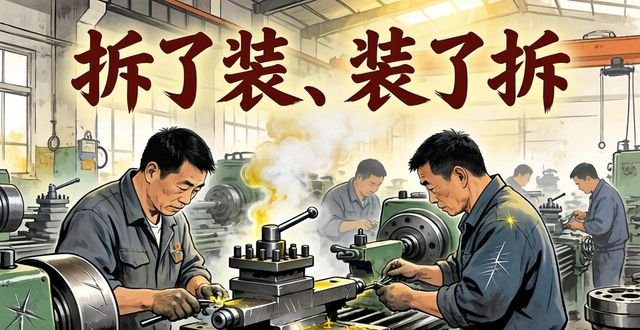
The traditional way to process complex parts, there will be “disassembled and assembled, assembled and disassembled” process, each time to re-fix the workpiece, will lead to micron-level positioning errors, the accumulation of these errors add up to the final parts made out of the contour is not accurate, the joints exist in the joints, in order to meet the needs of the factory, often rely on a lot of manual grinding and trimming to be able to “make up” precision, which is often referred to in the industry as “make up” precision. In order to meet the demand, factories often have to rely on a lot of manual grinding and trimming to be able to "make up" precision, which is often referred to in the industry as "make up precision".
Five-axis technology with “a clamping, the whole process” line, in the source to cut off the chain of error accumulation, it can be given to the tool is always along the tangential direction of the surface cutting ability, which guarantees the smoothness of the contour as well as the accuracy of the direct benefit is the quality of the surface can be a leap forward, some of the equipment to achieve the standard of five-axis can be direct The immediate benefit is a leap in surface quality, with some 5-axis machines able to mill directly to a mirror finish, and some precision moulds even eliminating the need for a subsequent polishing process.
A typical case is that an aerospace supplier used traditional three-axis machining for the machining of a titanium alloy impeller with a yield of only 601 TP3T, and then introduced five-axis technology and optimised the process, at which point the yield reached 1001 TP3T.
A leap in efficiency and application
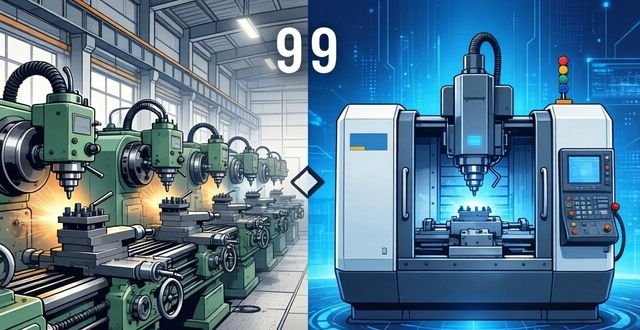
In addition to precision, the increase in efficiency is also extremely noticeable. Multiple passes are completed on a single 5-axis machining centre, reducing the need to move workpieces back and forth between machines and repositioning them accurately. Data shows that this can reduce the time for assisted clamping by more than 30%, while the roughing efficiency can be increased by 40% to 60%. In the field of production cycle time is tight, this efficiency advantage is decisive.
For example, in the manufacturing of new energy automobile moulds, by applying the 5-axis machining optimisation strategy, the machining cycle time of a mould cooling system has been reduced by 37.5% from the original 15 days.
It is these advantages that make 5-axis precision machining the centrepiece of extreme machining challenges, and it is particularly well suited to areas where conventional technologies are difficult.
The boundaries of precision and efficiency in high-end manufacturing are being reshaped by 5-axis technology, which represents not only a more advanced machine, but also a more efficient and reliable way of solving problems.



 Chinese
  Japanese
  English
  German
  Finnish
暂无评论内容