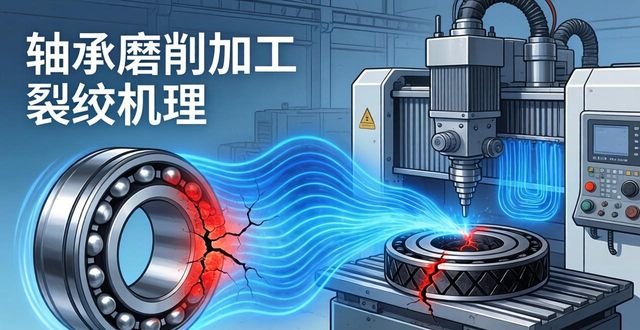


In the machinery manufacturing industry, a wide range of applications in the grinding process, carbon tool steel and carburised quenched steel parts for heat treatment quenching, grinding, and the grinding direction is basically perpendicular to the state of the surface, there are often a large number of more regular arrangement of the cracks, that is, theGrinding cracksThis crack not only affects the appearance of the part, but more importantly, has a direct impact on the quality of the part.
I. Mechanisms of grinding cracks
Grinding cracks are caused by the heat of grinding, and the temperature of the surface of the part, when the grinding operation is carried out, may be as high as 820°C to 840°C, or even higher.
Steel that has been quenched contains martensite and a certain amount of residual austenite, and is in a state of expansion, which is particularly severe in the untempered condition. If the surface is rapidly heated to about 100° C. and then rapidly cooled, shrinkage must occur, and this is the first contraction. This shrinkage occurs only on the surface, the matrix remains in an expanded state, which causes tensile stresses on the surface layer, resulting in micro-cracks, which are the first type of cracks. When the temperature rises to 300°C, the surface shrinks once again and a second type of crack occurs. The expansion and contraction of martensite increases as the carbon content of the steel increases, so that grinding cracks are particularly serious in carbon tool steels as well as in carburised hardened steels.
Affected by the grinding heat, hardened steel in the residual austenite in the grinding will occur in its own decomposition, and then a little bit gradually transformed into martensite, these newborn martensite concentrated in the surface of the parts resulting in the local volume expansion of the parts, which increases the surface stress of the parts, resulting in the concentration of grinding stress, and continue to adhere to the downward grinding is very easy to accelerate the emergence of grinding cracks, in addition to the newborn brittle martensite, and the newborn brittle, the grinding of this situation is more likely to accelerate the emergence of grinding cracks. Grinding such a situation is more likely to accelerate the emergence of grinding cracks, on the other hand, on the other hand, in the grinding machine on the workpiece grinding operation, for the workpiece there is both pressure, but also the existence of tensile force, so that complement each other together and contribute to the formation of grinding cracks.

If the cooling is not sufficient at the time of grinding, then the heat generated by grinding is enough to make the grinding surface of a tiny layer of austenitising again, and then quenched again into quenched martensite. This results in additional tissue stresses on the surface layer, plus the temperature of the surface of the part rises rapidly because of the heat generated by grinding, and the superposition of such tissue stresses and thermal stresses may result in grinding cracks on the ground surface.
II. Characteristics of grinding cracks
Grinding cracks are significantly different from general hardening cracks in that they appear only on the grinding surface, are relatively shallow, and remain essentially uniform in depth. Less serious grinding cracks are parallel lines perpendicular or nearly perpendicular to the direction of grinding, and are regularly arranged strip cracks, which belong to the first type of cracks. The more serious cracks are tortoise-shaped (closed network) and have a depth of approximately 0.03 - 0.15 mm. The cracks are clearly visible through acid etching. This is the second type of crack.
Third, grinding crack prevention measures
Grinding process aspects
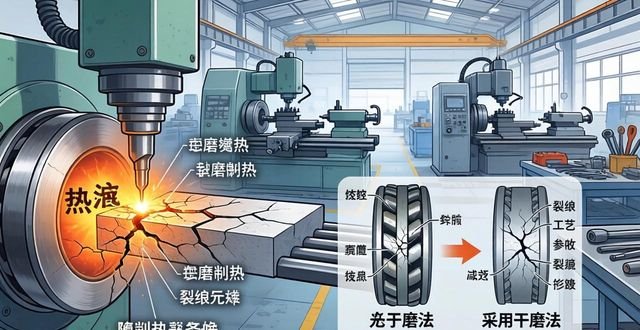
(1) Grinding cracks are caused by the heat of grinding, so reducing the heat of grinding is the key to solving grinding cracks. Usually used wet grinding method, no matter how to inject cutting fluid, cutting fluid are not able to enter the grinding surface at the same time of grinding, so it can not reduce the grinding heat at the location of the grinding point. The cutting fluid only cools the grinding point between the grinding wheel and the part instantly after grinding, and at the same time, the cutting fluid quenches the grinding point of the part, thus actually increasing the generation of grinding cracks. If dry grinding is used, grinding with a shallower backdraft can reduce grinding cracks. However, the effect of this method is not very obvious, and there is a large amount of dust, which affects the working environment, so it is not suitable for use.
(2) Grinding with a softer hardness and coarser grain size of the grinding wheel, can reduce the grinding heat, however, if the grain size is too coarse, it will have an impact on the surface roughness of the workpiece, for the surface roughness of the workpiece requires high quality, can not be used in this way, so it is subject to certain limitations.
(3) The use of sub-rough and fine grinding practices, that is, rough grinding when the choice of coarse size of the soft grinding wheel to grind, in order to facilitate the strong grinding, and thus improve efficiency, and then use the fine size of the grinding wheel to fine grinding, the fine grinding back to eat the amount of shallow knife. Rough grinding and fine grinding are carried out separately on two grinding machines, which is a relatively ideal method.
(4) just out of the piece of workpiece, must wait for the workpiece itself after the natural cooling, that is, after cooling to the usual temperature, before you can go to the grinding operation. If there is time under the circumstances, it is best to let the workpiece natural aging for one to two months, the stress eliminated and then go to carry out grinding, so it will also reap very good results.
(5) choose the kind of grain size is relatively sharp grinding wheel, its specifications are PA36 to 46K, to remove the grinding wheel surface in a timely manner to the accumulation of chips, to reduce the amount of back draft to be reduced to increase the number of times the knife that is grinding, will reduce the speed of the worktable, selected.




 Chinese
  Japanese
  English
  German
  Finnish
暂无评论内容