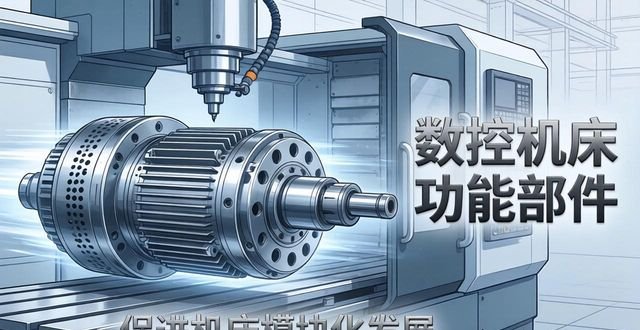


Key Point 1: High-speed electric spindles, forCNC machine toolsFirstly, it is a core component. Point 2: It is lightweight and compact, and does not generate significant inertia during operation. Point 3: It has excellent response characteristics, and the dynamic balance of the spindle is improved. Point 4: It possesses good dynamic performance. Point 5: High-speed electric spindles play a decisive role in the performance of machine tools. Point 6: This paper focuses on the key technical aspects of high-speed electric spindles in CNC machine tools.
Keywords: CNC machine tools; high speed; electric spindles; technical considerations
The electric spindle designed for high-speed operation—specifically the internal type known as the motor spindle unit—is a crucial component in CNC machine tools. The spindle motor is mounted inside the machine tool’s spindle unit, where it drives the spindle, thereby integrating the motor and spindle into a single unit. To enhance the operational efficiency of CNC machine tools, it is essential to master the technical principles of high-speed electric spindles and fully exploit their advantages, whilst simultaneously driving the continuous improvement of electric spindle technology.
1. The advantages of high-speed electric spindles
In CNC machine tools, when a traditional spindle is in operation, the motor primarily drives the intermediate speed-changing components—such as gears—as well as the transmission components, including belts and couplings. This is known as a “mechanical spindle”, which is also commonly referred to as a ‘separate’ or ‘direct-drive’ spindle. Compared to this traditional spindle, electric spindles offer the following advantages.
(1) When the spindle is in operation, it is driven by a motor installed within the unit, without the need for an intermediate speed-changing mechanism or transmission system. Its design is simple and compact, enabling improved operational efficiency and offering a high degree of precision. During operation, it produces minimal noise and exhibits negligible vibration.
(2) By making full use of AC variable-frequency technology, the electric spindle is capable of stepless speed variation within the rated speed range. When the machine tool is in operation, the electric spindle demonstrates excellent adaptability regardless of the operating conditions or changes in load.
(3) During internal operation, the motor can perform closed-loop vector control, enabling effective regulation of power output in accordance with control commands, as well as flexible control of the drive unit’s operating speed and output torque. The electric spindle can meet a wide range of high-power requirements. Whether in low-speed, heavy-cutting applications requiring high torque, or in high-speed finishing operations, the electric spindle performs exceptionally well, achieving precise stopping and featuring C-axis drive functionality.
(4) Electric spindles are capable of high-speed operation, offer excellent stability and possess high dynamic accuracy; this enables CNC machine tools to achieve higher cutting speeds and improves machining precision.
(5) When the electric spindle is in operation, its smoothness is enhanced as there are no intermediate transmission components. More importantly, it is not subject to external shocks, which means that the spindle bearings do not have to bear heavy dynamic loads, ultimately resulting in an extended service life and improved precision.

(6) There is a component that integrates the motor and the spindle into a single unit, thereby enabling mass production on a significant scale and allowing for greater specialisation in manufacturing; this component is the electric spindle. The electric spindle serves as a functional component of CNC machine tools, whilst also being marketed as a commercial product. Enterprises can select electric spindles based on the operational requirements of the CNC machine tool’s main unit, which can help to promote the development of machine tools towards a modular form.
2. Technical aspects of high-speed electric spindles
2.1 High-speed precision bearing technology for high-speed electric spindles
In electric spindle systems, spindle bearing technology is of paramount importance, encompassing three types: hydrodynamic bearings, angular contact ball bearings and magnetic levitation bearings. Among these, hydrostatic-hydrodynamic bearings combine hydrostatic and hydrodynamic principles, bringing together the advantages of both; they offer excellent high-speed performance and a wide range of speed adjustment. Angular contact ball bearings are frequently used in precision CNC machine tools, where they serve as the spindle support and have a certain influence on high-speed performance. The primary reason for this phenomenon is that the balls are manufactured from silicon nitride; at high speeds, these balls cause centrifugal force to increase. As centrifugal force increases, the gyroscopic torque also increases, thereby fully demonstrating the bearing’s high-speed performance, whilst the diameter of the rolling elements is reduced. Furthermore, due to the high manufacturing costs of these bearings and their highly complex control systems, the heat generation issues arising during operation are difficult to resolve. Consequently, they are only utilised in specialised applications.
2.2 Dynamic Balancing Technology for High-Speed Electric Spindles
High-speed electric spindles, which operate at high rotational speeds, are characterised by high-precision operation and high machining efficiency; however, these characteristics are only possible if the spindle is properly dynamically balanced. The operational performance of an electric spindle is influenced by numerous factors. Manufacturing factors, such as errors occurring during spindle installation or material inconsistencies, are bound to cause operational imbalance. Generally, during operation, the rotational speed of an electric spindle can exceed 10,000 rpm and may even reach 60,000–100,000 rpm. Even in cases where the imbalance is extremely slight, whilst the spindle is in operation, there is always a potential risk of compromising the spindle’s rotational precision; this may even affect the operational stability of the bearing support system. Consequently, strict requirements must be imposed on the dynamic balancing accuracy of high-speed electric spindles.
In the field of electric spindle design, to improve spindle balance, symmetrical structures must be employed, with particular emphasis placed on enhancing precision during the machining and assembly stages. Upon the spindle’s dispatch from the factory, meticulous adjustments are made to the initial dynamic balance to further enhance the spindle’s inherent stability. However, even with these measures, subtle asymmetries may still exist in the cutting tools used on the spindle. Furthermore, tool wear or the adhesion of swarf to the tool may occur, thereby disrupting the carefully adjusted dynamic balance. Given the extreme complexity of actual operating conditions, the spindle-tool system is subject to various disturbances. Factors such as cutting force excitation, centrifugal force and thermal deformation are particularly critical, and these elements can cause damage to the spindle system, making it difficult to maintain a stable operating state. To ensure that the electric spindle operates at high speeds whilst guaranteeing the efficient and stable performance of the CNC machine tool, it is essential to design a dynamic balancing system capable of online operation and automated control. Furthermore, this system must be continuously refined in accordance with practical application requirements to fully realise its potential.
2.3 Lubrication Technology for High-Speed Electric Spindles
When lubricating high-speed electric spindles, the primary focus is on lubricating the spindle bearings. This requires the use of a scientific and effective lubrication system to control the temperature rise of the bearings, with the aim of enhancing precision during the operation of the machine tool system, whilst also ensuring stability. When selecting a lubrication method for high-speed electric spindles, the choice depends on factors such as the type of bearing, operating speed and load. Depending on requirements, methods such as grease lubrication, oil mist lubrication or spray lubrication may be selected.
2.4 Cooling technology for high-speed electric spindles
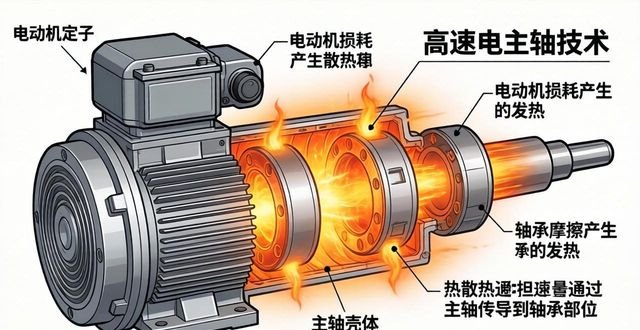
The stator of the motor is housed within the housing of the electric spindle. As the electric spindle features a sealed design, overheating can occur within the housing during high-speed operation due to inadequate heat dissipation. There are two sources of heat within the electric spindle: the first is the heat generated by the motor’s operational losses, and the second is the heat generated by friction during bearing operation. The motor generates heat during operation, with the spindle housing serving as the primary heat dissipation medium. Some of this heat is transferred via the spindle to the bearings, causing them to heat up rapidly, which inevitably affects their service life. Furthermore, thermal expansion affects the manufacturing precision of the rotating shaft, making it impossible to guarantee the stable and reliable operation of the spindle system. When cooling an electric spindle, a circulating water jacket must first be installed at the junction between the stator and the housing. Furthermore, the bearings must be lubricated to reduce heat generation; adopting a suitable lubrication method not only fulfils the lubrication function but also provides a cooling effect.
2.5 Spindle Motor Technology for High-Speed Electric Spindles
The motors used in electric spindles are mostly AC induction motors; however, given that permanent magnet motors have improved performance, AC permanent magnet synchronous motors have come into widespread use. The advantages they offer are that, in the case of electric spindles, the rotor no longer generates heat, the spindle is no longer subject to thermal deformation, and there is no loss in the rotor, the operational efficiency of the electric spindle is improved, the moment of inertia is reduced, and the speed of start-up and precise stopping is increased; furthermore, the electric spindle is able to maintain good performance even when operating at low speeds.
2.6 Precision Machining and Assembly Techniques for High-Speed Electric Spindles
When an electric spindle is operating at high speed, its rigidity and rotational accuracy must be guaranteed; key components must undergo precision machining, or even ultra-precision machining, and the precision of assembly must be enhanced. Within the spindle unit, all components—including the housing and bearing seats—must be precision-machined to a high standard. As the bearing spacers rotate at high speeds with the spindle, their machining precision must also be of the highest order. Furthermore, when assembling cutting tools for high-speed electric spindles, advanced manufacturing techniques must be employed to ensure that assembly precision meets the required specifications.
2.7 Temperature protection technology for high-speed electric spindles
When designing a high-speed CNC milling machine, it is necessary to activate the cooling system to cool the spindle. The spindle contains three bearings: a front bearing, a middle bearing and a rear bearing. When the spindle is running, depending on its speed and power, temperature sensors are installed near the bearings to monitor the spindle bearing temperature in real time. When the temperature sensors collect signals, the input modules of the programmable logic controller (PLC) come into play, with various sensors converting the generated signals into different 4–20 mA signals for classification. When designing the relevant machine tool, during the process of formulating the sequence of control system commands, it is necessary to quantify the spindle bearing temperature based on the sensor signals and assign corresponding interpretative labels to further configure the relevant settings and clarify the parameter settings for the issue in question. When implementing bearing overheating protection measures, appropriate threshold values must be set within the programme to ensure the bearings are adequately protected.
It is clear from the above research that the use of high-speed machining technology in the manufacture of mechanical products can resolve numerous challenges, whilst delivering high machining accuracy and ensuring quality. Consequently, this technology is widely employed in the manufacturing sector and has become a mainstream technology. Today, high-speed electric spindle technology is advancing rapidly. Various industries are conducting in-depth research into this technology in accordance with their specific needs. Whilst striving to improve the efficiency of its application, it is also necessary to leverage its energy-saving and environmentally friendly characteristics to achieve intelligent development.
Submissions:
If you have press releases relating to the machine tool industry or your company that you wish to publish, or if you are interested in collaborating on news coverage, please feel free to contact our editorial team at:




 Chinese
  Japanese
  English
  German
  Finnish
暂无评论内容