

In the stainless steel processing process, sticky knife this problem has always been plagued by a lot of processing masters of the heart of the problem, can be called a headache is the kind of “invisible killer”. Whether it is a high-end type of CNC machine tools, or traditional forms of manual processing equipment, sticky knife such phenomena will directly affect the processing quality and efficiency. So, what exactly is a sticky knife? Why does it appear? And what exist with practical solutions? Today, let us together to analyse this problem in depth, to find a practical and efficient solution.
I. What isStainless steel processingSticky knives?
Briefly speaking, the sticky knife means, in the stainless steel processing, the tool and the workpiece material between the adhesion situation. This situation is usually presented as, the cutting edge of the tool there is a build-up of processing materials, resulting in reduced machining accuracy, and even cause the tool to collapse or scrap. Stainless steel material has a strong viscosity, easy to produce high temperatures when processing, and poor thermal conductivity of the material, these characteristics make the phenomenon of sticky knife more common.
Second, why stainless steel easy to stick knife?
Talking about the reasons, which is closely linked with the characteristics of stainless steel, inseparable. The following points are the main culprits of the phenomenon of sticking knives:
1. High degree of material adhesion, stainless steel surface has a strong adhesion, in the machining period of the chip is easy to adhere to the surface of the tool.
2. Poor thermal conductivity: stainless steel has a low thermal conductivity, in the cutting process, the heat is not able to dissipate in a timely manner, resulting in a rapid increase in tool temperature.
3. When cutting stainless steel, once the force is applied, the phenomenon of work hardening occurs, which not only increases the difficulty of machining, but also makes the possibility of sticking to the knife become higher.
4. Tool SelectionImproper situation, if the material of the tool is not reasonable, or the geometric angle of the tool design is not reasonable, then it will cause the phenomenon of sticking to the knife is aggravated.
Third, the hazards of stainless steel processing sticky knife
Sticky knife phenomenon not only affects the processing quality, but also may bring a series of chain reaction:
The surface of the workpiece is left with scratches or irregular patterns, which is due to the adhesion of the material on the surface of the tool, resulting in a rough machined surface.
Tool wear shows an increase in the situation, sticky knife this situation will lead to faster wear of the tool, in serious cases, there may be directly chipped phenomenon.
Productivity is reduced by frequent tool changes or rework, which not only wastes time but also increases production costs.

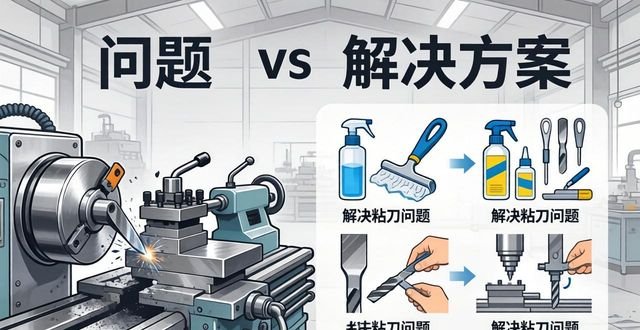
Fourth, how to solve the stainless steel processing sticky knife problem?
Since we clearly know the cause of the problem, then we will be able to take targeted measures based on this, and then to share a few with professional and practical solutions:
1. Selection of suitable tools
Tool selection is key. When machining stainless steel, preference is recommended:
Carbide cutters, which have good wear resistance and better heat resistance, are suitable for stainless steel machining, and they can effectively cope with that kind of high-temperature and high-hardness material.
Coated tools, such as those coated with titanium (TiN) or aluminium (AlTiN), not only reduce the friction between the tool surface and the material, but also increase the resistance to sticking, thus reducing the risk of sticking to a low level.
The tool geometry should be optimised to increase the back angle and improve the sharpness of the cutting edge, which will improve the cutting performance and significantly reduce the risk of sticking.
2. Usecutting fluid
Cutting fluids play a key role in machining, not only cooling the tool, but also lubricating the cutting interface. It is recommended for the machining of stainless steel:
Emulsion: better cooling effect, suitable for medium and light load cutting.
High-performance oil-based cutting fluids: Better lubricating properties for continuous machining and high-load cutting.
Ensure that the cutting fluid covers the entire cutting area and that it is replenished and replaced at the right time to avoid failure.
3. AdjustmentsProcessing parameters
Processing parameters have a direct impact on the machining effect, the parameters for a reasonable setting, can effectively reduce the phenomenon of sticky knife.
Reduce cutting speed: Appropriate reduction of cutting speed can reduce heat accumulation.
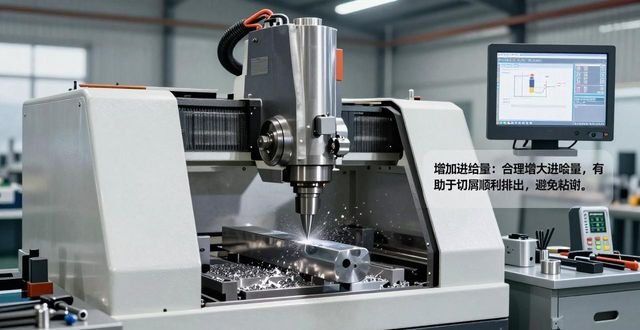
Increase the feed volume: Reasonably increase the feed volume, help the chip smoothly discharged, to avoid adhesion.
Control the depth of cut: choose the appropriate depth of cut to avoid machining the hardening layer is too thick.
4. Improvement of tool geometry
Increase the rake angle: Reduce the cutting resistance, reduce the probability of sticking the knife.
Sharp cutting edge: avoid blunt cutting and reduce chip sticking.
Reasonable chipbreaker design: helps chips to be discharged smoothly and prevents entanglement.
5. Reasonable chip removal design
The design of the chipformer on the cutting edge of a tool has an important influence on the generation and removal of chips. If the chips are not discharged smoothly, they can easily re-stick to the tool. Ensure that the chipformer is smooth and that the machining area is regularly cleaned of chips.
6. Improving the stability of processing equipment
Machining equipment with the rigidity of the machining effect will have a direct impact, if the machine tool vibration amplitude is large, or tool clamping in an unstable state, then it will make the sticky knife problem becomes more serious, so, should be regularly overhauled to ensure that the operation of the equipment in a smooth state.
V. Summary
Sticky knives when machining stainless steel may seem like a minor inconvenience, but in reality, it may have an impact on the entire machining process. We hope that with the above analyses and solutions, you will be able to reduce the likelihood of tool sticking and reap the rewards of improved machining efficiency and product quality. Of course, the processing environment is not the same in every factory, you need to be adaptive in the process of the actual operation, so as to find the most suitable method for their own situation.
If you have encountered similar problems during stainless steel processing, you may wish to try the above suggestions, or share your experience and insights in the comments area, to jointly develop exchanges, in order to make progress together!


 Chinese
  Japanese
  English
  German
  Finnish
No comments