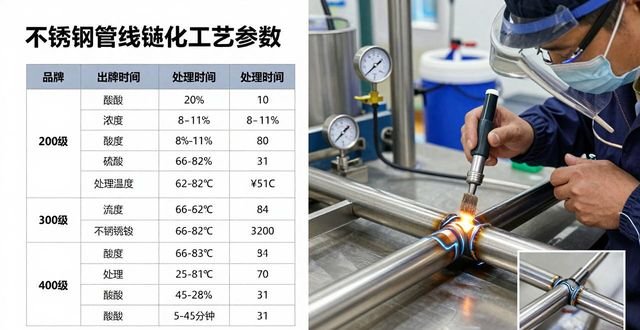



Subtract 75,stainless steelsAccording to Qiang et al., acid pickling and passivation must be carried out on the welds of stainless steel pipelines, as shown in Table 2. Table 3 provides relevant information on passivated stainless steel alloys, including composition (volume fraction), treatment temperature (°C) and duration (minutes). For the 200, 300 and 400 series, precipitation-hardening heat-treated alloys and martensitic alloys (excluding free-cutting alloys), H₂SO₄ is used at temperatures ranging from 66 to 82, for a duration of 5 to 45 minutes. For the 200 and 300 series; and for the 400 series with a Cr content of ≥16%, precipitation-hardening heat-treated alloys (excluding free-cutting alloys), use HNO₃, 15%–25%, with added HF; 1%–8%, at temperatures of 21–60, for 5–30 minutes. All free-cutting alloys and 400 series alloys with a Cr content < 16% shall be treated with HNO₃, 10%–15%, supplemented with HF, 0.5%–1.5%, at a temperature of 21–60, for a duration of 5–30 minutes. The commonly used pipe material in marine engineering is 304 stainless steel; the pickling paste based on this formulation uses a mixed acid of nitric acid and hydrofluoric acid, with specific proportions of 15%–25% nitric acid, hydrofluoric acid 1%–8%, water 10%–40%, and gel binder 30%–65%. 3. Prior to the acid pickling process, all debris must be thoroughly cleaned from the surface. Next, apply the acid pickling paste to the surface using a brush, ensuring a thickness of 2 to 3 millimetres; then wrap the surrounding pipework in plastic sheeting to prevent chemical splashes. Unlike immersion pickling, the pickling of welds must be carried out at ambient temperature. If the temperature is insufficient, the pickling time may be extended to compensate. However, care must be taken not to over-pickle, to prevent corrosion of the welds and the pipe itself. As shown in Table 2, the pickling time at room temperature is 30 minutes; however, as temperatures are relatively low during winter in northern regions, the pickling time may be extended to 1 hour. 3. With regard to cleaning and rinsing (Step 4), residual pickling paste must first be wiped off with a cloth, followed by rinsing with Ca(OH)₂ or Na₂CO₃ until the surface pH is ≥7. The pipe should then be repeatedly rinsed with high-pressure water until the pH of the workpiece surface becomes neutral. 4. Passivation involves treating the surface of stainless steel with a specific solution to form a corrosion-resistant passivation film, dissolving metallic impurities such as iron from the surface, thereby enhancing corrosion resistance. Stainless steel should undergo passivation treatment following acid pickling. As with pickling, the passivation of stainless steel welds is carried out by applying a passivation paste; the relevant parameters are set out in Table 3. For the 200 and 300 series, the alloys have specific compositions (by volume fraction), with treatment temperatures ranging from (°C) and durations of (minutes); In the 400 series, for precipitation-hardening heat-treated alloys (excluding free-cutting alloys) with a Cr content of ≥16%, HNO₃ is used for 20%–50%, with a treatment temperature of 49–71 and a duration of 10–30; as well as treatment temperatures of 21–38 and durations of 30–60; In the 400 series, for martensitic and precipitation-hardening heat-treated high-carbon chromium alloys with a Cr content < 16% (excluding free-cutting alloys), the treatment medium is HNO₃ 20%–50%, with a treatment temperature of 43–54, with a duration of 20–30; there is also a treatment temperature range of 21–38, with a duration of 30–60; For free-cutting alloys in the 200, 300 and 400 series, the treatment medium is HNO₃ 20%–50%, to which Na₂Cr₂O₇·2H₂O is added in a mass fraction of 2%–6%; treatment temperature 21–49, duration 25–40; special 400 series free-cutting alloys containing Mn greater than 1.25% or S greater than 0.4%, with the treatment medium being HNO₃ 40%–60%, with a mass fraction of 2%–6% Na₂Cr₂O₇·2H₂O added; treatment temperature 49–71, duration 20–30; For 304 stainless steel, commonly used in marine engineering, a nitric acid solution with a concentration of 20%–50% is selected as the passivation paste. As it is difficult to achieve higher temperatures during on-site construction, the only option is to extend the passivation time to meet the passivation requirements for stainless steel. After applying the passivation paste at room temperature, it should be left for 1 hour; in winter, this time is extended to 2 hours, Once the passivation process is complete, wipe off any residual passivation paste with a cloth. To prevent future corrosion caused by residual passivation solution on the stainless steel surface, the surface should be neutralised for 1 minute at room temperature in a 30–50 g/L sodium carbonate solution following passivation. The pickled and passivated areas should be thoroughly rinsed several times with hot clean water, and once rinsing is complete, they should be thoroughly dried. For the pickling and passivation of welded joints in marine engineering stainless steel pipelines, this method is generally employed, namely applying pickling and passivation paste to the weld surface. Prior to pickling, the weld and its surrounding area must be thoroughly cleaned to remove grease, dirt, sand and other contaminants. During the pickling process, a mixed acid solution comprising nitric acid and hydrofluoric acid is used to dissolve the scale. Once pickling is complete, the weld is passivated using a nitric acid solution. Finally, the pickled and passivated area must be thoroughly cleaned and dried. (Continued on page 82)

 Chinese
  Japanese
  English
  German
  Finnish
No comments